
News and Announcements
ActaPACK Funded
ICL’s joint venture with Lawrence Livermore National Laboratory for Small Tensor Operations on Advanced Architectures for High-order Applications (ActaPACK) was recently funded by the US Department of Energy. ActaPACK, which is funded for 18 months beginning in September of 2015, will involve UTK/ICL’s MAGMA group studying the performance optimization of the tensor kernels used in BLAST on various modern architectures. Congratulations to the Linear Algebra Group!
Conference Reports
9th Parallel Tools Workshop

Heike Jagode made it back to her hometown of Dresden, Germany for the 9th Parallel Tools Workshop on September 2-3. The Parallel Tools Workshop, held annually, is a joint venue between HLRS Stuttgart and ZIH Dresden and brings together researchers and practitioners that develop, maintain, or use tools that aid in the development of parallel applications. For her part, Heike gave a presentation on “Recent Advances in PAPI” on the first day of the workshop.
PPAM 2015
This year’s International Conference on Parallel Processing and Applied Mathematics (PPAM 2015) was held in Krakow, Poland on September 6-9, and is the 11th such conference so far in the biennial series. PPAM 2015 covered topics in parallel and distributed computing, including theory and applications, as well as applied mathematics with a focus on models, algorithms, and software tools that facilitate efficient and convenient utilization of modern parallel and distributed computing architectures.
Heike Jagode also attended PPAM to present ICL’s work on “Accelerating NWChem Coupled Cluster through Dataflow-based Execution.” ICL alumni and frequent collaborator Marc Baboulin presented his paper “Dense Symmetric Indefinite Factorization on GPU Accelerated Architectures,” of which Stan Tomov, Ichi Yamazaki, and Jack Dongarra are co-authors.
HPEC ’15
On the road again, ICL’s Piotr Luszczek went back to Boston to present a paper at the 2015 IEEE High Performance Extreme Computing Conference (HPEC ’15) on September 15-17. HPEC is the largest computing conference in New England and is the premier conference in the world on the convergence of High Performance and Embedded Computing.
The paper, “MAGMA Embedded: Towards a Dense Linear Algebra Library for Energy Efficient Extreme Computing,” earned Piotr and his co-authors (Azzam Haidar, Stan Tomov, and Jack Dongarra) a Best Paper Award. Congratulations!
Intel Big Data Retreat
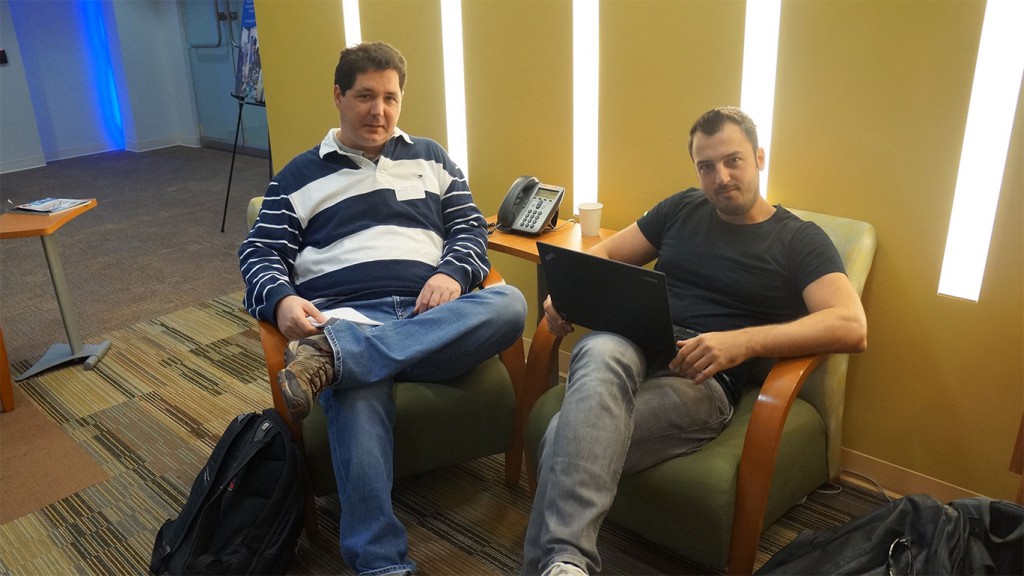

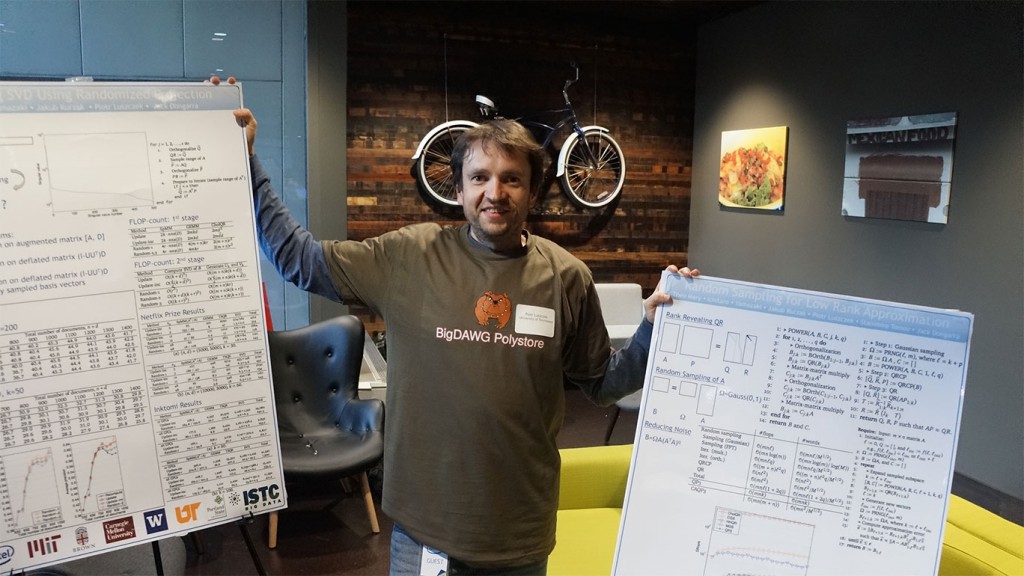


ICL’s Thomas Herault and Piotr Luszczek were invited to the Intel Big Data Retreat in Hillsboro, OR on September 24-25. As the name suggests, this annual retreat was hosted by Intel and provided a venue for experts in Big Data and analytics to discuss the latest challenges, innovations, and solutions in big data applications.
Thomas presented a poster on PaRSEC – Runtime Task Engine for Numerical Computation. Not to be outdone, Piotr presented two posters; the first described Updating SVD Using Randomized Projection and the second outlined Random Sampling for Low Rank Approximation.
Recent Releases
SC15 Videos
ICL’s Linear Algebra Group and DisCo Group both put together videos (with help from ICL Graphics Guru David Rogers) to advertise their upcoming tutorials at SC15. Check them out below and be sure to check out the actual tutorials at SC15 in Austin, TX.
“Linear Algebra Libraries for High-Performance Computing” – Narrated by Dawn Danalis
“Fault-Tolerance for HPC – Theory and Practice” – Narrated by George Bosilca
ULFM 1.0 Released
The major 1.0 milestone has been reached for the User Level Failure Mitigation (ULFM) compliant fault tolerant MPI. ULFM is a set of new interfaces for MPI that enables Message Passing programs to restore MPI functionality affected by process failures. The MPI implementation is spared the expense of internally taking protective and corrective actions against failures. Instead, it reports operations whose completions were rendered impossible by failures.
For the 1.0 release, the UFLM team focused on improving performance, both before and after the occurrence of failures. The list of new features includes:
- Support for the non-blocking version of the agreement, MPI_COMM_IAGREE.
- Compliance with the latest ULFM specification draft. In particular, the MPI_COMM_(I)AGREE semantic has changed.
- New algorithm to perform agreements, with a truly logarithmic complexity in number of ranks, which translates into huge performance boosts in MPI_COMM_(I)AGREE and MPI_COMM_SHRINK. Meet us at SC15 to learn more about the novel algorithm we designed!
- New algorithm to perform communicator revocation. MPI_COMM_REVOKE performs a reliable broadcast with a fixed maximum output degree, which scales logarithmically with the number of ranks. Meet us at EuroMPI’15 to learn more about the Revoke algorithm we designed!
- Improved support for our traditional network layer:
- TCP: fully tested.
- SM: fully tested (with the exception of XPMEM, which remains unsupported).
- Added support for High Performance networks.
- Open IB: reasonably tested.
- uGNI: reasonably tested.
- The tuned collective module is now enabled by default (reasonably tested), expect a huge performance boost compared to the former basic default setting.
- Back-ported PBS/ALPS fixes from Open MPI.
- Back-ported OpenIB bug/performance fixes from Open MPI.
- Improve Context ID allocation algorithm to reduce overheads of Shrink.
- Miscellaneous bug fixes (look at the commit log for the full list).
Fault tolerance support for RMA and IO is still under development.
Visit the ULFM software page to download the source and happy hacking.
Interview

Phil Vaccaro
Where are you from, originally?
I am from Nashville, TN.
Can you summarize your educational background?
I earned my BS in Computer Science from UTK and I started my MS in Computer Science this fall.
Tell us how you first learned about ICL.
I first heard about ICL during my undergrad when various professors spoke about the work going on at ICL, and it captured my interest. When I found out that ICL was looking for research assistants I jumped at the chance join the group.
What made you want to work for ICL?
HPC plays a critical role in scientific advancement so there is obviously a lot of intrigue in that respect. I also really wanted to be able to participate in leading edge research while getting my MS, and I developed an interest in HPC over the course of my undergrad degree. ICL has such a large footprint in the HPC community that I had no doubt that the work going on here would be at the forefront of the field. I really saw this as an opportunity to push myself intellectually and expand my knowledge into a very exciting realm of computing.
What are you working on while at ICL?
I am a member of the Performance Evaluation group, and I will be contributing to the PAPI-EX project during my time here.
If you weren’t working at ICL, where would you like to be working and why?
If I hadn’t decided to go back to school, I suppose it would be pretty interesting to work somewhere like SpaceX or NASA. I’ve always been fascinated by space, so it would be pretty fun to develop software that went towards the advancement of space travel.
What are your interests/hobbies outside of work?
I really love movies, especially older films with classic actors/actresses from the 50’s and 60’s. I try to watch as many as I can when I have time. I’ve probably watched 2001: A Space Odyssey ten times.
Tell us something about yourself that might surprise people.
I once saw lighting strike a car directly behind me on the interstate. It was strange.


