
News and Announcements
Dongarra Named to Committee for Square Kilometer Array
Jack Dongarra has been named to the Scientific and Engineering Advisory Committee for the Square Kilometer Array (SKA), an international effort to build the world’s largest radio telescope, eventually reaching over a square kilometer of collection area.
To accomplish this, SKA is not a single telescope but a collection of antennas to be spread over long distances that will use arrays at two primary sites—one in Australia and one in South Africa. The Australian site will have 130,000 antennas spread over 65 kilometers, while the South African site will have 200 antennas spread over 150 kilometers.
As one might imagine, this array will generate tremendous amounts of data that will need to be processed and stored, making it the quintessential “Big Data” endeavor. As Jack says, “It will generate data at a rate more than ten times today’s global Internet traffic. […] This is a mega-science project, which will test the limits of engineering and scientific endeavor over the coming decades.”
The SKA effort includes organizations from 10 countries—Australia, Canada, China, India, Italy, New Zealand, South Africa, Sweden, The Netherlands, and the United Kingdom—and is headquartered at the Jodrell Bank Observatory in Manchester, UK.
Read more from Tennessee Today.
SC15
ACM/IEEE’s Supercomputing Conference (SC15) is rapidly approaching. This year’s conference will be held on November 15 – 20 in Austin, TX. As usual, ICL will have a considerable presence at the conference with BoFs, papers, posters, and tutorials. Additionally, the University of Tennessee will again have its own booth where ICL’s research will be featured alongside other UT research centers. For an entire list of activities, visit the SC15 schedule page.
Conference Reports
Jack visits KAUST

On October 23 – 27, ICL’s Jack Dongarra visited the King Abdullah University of Science & Technology. While there, Jack met up with ICL alumni Hatem Ltaief, Mathieu Faverge, and Bilel Hadri.
KAUST is home to Shaheen II, a Cray XC40 supercomputer that currently sits at #7 on the TOP500 at 5.536 PetaFlop/s—making it the highest ranked Middle East system in the history of the TOP500 and the first to make the top 10.
SIAM Conference on Applied Linear Algebra
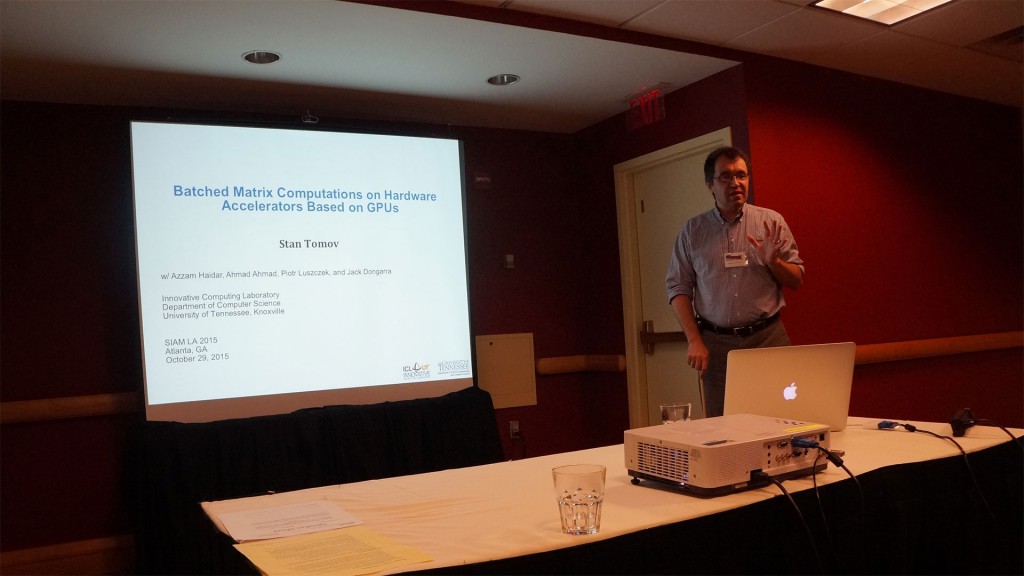


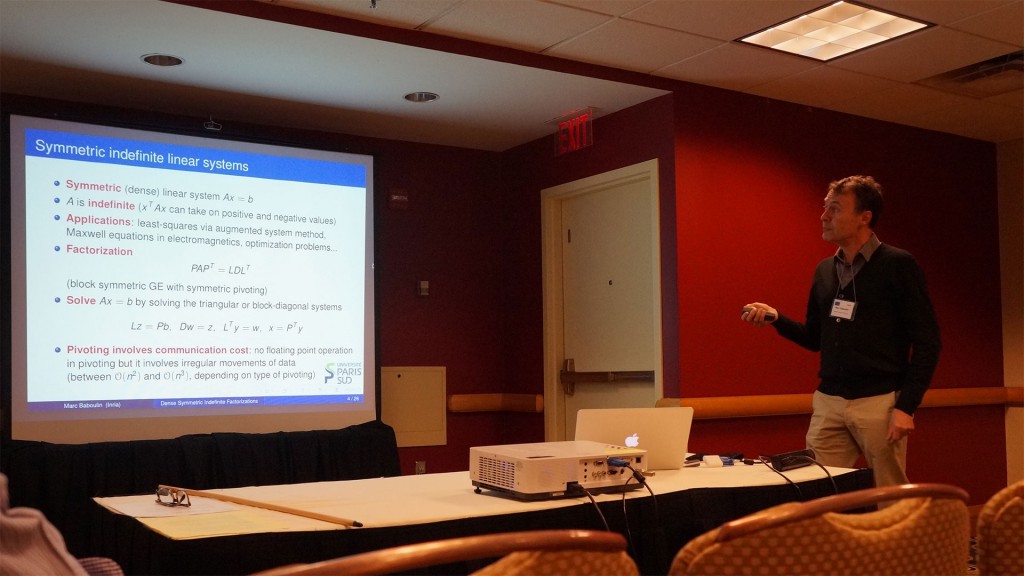


Knowing a little something about linear algebra, it is no surprise that a large contingent of ICLers attended the 2015 SIAM Conference on Applied Linear Algebra (SIAM LA) in Atlanta, GA on October 25 – 30. SIAM LA is organized by the Society of Industrial and Applied Mathematics (SIAM) and held every 3 years. The workshop is billed as the premier international conference in the field and brings together a diverse collection of researchers and practitioners from academia, laboratories, and industry to discuss the latest in applied linear algebra.
For our part, ICL attendance included Hartwig Anzt, Mark Gates, Piotr Luszczek, Stan Tomov, Mike Tsai, and Ichi Yamazaki. Hartwig acted as chair of the session on Mathematical Software and High Performance Computing and gave a talk on, “Random-Order Alternating Schwarz for Sparse Triangular Solves.” Mark Gates gave a talk, “Comparing Hybrid and Native GPU Acceleration for Linear Algebra.” Stan gave two talks, the first on “Efficient Eigensolver Algorithm on Accelerator Based Architecture,” and the second on, “Batched Matrix Computations on Hardware Accelerators Based on GPUs.” Mike Tsai presented a poster called, “Towards Batched Linear Solvers on Accelerated Hardware Platforms,” which will soon be hanging up in Stan’s office. Finally, Ichi presented ICL’s work on, “Mixed-Precision Orthogonalization Processes.”
As with every SIAM conference lately, and in part due to the proximity of Atlanta to Knoxville, the ICL team brought home a few visitors to the lab following SIAM LA, including ICL alum Marc Baboulin (INRIA) along with Takeshi Fukaya (Hokkaido University) and Toshiyuki Imamura (RIKEN).
Interview

Moritz Kreutzer
Where are you from, originally?
I am from Sonneberg, Germany but I’ve been living in or close to Nuremberg for the last nine years.
Can you summarize your educational background?
I earned my BS in Computational Engineering in Erlangen, Germany. Afterwards, I spent one year of my MS studies in Erlangen (Computational Engineering as well) and the other one in Stockholm, Sweden (Scientific Computing) before I started my PhD studies in Erlangen.
Tell us how you first learned about ICL.
To be honest, I cannot recall the exact moment. However, as ICL is very well-known and highly renowned in the HPC community, learning about it is just a matter of time if you work in this field.
What made you want to visit ICL?
At one point, we had contact with Hartwig Anzt from ICL due to a certain overlap of interest and work. We figured it would be a great opportunity to stay in Knoxville and work with ICL for some time during my PhD studies. Fortunately, it worked out and now I am here.
What are your research interests?
I am working on building blocks for sparse linear algebra on heterogeneous systems. My work involves high-performance implementations for CPUs and accelerators guided by performance models in close collaboration with experts from the application side.
What are you working on during your visit with ICL?
During my visit with ICL, we are planning to conduct a heterogeneous implementation of the block Jacobi-Davidson method, a sparse eigenvalue solver.
What are your interests/hobbies outside work?
I really enjoy doing sports (especially rock climbing) and I am a passionate amateur chef. Besides, I also like travelling and reading.
Tell us something about yourself that might surprise people.
I can make the best pizza far and wide.


