Loading...
Searching...
No Matches
pe_libpfm4_events.h File Reference
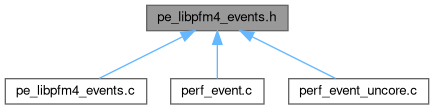
This graph shows which files directly or indirectly include this file:
Go to the source code of this file.
Function Documentation
◆ _pe_libpfm4_init()
| int _pe_libpfm4_init | ( | papi_vector_t * | my_vector, |
| int | cidx, | ||
| struct native_event_table_t * | event_table, | ||
| int | pmu_type | ||
| ) |
Definition at line 1146 of file pe_libpfm4_events.c.
1148 {
1149
1150 int detected_pmus=0, found_default=0;
1152 int j=0;
1153 unsigned int ncnt;
1154
1156 pfm_pmu_info_t pinfo;
1157 unsigned int strSize;
1158
1159 /* allocate the native event structure */
1160 event_table->num_native_events=0;
1161 event_table->pmu_type=pmu_type;
1162
1167 }
1168
1170
1171 /* Count number of present PMUs */
1172 detected_pmus=0;
1173 ncnt=0;
1174
1175 /* init default pmu */
1176 /* need to init pinfo or pfmlib might complain */
1180
1182 /* We have to see if we have aliases in there as separate PMUs, */
1183 /* we don't want both PMUs with all the events duplicated. */
1184 /* For aliases, either is valid alone, but if both are present */
1185 /* specify a preference in the code. */
1186 /* Alias: amd64_fam17h_zen1 over amd64_fam17h. */
1187 /* Alias flags are static ints global to this file. */
1188 i=0;
1189 while(1) {
1190 memset(&pinfo,0,sizeof(pfm_pmu_info_t));
1191 pinfo.size = sizeof(pfm_pmu_info_t);
1193
1194 /* We're done if we hit an invalid PMU entry */
1195 /* We can't check against PFM_PMU_MAX as that might not */
1196 /* match if libpfm4 is dynamically linked */
1197
1199 break;
1200 }
1201
1203 (pmu_is_present_and_right_type(&pinfo,pmu_type)) &&
1204 (strcmp(pinfo.name,"amd64_fam17h_zen1") == 0) ) {
1205 amd64_fam17h_zen1_present = 1;
1206 }
1207 i++;
1208 }
1209
1211 i=0;
1212 while(1) {
1213 memset(&pinfo,0,sizeof(pfm_pmu_info_t));
1214 pinfo.size = sizeof(pfm_pmu_info_t);
1216
1217 /* We're done if we hit an invalid PMU entry */
1218 /* We can't check against PFM_PMU_MAX as that might not */
1219 /* match if libpfm4 is dynamically linked */
1220
1222 break;
1223 }
1224
1226 (pmu_is_present_and_right_type(&pinfo,pmu_type))) {
1227
1228 /* skip if it is amd64_fam17h and zen1 is also present. */
1230 i++;
1231 continue;
1232 }
1233
1235 pinfo.name,pinfo.desc,pinfo.type);
1236
1237 detected_pmus++;
1238 ncnt+=pinfo.nevents;
1239
1241 component->cmp_info.pmu_names[j++] =
1242 strdup(pinfo.name);
1243 }
1244
1246
1247 /* Hack to have "default core" PMU */
1248 if ( (pinfo.type==PFM_PMU_TYPE_CORE) &&
1249 strcmp(pinfo.name,"ix86arch")) {
1250 memcpy(&(event_table->default_pmu),
1251 &pinfo,sizeof(pfm_pmu_info_t));
1252 found_default++;
1253 }
1254
1255 /* For ARM processors, */
1256 if ( (pinfo.type==PFM_PMU_TYPE_CORE) &&
1261 }
1262 }
1263 }
1264
1266 /* To avoid confusion, no "default" CPU for uncore */
1267 found_default=1;
1268 }
1269 }
1270 i++;
1271 }
1273
1274 if (detected_pmus==0) {
1277 }
1278
1279 if (!found_default) {
1281 }
1282
1283 if (found_default>1) {
1285 }
1286
1287 component->cmp_info.num_native_events = ncnt;
1288
1289 component->cmp_info.num_cntrs = event_table->default_pmu.num_cntrs+
1290 event_table->default_pmu.num_fixed_cntrs;
1291
1293
1294 /* Setup presets, only if Component 0 and default core PMU */
1300 }
1301 }
1302
1304}
int _papi_load_preset_table(char *pmu_str, int pmu_type, int cidx)
Definition: papi_preset.c:771
static int pmu_is_present_and_right_type(pfm_pmu_info_t *pinfo, int type)
Definition: pe_libpfm4_events.c:87
Definition: papi_libpfm4_events.h:11
struct native_event_t * native_events
Definition: papi_libpfm4_events.h:32
int allocated_native_events
Definition: papi_libpfm4_events.h:34
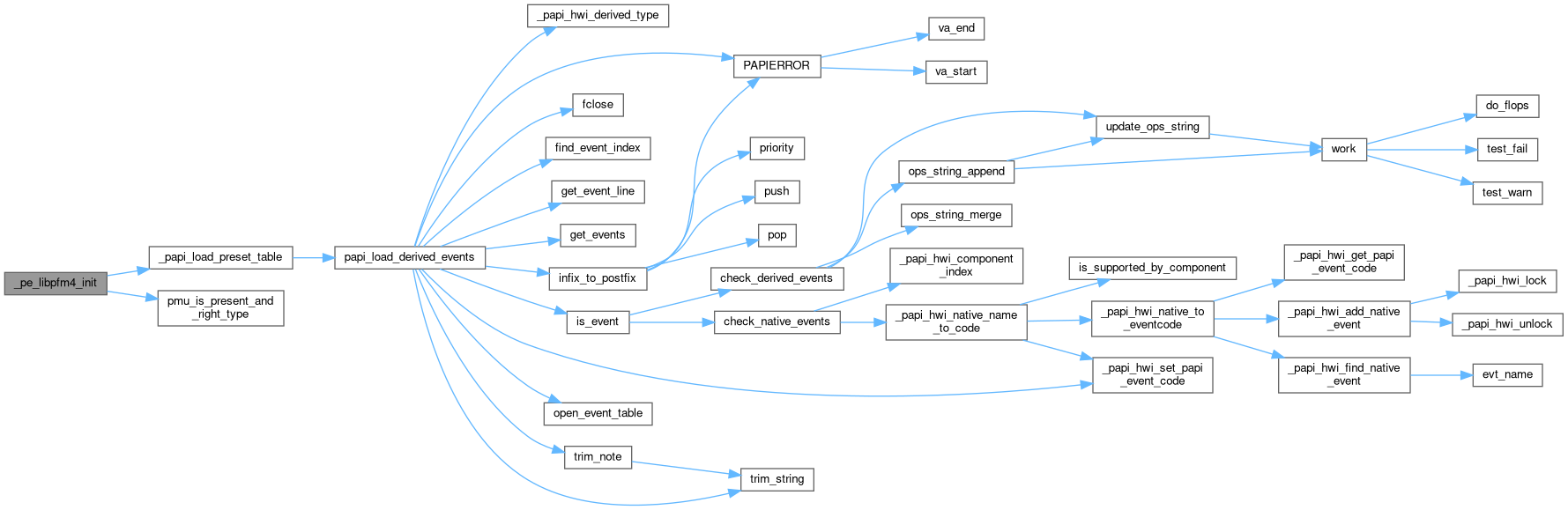
Here is the call graph for this function:
◆ _pe_libpfm4_ntv_code_to_descr()
| int _pe_libpfm4_ntv_code_to_descr | ( | unsigned int | EventCode, |
| char * | name, | ||
| int | len, | ||
| struct native_event_table_t * | event_table | ||
| ) |
Definition at line 725 of file pe_libpfm4_events.c.
728{
729 SUBDBG("ENTER: EventCode: %#x, ntv_descr: %p, len: %d: event_table: %p\n", EventCode, ntv_descr, len, event_table);
730
731 int eidx;
732 int papi_event_code;
733 char *mdesc;
734 char *edesc;
735
736 // get the attribute index for this papi event
737 papi_event_code = _papi_hwi_get_papi_event_code();
738
739 // a papi event code less than 0 is invalid, return error
740 if (papi_event_code <= 0) {
743 }
744
745 // find our native event table for this papi event code (search list backwards because it improves chances of finding it quickly)
747 SUBDBG("native_event[%d]: papi_event_code: %#x, libpfm4_idx: %#x\n", eidx, event_table->native_events[eidx].papi_event_code, event_table->native_events[eidx].libpfm4_idx);
748 if ((papi_event_code == event_table->native_events[eidx].papi_event_code) && (EventCode == ((unsigned)event_table->native_events[eidx].libpfm4_idx))) {
749 break;
750 }
751 }
752
753 // if we did not find a match, return an error
754 if (eidx < 0) {
755 // If we did not find a match in our native event table, then the code passed in has not been
756 // allocated yet It should not be possible to get to this code. The user has to call the papi
757 // code_to_name api with a papi event code for a native event. But the only way to get one of
758 // those is to call either name_to_code or enum_cmp_events first. When one of these calls is
759 // done we allocate the event so it should always be there.
760
763 }
764
766
767 // if it will not fit, return error
768 if (strlen (edesc) >= (unsigned)len) {
771 }
772 strcpy (ntv_descr, edesc);
773
774 // if this event had masks, also add their descriptions
776 if ((mdesc != NULL) && (strlen(mdesc) > 0)) {
777 if ((strlen(edesc) + 8 + strlen(mdesc)) >= (unsigned)len) {
778 SUBDBG("EXIT: Not enough room for event and mask descriptions: need: %u, have: %u", (unsigned)(strlen(edesc) + 8 + strlen(mdesc)), (unsigned)len);
780 }
781 strcat (ntv_descr, ", masks:");
782 strcat (ntv_descr, mdesc);
783 }
784
787}
unsigned int _papi_hwi_get_papi_event_code()
Definition: papi_internal.c:136
Here is the call graph for this function:

◆ _pe_libpfm4_ntv_code_to_info()
| int _pe_libpfm4_ntv_code_to_info | ( | unsigned int | EventCode, |
| PAPI_event_info_t * | info, | ||
| struct native_event_table_t * | event_table | ||
| ) |
Definition at line 791 of file pe_libpfm4_events.c.
794{
796
797 int ret;
798
799 // get the event name first
800 if ((ret = _pe_libpfm4_ntv_code_to_name(EventCode, info->symbol, sizeof(info->symbol), event_table)) != PAPI_OK) {
803 }
804
805 if ((ret = _pe_libpfm4_ntv_code_to_descr(EventCode, info->long_descr, sizeof(info->long_descr), event_table)) != PAPI_OK) {
808 }
809
810 SUBDBG("EXIT: EventCode: %#x, name: %s, desc: %s\n", EventCode, info->symbol, info->long_descr);
812}
Take an event code and convert it to a description.
Take an event code and convert it to a name.
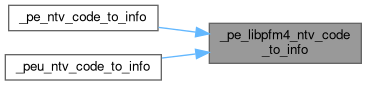
Here is the caller graph for this function:
◆ _pe_libpfm4_ntv_code_to_name()
| int _pe_libpfm4_ntv_code_to_name | ( | unsigned int | EventCode, |
| char * | name, | ||
| int | len, | ||
| struct native_event_table_t * | event_table | ||
| ) |
Definition at line 632 of file pe_libpfm4_events.c.
635{
636 SUBDBG("ENTER: EventCode: %#x, ntv_name: %p, len: %d, event_table: %p\n", EventCode, ntv_name, len, event_table);
637
638 int eidx;
639 int papi_event_code;
640
641 // get the attribute index for this papi event
642 papi_event_code = _papi_hwi_get_papi_event_code();
643
644 // a papi event code less than 0 is invalid, return error
645 if (papi_event_code <= 0) {
648 }
649
650 // find our native event table for this papi event code (search list backwards because it improves chances of finding it quickly)
652 if ((papi_event_code == event_table->native_events[eidx].papi_event_code) && (EventCode == ((unsigned)event_table->native_events[eidx].libpfm4_idx))) {
653 SUBDBG("Found native_event[%d]: papi_event_code: %#x, libpfm4_idx: %#x\n", eidx, event_table->native_events[eidx].papi_event_code, event_table->native_events[eidx].libpfm4_idx);
654 break;
655 }
656 }
657
658 // if we did not find a match, return an error
659 if (eidx < 0) {
660 // If we did not find a match in our native event table, then the code passed in has not been
661 // allocated yet It should not be possible to get to this code. The user has to call the papi
662 // code_to_name api with a papi event code for a native event. But the only way to get one of
663 // those is to call either name_to_code or enum_cmp_events first. When one of these calls is
664 // done we allocate the event so it should always be there.
665
668 }
669
670 // if this event is defined by the default pmu, then use only the event name
671 // if it is not defined by the default pmu, then use both the pmu name and event name
672 char *ename;
673 if ((event_table->default_pmu.name) && (strcmp(event_table->default_pmu.name, event_table->native_events[eidx].pmu) == 0)) {
675 } else {
677 }
678
679 // if it will not fit, return error
680 if (strlen (ename) >= (unsigned)len) {
683 }
684 strcpy (ntv_name, ename);
685
686 // if this event had masks, also add their names
688 if ((mname != NULL) && (strlen(mname) > 0)) {
689 if ((strlen(ename) + 8 + strlen(mname)) >= (unsigned)len) {
690 SUBDBG("EXIT: Not enough room for event and mask descriptions: need: %u, have: %u", (unsigned)(strlen(ename) + 8 + strlen(mname)), (unsigned)len);
692 }
693 strcat (ntv_name, ":");
694 strcat (ntv_name, mname);
695 }
696
699}
Here is the call graph for this function:

◆ _pe_libpfm4_ntv_enum_events()
| int _pe_libpfm4_ntv_enum_events | ( | unsigned int * | EventCode, |
| int | modifier, | ||
| int | cidx, | ||
| struct native_event_table_t * | event_table | ||
| ) |
Definition at line 832 of file pe_libpfm4_events.c.
834 {
835
836 SUBDBG("ENTER: PapiEventCode: %p, *PapiEventCode: %#x, modifier: %d, event_table: %p\n", PapiEventCode, *PapiEventCode, modifier, event_table);
837
838 int code,ret, pnum;
839 int max_umasks;
840 char event_string[BUFSIZ];
841 pfm_pmu_info_t pinfo;
842 pfm_event_info_t einfo;
844
845 /* return first event if so specified */
847 attr_idx = 0; // set so if they want attribute information, it will start with the first attribute
849 if (code < 0 ) {
851 return code;
852 }
853
854 // get the event information from libpfm4 (must zero structure)
855 memset( &einfo, 0, sizeof( pfm_event_info_t ));
856 einfo.size = sizeof(pfm_event_info_t);
857 if ((ret = pfm_get_event_info(code, PFM_OS_PERF_EVENT_EXT, &einfo)) != PFM_SUCCESS) {
860 }
861
862 // get the pmu information from libpfm4 (must zero structure)
863 memset( &pinfo, 0, sizeof(pfm_pmu_info_t) );
864 pinfo.size = sizeof(pfm_pmu_info_t);
865 ret=pfm_get_pmu_info(einfo.pmu, &pinfo);
866 if (ret!=PFM_SUCCESS) {
868 return ret;
869 }
870
871 // build full event name
872 sprintf (event_string, "%s::%s", pinfo.name, einfo.name);
873 SUBDBG("code: %#x, pmu: %s, event: %s, event_string: %s\n", code, pinfo.name, einfo.name, event_string);
874
875 // go allocate this event, need to create tables used by the get event info call that will probably follow
877 // allocate may have created the event table but returned NULL to tell the caller the event string was invalid (attempt to encode it failed).
878 // if the caller wants to use this event to count something, it will report an error
879 // but if the caller is just interested in listing the event, then we need an event table with an event name and libpfm4 index
880 int evt_idx;
884 }
885
886 // give back the new event code
890 }
891
892 *PapiEventCode = our_event->libpfm4_idx;
893
896 }
897
898 /* Handle looking for the next event */
900 attr_idx = 0; // set so if they want attribute information, it will start with the first attribute
901
902 // get the next event code from libpfm4, if there are no more in this pmu find first event in next pmu
903 if ((code = pfm_get_event_next(*PapiEventCode)) < 0) {
904
905 // get this events information from libpfm4, we need the pmu number of the last event we processed (table must be cleared)
906 memset( &einfo, 0, sizeof( pfm_event_info_t ));
907 einfo.size = sizeof(pfm_event_info_t);
908 if ((ret = pfm_get_event_info(*PapiEventCode, PFM_OS_PERF_EVENT_EXT, &einfo)) != PFM_SUCCESS) {
911 }
913
914 // get the pmu number of the last event
915 pnum = einfo.pmu;
916
919 if (code < 0) {
921 return code;
922 }
923 }
924
925
926 // get the event information from libpfm4 (must zero structure)
927 memset( &einfo, 0, sizeof( pfm_event_info_t ));
928 einfo.size = sizeof(pfm_event_info_t);
929 if ((ret = pfm_get_event_info(code, PFM_OS_PERF_EVENT_EXT, &einfo)) != PFM_SUCCESS) {
932 }
933
934 // get the pmu information from libpfm4 (must zero structure)
935 memset( &pinfo, 0, sizeof(pfm_pmu_info_t) );
936 pinfo.size = sizeof(pfm_pmu_info_t);
937 ret=pfm_get_pmu_info(einfo.pmu, &pinfo);
938 if (ret!=PFM_SUCCESS) {
940 return ret;
941 }
942
943 // build full event name
944 sprintf (event_string, "%s::%s", pinfo.name, einfo.name);
945 SUBDBG("code: %#x, pmu: %s, event: %s, event_string: %s\n", code, pinfo.name, einfo.name, event_string);
946
947 // go allocate this event, need to create tables used by the get event info call that will follow
949 // allocate may have created the event table but returned NULL to tell the caller the event string was invalid (attempt to encode it failed).
950 // if the caller wants to use this event to count something, it will report an error
951 // but if the caller is just interested in listing the event, then we need an event table with an event name and libpfm4 index
952 int evt_idx;
956 }
957
958 // give back the new event code
962 }
963
964 // give back the new event code
965 *PapiEventCode = our_event->libpfm4_idx;
966
969 }
970
971 /* We don't handle PAPI_NTV_ENUM_UMASK_COMBOS */
975 }
976
977 /* Enumerate PAPI_NTV_ENUM_UMASKS (umasks on an event) */
979 // get this events information from libpfm4, we need the number of masks this event knows about (table must be cleared)
980 memset( &einfo, 0, sizeof( pfm_event_info_t ));
981 einfo.size = sizeof(pfm_event_info_t);
982 if ((ret = pfm_get_event_info(*PapiEventCode, PFM_OS_PERF_EVENT_EXT, &einfo)) != PFM_SUCCESS) {
985 }
986// SUBDBG("*PapiEventCode: %#x, einfo.name: %s, einfo.code: %#x, einfo.nattrs: %d\n", *PapiEventCode, einfo.name, einfo.code, einfo.nattrs);
987
988 // set max number of masks
989 max_umasks = einfo.nattrs;
990
991 // if we reached last attribute, return error to show we are done with this events masks
995 }
996
997 // find the event table for this event, we need the pmu name and event name without any masks
999 if (ntv_idx < 0) {
1001 return ntv_idx;
1002 }
1004 if ((ename == NULL) || (strlen(ename) >= sizeof(event_string))) {
1007 }
1008 strcpy (event_string, ename);
1010
1011 // go get the attribute information for this event
1012 // libpfm4 likes the table cleared
1013 pfm_event_attr_info_t ainfo;
1014 memset (&ainfo, 0, sizeof(pfm_event_attr_info_t));
1015 ainfo.size = sizeof(pfm_event_attr_info_t);
1016 ret = pfm_get_event_attr_info(*PapiEventCode, attr_idx, PFM_OS_PERF_EVENT_EXT, &ainfo);
1017 if (ret != PFM_SUCCESS) {
1018 SUBDBG("EXIT: Attribute info not found, EventCode: %#x, attr_idx: %d, ret: %d\n", *PapiEventCode, attr_idx, _papi_libpfm4_error(ret));
1020 }
1021 SUBDBG("*PapiEventCode: %#x, attr_idx: %d, type: %d, name: %s, description: %s\n", *PapiEventCode, attr_idx, ainfo.type, ainfo.name, ainfo.desc);
1022
1023 if (strlen(event_string) + strlen(ainfo.name) + 35 > sizeof(event_string)) {
1026 }
1027
1028 strcat (event_string, ":");
1029 strcat (event_string, ainfo.name);
1030 switch (ainfo.type) {
1031 case PFM_ATTR_UMASK:
1032 break;
1033 case PFM_ATTR_MOD_BOOL:
1034 case PFM_ATTR_MOD_INTEGER:
1035 // a few attributes require a non-zero value to encode correctly (most would accept zero here)
1036 strcat(event_string,"=0");
1037 break;
1038 default:
1041 }
1042
1043 // go allocate this event, need to create tables used by the get event info call that will follow
1044 if ((our_event = allocate_native_event(event_string, *PapiEventCode, cidx, event_table)) == NULL) {
1045 // allocate may have created the event table but returned NULL to tell the caller the event string was invalid.
1046 // if the caller wants to use this event to count something, it must report the error
1047 // but if the caller is just interested in listing the event (like this code), then find the table that was created and return its libpfm4 index
1048 int evt_idx;
1052 }
1053 // bump so next time we will use next attribute
1054 attr_idx++;
1055 // give back the new event code
1059 }
1060
1061 // bump so next time we will use next attribute
1062 attr_idx++;
1063
1064 // give back the new event code
1065 *PapiEventCode = our_event->libpfm4_idx;
1066
1069 }
1070
1071 /* Enumerate PAPI_NTV_ENUM_GROUPS (groups on an event) */
1075 }
1076
1077 /* An unknown enumeration method was indicated */
1078
1081}
convert libpfm error codes to PAPI error codes
Allocates a native event.
looks up an event, returns it if it exists
return the first available event that's on an active PMU
int _papi_hwi_get_ntv_idx(unsigned int papi_evt_code)
Definition: papi_internal.c:142
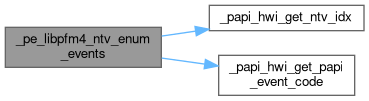
Here is the call graph for this function:
◆ _pe_libpfm4_ntv_name_to_code()
| int _pe_libpfm4_ntv_name_to_code | ( | const char * | ntv_name, |
| unsigned int * | EventCode, | ||
| int | cidx, | ||
| struct native_event_table_t * | event_table | ||
| ) |
Definition at line 582 of file pe_libpfm4_events.c.
585{
586 SUBDBG( "ENTER: name: %s, event_code: %p, *event_code: %#x, event_table: %p\n", name, event_code, *event_code, event_table);
587
589 int event_num;
590
591 // if we already know this event name, just return its native code
593 if (event_num >= 0) {
595 // the following call needs to happen to prevent the internal layer from creating a new papi native event table
597 SUBDBG("EXIT: Found papi_event_code: %#x, libpfm4_idx: %#x\n", event_table->native_events[event_num].papi_event_code, event_table->native_events[event_num].libpfm4_idx);
599 }
600
601 // Try to allocate this event to see if it is known by libpfm4, if allocate fails tell the caller it is not valid
603 if (our_event==NULL) {
606 }
607
608 *event_code = our_event->libpfm4_idx;
611}
void _papi_hwi_set_papi_event_code(unsigned int event_code, int update_flag)
Definition: papi_internal.c:119
Here is the call graph for this function:

◆ _pe_libpfm4_setup_presets()
◆ _pe_libpfm4_shutdown()
| int _pe_libpfm4_shutdown | ( | papi_vector_t * | my_vector, |
| struct native_event_table_t * | event_table | ||
| ) |
Definition at line 1095 of file pe_libpfm4_events.c.
1096 {
1098
1100
1104 }
1105 }
1106
1107 /* clean out and free the native events structure */
1109
1110 /* free memory allocated with strdup or malloc */
1120 }
1121 }
1122
1123 free(event_table->native_events);
1124
1126
1129}
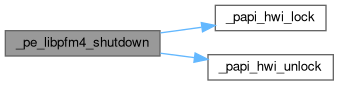
Here is the call graph for this function:
◆ _peu_libpfm4_init()
| int _peu_libpfm4_init | ( | papi_vector_t * | my_vector, |
| int | cidx, | ||
| struct native_event_table_t * | event_table, | ||
| int | pmu_type | ||
| ) |
Definition at line 1318 of file pe_libpfm4_events.c.
1320 {
1321
1322 int detected_pmus=0;
1324 int j=0;
1326 unsigned int ncnt;
1327 pfm_pmu_info_t pinfo;
1328
1329 (void)cidx;
1330
1331 /* allocate the native event structure */
1332
1333 event_table->num_native_events=0;
1334 event_table->pmu_type=pmu_type;
1335
1340 }
1342
1343 /* Count number of present PMUs */
1344 detected_pmus=0;
1345 ncnt=0;
1346
1348
1350 i=0;
1351 while(1) {
1352 memset(&pinfo,0,sizeof(pfm_pmu_info_t));
1353 pinfo.size = sizeof(pfm_pmu_info_t);
1355
1356 /* We're done if we hit an invalid PMU entry */
1357 /* We can't check against PFM_PMU_MAX */
1358 /* as that might not match if libpfm4 is dynamically linked */
1359
1361 break;
1362 }
1363
1365 (pmu_is_present_and_right_type(&pinfo,pmu_type))) {
1366
1368
1369 detected_pmus++;
1370 ncnt+=pinfo.nevents;
1371
1374 }
1376 pinfo.num_fixed_cntrs;
1377 }
1378 i++;
1379 }
1381
1383
1385
1387}
Here is the call graph for this function: