PAPI 7.1.0.0
Loading...
Searching...
No Matches
linux-bgq.c File Reference

This file has the source code for a component that enables PAPI-C to access hardware monitoring counters for BG/Q through the BGPM library. More...

Include dependency graph for linux-bgq.c:

Go to the source code of this file.

Data Structures

struct  bgq_generic_events_t
 

Macros

#define get_cycles   GetTimeBase
 
#define OPCODE_EVENT_CHUNK   8
 

Functions

int _bgq_get_memory_info (PAPI_hw_info_t *pHwInfo, int pCPU_Type)
 
int _bgq_get_dmem_info (PAPI_dmem_info_t *pDmemInfo)
 
void user_signal_handler (int hEvtSet, uint64_t address, uint64_t ovfVector, const ucontext_t *pContext)
 
void _papi_hwd_lock (int lock)
 
void _papi_hwd_unlock (int lock)
 
int _bgq_get_system_info (papi_mdi_t *mdi)
 
int _bgq_init_control_state (hwd_control_state_t *ptr)
 
int _bgq_set_domain (hwd_control_state_t *cntrl, int domain)
 
int _bgq_init (hwd_context_t *ctx)
 
int _bgq_multiplex (hwd_control_state_t *bgq_state)
 
int _bgq_allocate_registers (EventSetInfo_t *ESI)
 
int _bgq_cleanup_eventset (hwd_control_state_t *ctrl)
 
int _bgq_update_control_state (hwd_control_state_t *ptr, NativeInfo_t *native, int count, hwd_context_t *ctx)
 
int _bgq_start (hwd_context_t *ctx, hwd_control_state_t *ptr)
 
int _bgq_stop (hwd_context_t *ctx, hwd_control_state_t *ptr)
 
int _bgq_read (hwd_context_t *ctx, hwd_control_state_t *ptr, long_long **dp, int flags)
 
int _bgq_reset (hwd_context_t *ctx, hwd_control_state_t *ptr)
 
int _bgq_shutdown (hwd_context_t *ctx)
 
int _bgq_write (hwd_context_t *ctx, hwd_control_state_t *cntrl, long_long *from)
 
void _bgq_dispatch_timer (int signal, hwd_siginfo_t *info, void *uc)
 
int _bgq_set_overflow (EventSetInfo_t *ESI, int EventIndex, int threshold)
 
int _bgq_set_profile (EventSetInfo_t *ESI, int EventIndex, int threshold)
 
int _bgq_stop_profiling (ThreadInfo_t *master, EventSetInfo_t *ESI)
 
int _bgq_ctl (hwd_context_t *ctx, int code, _papi_int_option_t *option)
 
long long _bgq_get_real_usec (void)
 
long long _bgq_get_real_cycles (void)
 
long long _bgq_get_virt_usec (void)
 
long long _bgq_get_virt_cycles (void)
 
int _bgq_init_component (int cidx)
 
int _bgq_ntv_name_to_code (const char *name, unsigned int *event_code)
 
int _bgq_ntv_code_to_name (unsigned int EventCode, char *name, int len)
 
int _bgq_ntv_code_to_descr (unsigned int EventCode, char *name, int len)
 
int _bgq_ntv_code_to_bits (unsigned int EventCode, hwd_register_t *bits)
 
int _bgq_ntv_enum_events (unsigned int *EventCode, int modifier)
 
int _papi_hwi_init_os (void)
 

Variables

UPC_Lock_t thdLocks [PAPI_MAX_LOCK]
 
papi_vector_t _bgq_vectors
 
PAPI_os_info_t _papi_os_info
 
static int allocated_opcode_events = 0
 
static int num_opcode_events = 0
 
static struct bgq_generic_events_tGenericEvent
 
papi_os_vector_t _papi_os_vector
 

Detailed Description

Author
Heike Jagode jagod.nosp@m.e@ee.nosp@m.cs.ut.nosp@m.k.ed.nosp@m.u Mods: < your name here > < your email address > Blue Gene/Q CPU component: BGPM / Punit

Tested version of bgpm (early access)

Definition in file linux-bgq.c.

Macro Definition Documentation

◆ get_cycles

#define get_cycles (   void)    GetTimeBase

Definition at line 48 of file linux-bgq.c.

◆ OPCODE_EVENT_CHUNK

#define OPCODE_EVENT_CHUNK   8

Definition at line 63 of file linux-bgq.c.

Function Documentation

◆ _bgq_allocate_registers()

int _bgq_allocate_registers ( EventSetInfo_t ESI)

Definition at line 323 of file linux-bgq.c.

324{
325#ifdef DEBUG_BGQ
326 printf("_bgq_allocate_registers\n");
327#endif
328 int i, natNum;
329 int xEventId;
330
331 /*
332 * Start monitoring the events...
333 */
334 natNum = ESI->NativeCount;
335
336 for ( i = 0; i < natNum; i++ ) {
337 xEventId = ( ESI->NativeInfoArray[i].ni_event & PAPI_NATIVE_AND_MASK ) + 1;
339 }
340
341 return PAPI_OK;
342}
int i
#define PAPI_OK
Definition: f90papi.h:73
#define PAPI_NATIVE_AND_MASK
NativeInfo_t * NativeInfoArray

◆ _bgq_cleanup_eventset()

int _bgq_cleanup_eventset ( hwd_control_state_t ctrl)

Definition at line 351 of file linux-bgq.c.

352{
353#ifdef DEBUG_BGQ
354 printf( "_bgq_cleanup_eventset\n" );
355#endif
356
357 // set multiplexing flag to OFF (0)
358 ctrl->muxOn = 0;
359 // set overflow flag to OFF (0)
360 ctrl->overflow = 0;
361 ctrl->overflow_count = 0;
362 // set BGPM eventGroup flag back to NOT applied yet (0)
363 ctrl->bgpm_eventset_applied = 0;
364
365 return ( PAPI_OK );
366}

◆ _bgq_ctl()

int _bgq_ctl ( hwd_context_t ctx,
int  code,
_papi_int_option_t option 
)

Definition at line 895 of file linux-bgq.c.

896{
897#ifdef DEBUG_BGQ
898 printf( "_bgq_ctl\n" );
899#endif
900 ( void ) ctx;
901 int retval;
902
903 switch ( code ) {
904 case PAPI_MULTIPLEX:
905 {
906 hwd_control_state_t * bgq_state = ( ( hwd_control_state_t * ) option->multiplex.ESI->ctl_state );
907 bgq_state->muxOn = 1;
908 retval = _bgq_multiplex( bgq_state );
909 return ( retval );
910 }
911 default:
912 return ( PAPI_OK );
913 }
914}
#define PAPI_MULTIPLEX
Definition: f90papi.h:223
int _bgq_multiplex(hwd_control_state_t *bgq_state)
Definition: linux-bgq.c:262
hwd_control_state_t * ctl_state
EventSetInfo_t * ESI
_papi_int_multiplex_t multiplex
int retval
Definition: zero_fork.c:53
Here is the call graph for this function:

◆ _bgq_dispatch_timer()

void _bgq_dispatch_timer ( int  signal,
hwd_siginfo_t info,
void *  uc 
)

Definition at line 663 of file linux-bgq.c.

664{
665 ( void ) signal;
666 ( void ) info;
667 ( void ) uc;
668#ifdef DEBUG_BGQ
669 printf("BEGIN _bgq_dispatch_timer\n");
670#endif
671
672 return;
673}
__sighandler_t signal(int __sig, __sighandler_t __handler) __attribute__((__nothrow__
Here is the call graph for this function:

◆ _bgq_get_dmem_info()

int _bgq_get_dmem_info ( PAPI_dmem_info_t pDmemInfo)

Definition at line 53 of file linux-bgq-memory.c.

54{
55// pid_t xPID = getpid();
56// prpsinfo_t xInfo;
57// char xFile[256];
58// int xFD;
59
60// sprintf(xFile, "/proc/%05d", xPID);
61// if ((fd = open(xFile, O_RDONLY)) < 0) {
62// SUBDBG("PAPI_get_dmem_info can't open /proc/%d\n", xPID);
63// return (PAPI_ESYS);
64// }
65// if (ioctl(xFD, PIOCPSINFO, &xInfo) < 0) {
66// return (PAPI_ESYS);
67// }
68// close(xFD);
69
70 pDmemInfo->size = PAPI_EINVAL;
71 pDmemInfo->resident = PAPI_EINVAL;
72 pDmemInfo->high_water_mark = PAPI_EINVAL;
73 pDmemInfo->shared = PAPI_EINVAL;
74 pDmemInfo->text = PAPI_EINVAL;
75 pDmemInfo->library = PAPI_EINVAL;
76 pDmemInfo->heap = PAPI_EINVAL;
77 pDmemInfo->locked = PAPI_EINVAL;
78 pDmemInfo->stack = PAPI_EINVAL;
79 pDmemInfo->pagesize = PAPI_EINVAL;
80
81 return PAPI_OK;
82}
#define PAPI_EINVAL
Definition: f90papi.h:115
long long locked
Definition: papi.h:874
long long shared
Definition: papi.h:870
long long text
Definition: papi.h:871
long long heap
Definition: papi.h:873
long long size
Definition: papi.h:867
long long library
Definition: papi.h:872
long long stack
Definition: papi.h:875
long long pagesize
Definition: papi.h:876
long long high_water_mark
Definition: papi.h:869
long long resident
Definition: papi.h:868

◆ _bgq_get_memory_info()

int _bgq_get_memory_info ( PAPI_hw_info_t pHwInfo,
int  pCPU_Type 
)

Definition at line 33 of file linux-bgq-memory.c.

34{
35 int retval = 0;
36
37 switch ( pCPU_Type ) {
38 default:
39 //fprintf(stderr,"Default CPU type in %s (%d)\n",__FUNCTION__,__LINE__);
40 retval = init_bgq( &pHwInfo->mem_hierarchy );
41 break;
42 }
43
44 return retval;
45}
int init_bgq(PAPI_mh_info_t *pMem_Info)
PAPI_mh_info_t mem_hierarchy
Definition: papi.h:793
Here is the call graph for this function:
Here is the caller graph for this function:

◆ _bgq_get_real_cycles()

long long _bgq_get_real_cycles ( void  )

Definition at line 942 of file linux-bgq.c.

943{
944#ifdef DEBUG_BGQ
945 printf( "_bgq_get_real_cycles\n" );
946#endif
947
948 return ( ( long long ) get_cycles( ) );
949
950}
#define get_cycles
Definition: linux-bgq.c:48
Here is the caller graph for this function:

◆ _bgq_get_real_usec()

long long _bgq_get_real_usec ( void  )

Definition at line 920 of file linux-bgq.c.

921{
922#ifdef DEBUG_BGQ
923 printf( "_bgq_get_real_usec\n" );
924#endif
925
926 /*
927 * NOTE: _papi_hwi_system_info.hw_info.mhz is really a representation of unit of time per cycle.
928 * On BG/P, it's value is 8.5e-4. Therefore, to get cycles per sec, we have to multiply
929 * by 1.0e12. To then convert to usec, we have to divide by 1.0e-3.
930 */
931 return ( ( long long ) ( ( ( float ) get_cycles( ) ) /
933
934}
papi_mdi_t _papi_hwi_system_info
Definition: papi_internal.c:56
int cpu_max_mhz
Definition: papi.h:790
PAPI_hw_info_t hw_info
Here is the caller graph for this function:

◆ _bgq_get_system_info()

int _bgq_get_system_info ( papi_mdi_t mdi)

Definition at line 138 of file linux-bgq.c.

139{
140#ifdef DEBUG_BGQ
141 printf( "_bgq_get_system_info\n" );
142#endif
143
144 ( void ) mdi;
145 Personality_t personality;
146 int retval;
147
148 /* Hardware info */
149 retval = Kernel_GetPersonality( &personality, sizeof( Personality_t ) );
150 if ( retval ) {
151 fprintf( stdout, "Kernel_GetPersonality returned %d (sys error=%d).\n"
152 "\t%s\n", retval, errno, strerror( errno ) );
153 return PAPI_ESYS;
154 }
155
156 /* Returns the number of processors that are associated with the currently
157 * running process */
158 _papi_hwi_system_info.hw_info.ncpu = Kernel_ProcessorCount( );
159 // TODO: HJ Those values need to be fixed
160 _papi_hwi_system_info.hw_info.nnodes = Kernel_ProcessCount( );
162
163 _papi_hwi_system_info.hw_info.cpu_max_mhz = personality.Kernel_Config.FreqMHz;
164 _papi_hwi_system_info.hw_info.cpu_min_mhz = personality.Kernel_Config.FreqMHz;
165
166 _papi_hwi_system_info.hw_info.mhz = ( float ) personality.Kernel_Config.FreqMHz;
167 SUBDBG( "_bgq_get_system_info: Detected MHZ is %f\n",
169
170 return ( PAPI_OK );
171}
int errno
#define PAPI_ESYS
Definition: f90papi.h:136
#define SUBDBG(format, args...)
Definition: papi_debug.h:64
FILE * stdout
float mhz
Definition: papi.h:801
int nnodes
Definition: papi.h:779
int totalcpus
Definition: papi.h:780
int cpu_min_mhz
Definition: papi.h:791
int ncpu
Definition: papi.h:775
Here is the caller graph for this function:

◆ _bgq_get_virt_cycles()

long long _bgq_get_virt_cycles ( void  )

Definition at line 973 of file linux-bgq.c.

974{
975#ifdef DEBUG_BGQ
976 printf( "_bgq_get_virt_cycles\n" );
977#endif
978
979 return _bgq_get_real_cycles( );
980}
long long _bgq_get_real_cycles(void)
Definition: linux-bgq.c:942
Here is the call graph for this function:

◆ _bgq_get_virt_usec()

long long _bgq_get_virt_usec ( void  )

Definition at line 958 of file linux-bgq.c.

959{
960#ifdef DEBUG_BGQ
961 printf( "_bgq_get_virt_usec\n" );
962#endif
963
964 return _bgq_get_real_usec( );
965}
long long _bgq_get_real_usec(void)
Definition: linux-bgq.c:920
Here is the call graph for this function:

◆ _bgq_init()

int _bgq_init ( hwd_context_t ctx)

Definition at line 234 of file linux-bgq.c.

235{
236#ifdef DEBUG_BGQ
237 printf( "_bgq_init\n" );
238#endif
239 ( void ) ctx;
240 int retval;
241
242#ifdef DEBUG_BGPM
243 Bgpm_PrintOnError(1);
244 Bgpm_ExitOnError(0);
245#else
246 Bgpm_PrintOnError(0);
247 // avoid bgpm default of exiting when error occurs - caller will check return code instead.
248 Bgpm_ExitOnError(0);
249#endif
250
251 retval = Bgpm_Init( BGPM_MODE_SWDISTRIB );
252 retval = _check_BGPM_error( retval, "Bgpm_Init" );
253 if ( retval < 0 ) return retval;
254
255 //_common_initBgpm();
256
257 return PAPI_OK;
258}
int _check_BGPM_error(int err, char *bgpmfunc)
Here is the call graph for this function:

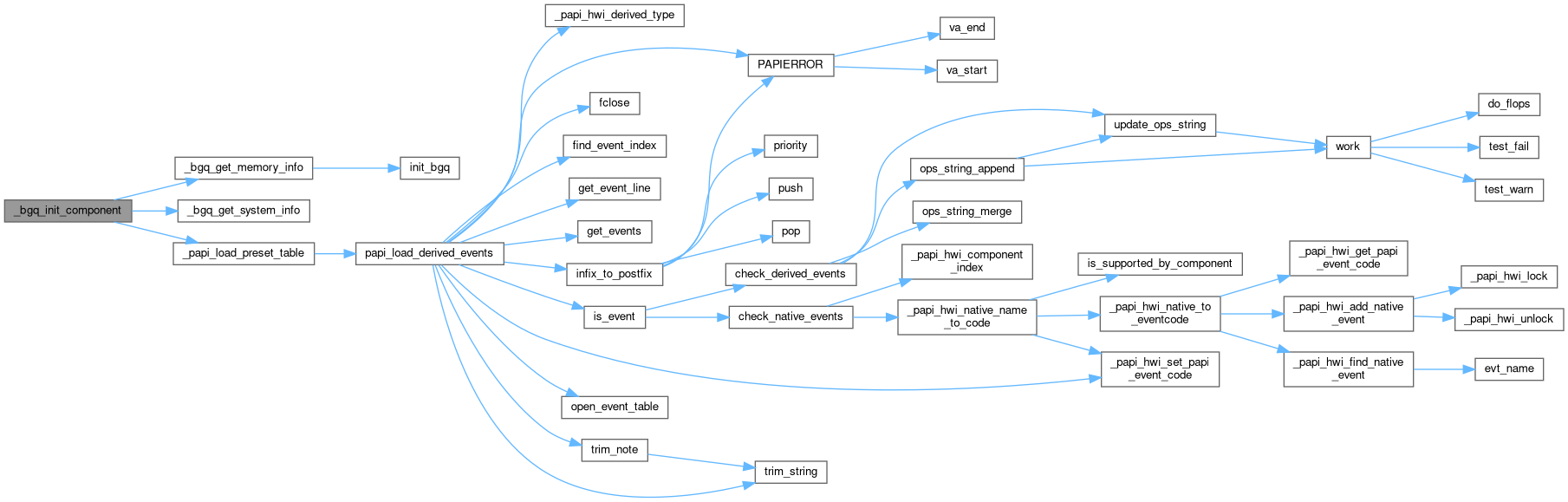
◆ _bgq_init_component()

int _bgq_init_component ( int  cidx)

Definition at line 990 of file linux-bgq.c.
991{
992#ifdef DEBUG_BGQ
993 printf("_bgq_init_substrate\n");
994 //printf("_bgq_init_substrate: 1. BGPM_INITIALIZED = %d \n", BGPM_INITIALIZED);
995#endif
996 int retval;
997 int i;
998
999 /* allocate the opcode event structure */
1000 GenericEvent = calloc( OPCODE_EVENT_CHUNK, sizeof( struct bgq_generic_events_t ) );
1001 if ( NULL == GenericEvent ) {
1002 return PAPI_ENOMEM;
1003 }
1004
1005 /* init opcode event stuff */
1008
1010
1011 /*
1012 * Fill in what we can of the papi_system_info
1013 */
1014 SUBDBG( "Before _bgq_get_system_info()...\n" );
1016 SUBDBG( "After _bgq_get_system_info(), retval=%d...\n", retval );
1017 if ( retval != PAPI_OK )
1018 return ( retval );
1019
1020 /*
1021 * Setup memory info
1022 */
1023
1024 SUBDBG( "Before _bgq_get_memory_info...\n" );
1027 model );
1028 SUBDBG( "After _bgq_get_memory_info, retval=%d...\n", retval );
1029 if ( retval )
1030 return ( retval );
1031#if 1
1032 /* Setup Locks */
1033 for ( i = 0; i < PAPI_MAX_LOCK; i++ )
1034 thdLocks[i] = 0; // MUTEX_OPEN
1035#else
1036 for( i = 0; i < PAPI_MAX_LOCK; i++ ) {
1037 pthread_mutex_init( &thdLocks[i], NULL );
1038 }
1039#endif
1040
1041 /* Setup presets */
1042 retval = _papi_load_preset_table( "BGQ", 0, cidx );
1043 if ( retval ) {
1044 return retval;
1045 }
1046
1047
1048 return ( PAPI_OK );
1049}
#define PAPI_ENOMEM
Definition: f90papi.h:16
papi_vector_t _bgq_vectors
Definition: linux-bgq.c:60
static int allocated_opcode_events
Definition: linux-bgq.c:64
int _bgq_get_system_info(papi_mdi_t *mdi)
Definition: linux-bgq.c:138
static struct bgq_generic_events_t * GenericEvent
Definition: linux-bgq.c:75
UPC_Lock_t thdLocks[PAPI_MAX_LOCK]
Definition: linux-bgq.c:52
int _bgq_get_memory_info(PAPI_hw_info_t *pHwInfo, int pCPU_Type)
#define OPCODE_EVENT_CHUNK
Definition: linux-bgq.c:63
static int num_opcode_events
Definition: linux-bgq.c:65
#define PAPI_MAX_LOCK
Definition: papi_lock.h:18
int _papi_load_preset_table(char *pmu_str, int pmu_type, int cidx)
Definition: papi_preset.c:771
static int cidx
int model
Definition: pfmlib_amd64.c:86
PAPI_component_info_t cmp_info
Definition: papi_vector.h:20
Here is the call graph for this function:

◆ _bgq_init_control_state()

int _bgq_init_control_state ( hwd_control_state_t ptr)

Definition at line 179 of file linux-bgq.c.

180{
181#ifdef DEBUG_BGQ
182 printf( "_bgq_init_control_state\n" );
183#endif
184 int retval;
185
186 ptr->EventGroup = Bgpm_CreateEventSet();
187 retval = _check_BGPM_error( ptr->EventGroup, "Bgpm_CreateEventSet" );
188 if ( retval < 0 ) return retval;
189
190 // initialize multiplexing flag to OFF (0)
191 ptr->muxOn = 0;
192 // initialize overflow flag to OFF (0)
193 ptr->overflow = 0;
194 ptr->overflow_count = 0;
195 // initialized BGPM eventGroup flag to NOT applied yet (0)
196 ptr->bgpm_eventset_applied = 0;
197
198 return PAPI_OK;
199}
Here is the call graph for this function:

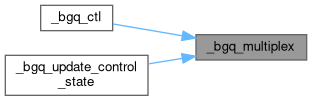
◆ _bgq_multiplex()

int _bgq_multiplex ( hwd_control_state_t bgq_state)

Definition at line 262 of file linux-bgq.c.

263{
264 int retval;
265 uint64_t bgpm_period;
266 double Sec, Hz;
267
268#ifdef DEBUG_BGQ
269 printf("_bgq_multiplex BEGIN: Num of Events = %d (vs %d)\n", Bgpm_NumEvents( bgq_state->EventGroup ), bgq_state->count );
270#endif
271
272 // convert Mhz to Hz ( = cycles / sec )
273 Hz = (double) _papi_hwi_system_info.hw_info.cpu_max_mhz * 1000 * 1000;
274 // convert PAPI multiplex period (in ns) to BGPM period (in cycles)
275 Sec = (double) _papi_os_info.itimer_ns / ( 1000 * 1000 * 1000 );
276 bgpm_period = Hz * Sec;
277
278 // if EventGroup is not empty -- which is required by BGPM before
279 // we can call SetMultiplex() -- then drain the events from the
280 // BGPM EventGroup, turn on multiplex flag, and rebuild BGPM EventGroup.
281 if ( 0 < bgq_state->count ) {
282 // Delete and re-create BGPM eventset
283 retval = _common_deleteRecreate( &bgq_state->EventGroup );
284 if ( retval < 0 ) return retval;
285
286 // turn on multiplex for BGPM
287 retval = Bgpm_SetMultiplex( bgq_state->EventGroup, bgpm_period, BGPM_NORMAL );
288 retval = _check_BGPM_error( retval, "Bgpm_SetMultiplex" );
289 if ( retval < 0 ) return retval;
290
291 // rebuild BGPM EventGroup
292 retval = _common_rebuildEventgroup( bgq_state->count,
293 bgq_state->EventGroup_local,
294 &bgq_state->EventGroup );
295 if ( retval < 0 ) return retval;
296 }
297 else {
298 // need to pass either BGPM_NORMAL or BGPM_NOTNORMAL
299 // BGPM_NORMAL: numbers reported by Bgpm_ReadEvent() are normalized
300 // to the maximum time spent in a multiplexed group
301 retval = Bgpm_SetMultiplex( bgq_state->EventGroup, bgpm_period, BGPM_NORMAL );
302 retval = _check_BGPM_error( retval, "Bgpm_SetMultiplex" );
303 if ( retval < 0 ) return retval;
304 }
305
306#ifdef DEBUG_BGQ
307 printf("_bgq_multiplex END: Num of Events = %d (vs %d) --- retval = %d\n",
308 Bgpm_NumEvents( bgq_state->EventGroup ), bgq_state->count, retval );
309#endif
310
311 return ( retval );
312}
int _common_deleteRecreate(int *EventGroup_ptr)
int _common_rebuildEventgroup(int count, int *EventGroup_local, int *EventGroup_ptr)
PAPI_os_info_t _papi_os_info
Definition: linux-bgq.c:61
Here is the call graph for this function:
Here is the caller graph for this function:

◆ _bgq_ntv_code_to_bits()

int _bgq_ntv_code_to_bits ( unsigned int  EventCode,
hwd_register_t bits 
)

Definition at line 1218 of file linux-bgq.c.

1219{
1220#ifdef DEBUG_BGQ
1221 printf( "_bgq_ntv_code_to_bits\n" );
1222#endif
1223
1224 ( void ) EventCode;
1225 ( void ) bits;
1226
1227 return ( PAPI_OK );
1228}

◆ _bgq_ntv_code_to_descr()

int _bgq_ntv_code_to_descr ( unsigned int  EventCode,
char *  name,
int  len 
)

Definition at line 1192 of file linux-bgq.c.

1193{
1194#ifdef DEBUG_BGQ
1195 printf( "_bgq_ntv_code_to_descr\n" );
1196#endif
1197 int retval;
1198 int index = ( EventCode & PAPI_NATIVE_AND_MASK ) + 1;
1199
1200 retval = Bgpm_GetLongDesc( index, name, &len );
1201 retval = _check_BGPM_error( retval, "Bgpm_GetLongDesc" );
1202 if ( retval < 0 ) return retval;
1203
1204 return ( PAPI_OK );
1205}
const char * name
Definition: rocs.c:225
Here is the call graph for this function:

◆ _bgq_ntv_code_to_name()

int _bgq_ntv_code_to_name ( unsigned int  EventCode,
char *  name,
int  len 
)

Definition at line 1161 of file linux-bgq.c.

1162{
1163#ifdef DEBUG_BGQ
1164 printf( "_bgq_ntv_code_to_name\n" );
1165#endif
1166 int index = ( EventCode & PAPI_NATIVE_AND_MASK ) + 1;
1167
1168 if ( index >= MAX_COUNTERS )
1169 return PAPI_ENOEVNT;
1170
1171 strncpy( name, Bgpm_GetEventIdLabel( index ), len );
1172
1173 if ( name == NULL ) {
1174#ifdef DEBUG_BGPM
1175 printf ("Error: ret value is NULL for BGPM API function Bgpm_GetEventIdLabel.\n" );
1176#endif
1177 return PAPI_ENOEVNT;
1178 }
1179#ifdef DEBUG_BGQ
1180 printf( "name = ===%s===\n", name );
1181#endif
1182
1183 return ( PAPI_OK );
1184}
#define PAPI_ENOEVNT
Definition: f90papi.h:139
#define MAX_COUNTERS
Definition: perfctr-x86.h:8

◆ _bgq_ntv_enum_events()

int _bgq_ntv_enum_events ( unsigned int EventCode,
int  modifier 
)

Definition at line 1235 of file linux-bgq.c.

1236{
1237#ifdef DEBUG_BGQ
1238 printf( "_bgq_ntv_enum_events\n" );
1239#endif
1240
1241 switch ( modifier ) {
1242 case PAPI_ENUM_FIRST:
1243 *EventCode = PAPI_NATIVE_MASK;
1244
1245 return ( PAPI_OK );
1246 break;
1247
1248 case PAPI_ENUM_EVENTS:
1249 {
1250 int index = ( *EventCode & PAPI_NATIVE_AND_MASK ) + 1;
1251
1252 if ( index < BGQ_PUNIT_MAX_EVENTS ) {
1253 *EventCode = *EventCode + 1;
1254 return ( PAPI_OK );
1255 } else
1256 return ( PAPI_ENOEVNT );
1257
1258 break;
1259 }
1260 default:
1261 return ( PAPI_EINVAL );
1262 }
1263
1264 return ( PAPI_EINVAL );
1265}
#define PAPI_ENUM_EVENTS
Definition: f90papi.h:224
#define PAPI_ENUM_FIRST
Definition: f90papi.h:85
#define BGQ_PUNIT_MAX_EVENTS
Definition: linux-bgq.h:46
#define PAPI_NATIVE_MASK

◆ _bgq_ntv_name_to_code()

int _bgq_ntv_name_to_code ( const char *  name,
unsigned int event_code 
)

Definition at line 1060 of file linux-bgq.c.

1061{
1062#ifdef DEBUG_BGQ
1063 printf( "_bgq_ntv_name_to_code\n" );
1064#endif
1065 int ret;
1066#ifdef DEBUG_BGQ
1067 printf( "name = ===%s===\n", name );
1068#endif
1069
1070 /* Treat events differently if BGPM Opcodes are used */
1071 /* Opcode group selection values are "OR"ed together to create a desired
1072 mask of instruction group events to accumulate in the same counter */
1073 if ( 0 == strncmp( name, "PEVT_INST_XU_GRP_MASK", strlen( "PEVT_INST_XU_GRP_MASK" ) ) ||
1074 0 == strncmp( name, "PEVT_INST_QFPU_GRP_MASK", strlen( "PEVT_INST_QFPU_GRP_MASK" ) ) ) {
1075
1076 char *pcolon;
1077 pcolon = strchr( name, ':' );
1078
1079 // Found colon separator
1080 if ( pcolon != NULL ) {
1081 int mask_len = pcolon - name;
1082 strncpy( GenericEvent[num_opcode_events].mask, name, mask_len );
1083 strncpy( GenericEvent[num_opcode_events].opcode, pcolon+1, strlen(name) - 1 - mask_len );
1084 /* opcode_mask needs to be 'uint64_t',
1085 hence we use strtoull() which returns an 'unsigned long long int' */
1086 GenericEvent[num_opcode_events].opcode_mask = strtoull( GenericEvent[num_opcode_events].opcode, (char **)NULL, 16 );
1088 /* Return event id matching the generic XU/QFPU event string */
1089 GenericEvent[num_opcode_events].eventId = Bgpm_GetEventIdFromLabel( GenericEvent[num_opcode_events].mask );
1090 if ( GenericEvent[num_opcode_events].eventId <= 0 ) {
1091#ifdef DEBUG_BGPM
1092 printf ("Error: ret value is %d for BGPM API function '%s'.\n",
1093 ret, "Bgpm_GetEventIdFromLabel" );
1094#endif
1095 return PAPI_ENOEVNT;
1096 }
1097
1098 *event_code = GenericEvent[num_opcode_events].idx;
1099
1101
1102 /* If there are too many opcode events than allocated, then allocate more room */
1104
1105 SUBDBG("Allocating more room for BGPM opcode events (%d %ld)\n",
1106 ( allocated_opcode_events + NATIVE_OPCODE_CHUNK ),
1107 ( long )sizeof( struct bgq_generic_events_t ) *
1108 ( allocated_opcode_events + NATIVE_OPCODE_CHUNK ) );
1109
1110 GenericEvent = realloc( GenericEvent, sizeof( struct bgq_generic_events_t ) *
1112 if ( NULL == GenericEvent ) {
1113 return PAPI_ENOMEM;
1114 }
1116 }
1117 }
1118 else {
1119 SUBDBG( "Error: Found a generic BGPM event mask without opcode string\n" );
1120 return PAPI_ENOEVNT;
1121 }
1122
1123
1124#ifdef DEBUG_BGQ
1125 printf(_AT_ " _bgq_ntv_name_to_code: GenericEvent no. %d: \n", num_opcode_events-1 );
1126 printf( "idx = %d\n", GenericEvent[num_opcode_events-1].idx);
1127 printf( "eventId = %d\n", GenericEvent[num_opcode_events-1].eventId);
1128 printf( "mask = %s\n", GenericEvent[num_opcode_events-1].mask);
1129 printf( "opcode = %s\n", GenericEvent[num_opcode_events-1].opcode);
1130 printf( "opcode_mask = %#lX (%lu)\n", GenericEvent[num_opcode_events-1].opcode_mask,
1131 GenericEvent[num_opcode_events-1].opcode_mask );
1132#endif
1133 }
1134 else {
1135 /* Return event id matching a given event label string */
1136 ret = Bgpm_GetEventIdFromLabel ( name );
1137
1138 if ( ret <= 0 ) {
1139#ifdef DEBUG_BGPM
1140 printf ("Error: ret value is %d for BGPM API function '%s'.\n",
1141 ret, "Bgpm_GetEventIdFromLabel" );
1142#endif
1143 return PAPI_ENOEVNT;
1144 }
1145 else if ( ret > BGQ_PUNIT_MAX_EVENTS ) // not a PUnit event
1146 return PAPI_ENOEVNT;
1147 else
1148 *event_code = ( ret - 1 );
1149 }
1150
1151 return PAPI_OK;
1152}
#define _AT_
#define OPCODE_BUF
Definition: linux-bgq.h:49
uint64_t opcode_mask
Definition: linux-bgq.c:72

◆ _bgq_read()

int _bgq_read ( hwd_context_t ctx,
hwd_control_state_t ptr,
long_long **  dp,
int  flags 
)

Definition at line 556 of file linux-bgq.c.

558{
559#ifdef DEBUG_BGQ
560 printf( "_bgq_read\n" );
561#endif
562 ( void ) ctx;
563 ( void ) flags;
564 int i, numEvts;
565
566 numEvts = Bgpm_NumEvents( ptr->EventGroup );
567 if ( numEvts == 0 ) {
568#ifdef DEBUG_BGPM
569 printf ("Error: ret value is %d for BGPM API function Bgpm_NumEvents.\n", numEvts );
570 //return ( EXIT_FAILURE );
571#endif
572 }
573
574 for ( i = 0; i < numEvts; i++ )
575 ptr->counters[i] = _common_getEventValue( i, ptr->EventGroup );
576
577 *dp = ptr->counters;
578
579 return ( PAPI_OK );
580}
long_long _common_getEventValue(unsigned event_id, int EventGroup)
char ** counters
Definition: freebsd.h:59
Here is the call graph for this function:

◆ _bgq_reset()

int _bgq_reset ( hwd_context_t ctx,
hwd_control_state_t ptr 
)

Definition at line 588 of file linux-bgq.c.

589{
590#ifdef DEBUG_BGQ
591 printf( "_bgq_reset\n" );
592#endif
593 ( void ) ctx;
594 int retval;
595
596 /* we can't simply call Bgpm_Reset() since PAPI doesn't have the
597 restriction that an EventSet has to be stopped before resetting is
598 possible. However, BGPM does have this restriction.
599 Hence we need to stop, reset and start */
600 retval = Bgpm_Stop( ptr->EventGroup );
601 retval = _check_BGPM_error( retval, "Bgpm_Stop" );
602 if ( retval < 0 ) return retval;
603
604 retval = Bgpm_ResetStart( ptr->EventGroup );
605 retval = _check_BGPM_error( retval, "Bgpm_ResetStart" );
606 if ( retval < 0 ) return retval;
607
608 return ( PAPI_OK );
609}
Here is the call graph for this function:

◆ _bgq_set_domain()

int _bgq_set_domain ( hwd_control_state_t cntrl,
int  domain 
)

Definition at line 206 of file linux-bgq.c.

207{
208#ifdef DEBUG_BGQ
209 printf( "_bgq_set_domain\n" );
210#endif
211 int found = 0;
212 ( void ) cntrl;
213
214 if ( PAPI_DOM_USER & domain )
215 found = 1;
216
217 if ( PAPI_DOM_KERNEL & domain )
218 found = 1;
219
220 if ( PAPI_DOM_OTHER & domain )
221 found = 1;
222
223 if ( !found )
224 return ( PAPI_EINVAL );
225
226 return ( PAPI_OK );
227}
#define PAPI_DOM_USER
Definition: f90papi.h:174
#define PAPI_DOM_OTHER
Definition: f90papi.h:21
#define PAPI_DOM_KERNEL
Definition: f90papi.h:254

◆ _bgq_set_overflow()

int _bgq_set_overflow ( EventSetInfo_t ESI,
int  EventIndex,
int  threshold 
)

Definition at line 776 of file linux-bgq.c.

777{
778#ifdef DEBUG_BGQ
779 printf("BEGIN _bgq_set_overflow\n");
780#endif
781 hwd_control_state_t * this_state = ( hwd_control_state_t * ) ESI->ctl_state;
782 int retval;
783 int evt_idx;
784
785 /*
786 * In case an BGPM eventGroup HAS BEEN applied or attached before
787 * overflow is set, delete the eventGroup and create an new empty one,
788 * and rebuild as it was prior to deletion
789 */
790#ifdef DEBUG_BGQ
791 printf( "_bgq_set_overflow: bgpm_eventset_applied = %d, threshold = %d\n",
792 this_state->bgpm_eventset_applied, threshold );
793#endif
794 if ( 1 == this_state->bgpm_eventset_applied && 0 != threshold ) {
795 retval = _common_deleteRecreate( &this_state->EventGroup );
796 if ( retval < 0 ) return retval;
797
798 retval = _common_rebuildEventgroup( this_state->count,
799 this_state->EventGroup_local,
800 &this_state->EventGroup );
801 if ( retval < 0 ) return retval;
802
803 /* set BGPM eventGroup flag back to NOT applied yet (0)
804 * because the eventGroup has been recreated from scratch */
805 this_state->bgpm_eventset_applied = 0;
806 }
807
808
809 evt_idx = ESI->EventInfoArray[EventIndex].pos[0];
810 //evt_id = ( ESI->NativeInfoArray[EventIndex].ni_event & PAPI_NATIVE_AND_MASK ) + 1;
811 SUBDBG( "Hardware counter %d (vs %d) used in overflow, threshold %d\n",
812 evt_idx, EventIndex, threshold );
813#ifdef DEBUG_BGQ
814 printf( "Hardware counter %d (vs %d) used in overflow, threshold %d\n",
815 evt_idx, EventIndex, threshold );
816#endif
817
818 /* If this counter isn't set to overflow, it's an error */
819 if ( threshold == 0 ) {
820 /* Remove the signal handler */
822 if ( retval != PAPI_OK )
823 return ( retval );
824 }
825 else {
826 this_state->overflow = 1;
827 this_state->overflow_count++;
828 this_state->overflow_list[this_state->overflow_count-1].threshold = threshold;
829 this_state->overflow_list[this_state->overflow_count-1].EventIndex = evt_idx;
830
831#ifdef DEBUG_BGQ
832 printf( "_bgq_set_overflow: Enable the signal handler\n" );
833#endif
834 /* Enable the signal handler */
838 if ( retval != PAPI_OK )
839 return ( retval );
840
841 retval = _common_set_overflow_BGPM( this_state->EventGroup,
842 this_state->overflow_list[this_state->overflow_count-1].EventIndex,
843 this_state->overflow_list[this_state->overflow_count-1].threshold,
845 if ( retval < 0 ) return retval;
846 }
847
848 return ( PAPI_OK );
849}
int _papi_hwi_start_signal(int signal, int need_context, int cidx)
Definition: extras.c:403
int _papi_hwi_stop_signal(int signal)
Definition: extras.c:443
static int threshold
int _common_set_overflow_BGPM(int EventGroup, int evt_idx, int threshold, void(*handler)(int, uint64_t, uint64_t, const ucontext_t *))
void user_signal_handler(int hEvtSet, uint64_t address, uint64_t ovfVector, const ucontext_t *pContext)
Definition: linux-bgq.c:684
#define NEED_CONTEXT
Definition: papi_internal.h:97
int pos[PAPI_EVENTS_IN_DERIVED_EVENT]
EventInfo_t * EventInfoArray
Here is the call graph for this function:

◆ _bgq_set_profile()

int _bgq_set_profile ( EventSetInfo_t ESI,
int  EventIndex,
int  threshold 
)

Definition at line 858 of file linux-bgq.c.

859{
860#ifdef DEBUG_BGQ
861 printf("BEGIN _bgq_set_profile\n");
862#endif
863
864 ( void ) ESI;
865 ( void ) EventIndex;
866 ( void ) threshold;
867
868 return PAPI_ECMP;
869}
#define PAPI_ECMP
Definition: f90papi.h:214

◆ _bgq_shutdown()

int _bgq_shutdown ( hwd_context_t ctx)

Definition at line 620 of file linux-bgq.c.

621{
622#ifdef DEBUG_BGQ
623 printf( "_bgq_shutdown\n" );
624#endif
625 ( void ) ctx;
626 int retval;
627
628 /* Disable BGPM library */
629 retval = Bgpm_Disable();
630 retval = _check_BGPM_error( retval, "Bgpm_Disable" );
631 if ( retval < 0 ) return retval;
632
633 return ( PAPI_OK );
634}
Here is the call graph for this function:

◆ _bgq_start()

int _bgq_start ( hwd_context_t ctx,
hwd_control_state_t ptr 
)

Definition at line 499 of file linux-bgq.c.

500{
501#ifdef DEBUG_BGQ
502 printf( "BEGIN _bgq_start\n" );
503#endif
504 ( void ) ctx;
505 int retval;
506
507 retval = Bgpm_Apply( ptr->EventGroup );
508 retval = _check_BGPM_error( retval, "Bgpm_Apply" );
509 if ( retval < 0 ) return retval;
510
511 // set flag to 1: BGPM eventGroup HAS BEEN applied
512 ptr->bgpm_eventset_applied = 1;
513
514#ifdef DEBUG_BGQ
515 int i;
516 int numEvts = Bgpm_NumEvents( ptr->EventGroup );
517 for ( i = 0; i < numEvts; i++ ) {
518 printf("%d = %s\n", i, Bgpm_GetEventLabel( ptr->EventGroup, i) );
519 }
520#endif
521
522 /* Bgpm_Apply() does an implicit reset;
523 hence no need to use Bgpm_ResetStart */
524 retval = Bgpm_Start( ptr->EventGroup );
525 retval = _check_BGPM_error( retval, "Bgpm_Start" );
526 if ( retval < 0 ) return retval;
527
528 return ( PAPI_OK );
529}
Here is the call graph for this function:

◆ _bgq_stop()

int _bgq_stop ( hwd_context_t ctx,
hwd_control_state_t ptr 
)

Definition at line 535 of file linux-bgq.c.

536{
537#ifdef DEBUG_BGQ
538 printf( "BEGIN _bgq_stop\n" );
539#endif
540 ( void ) ctx;
541 int retval;
542
543 retval = Bgpm_Stop( ptr->EventGroup );
544 retval = _check_BGPM_error( retval, "Bgpm_Stop" );
545 if ( retval < 0 ) return retval;
546
547 return ( PAPI_OK );
548}
Here is the call graph for this function:

◆ _bgq_stop_profiling()

int _bgq_stop_profiling ( ThreadInfo_t master,
EventSetInfo_t ESI 
)

Definition at line 877 of file linux-bgq.c.

878{
879#ifdef DEBUG_BGQ
880 printf("BEGIN _bgq_stop_profiling\n");
881#endif
882
883 ( void ) master;
884 ( void ) ESI;
885
886 return ( PAPI_OK );
887}

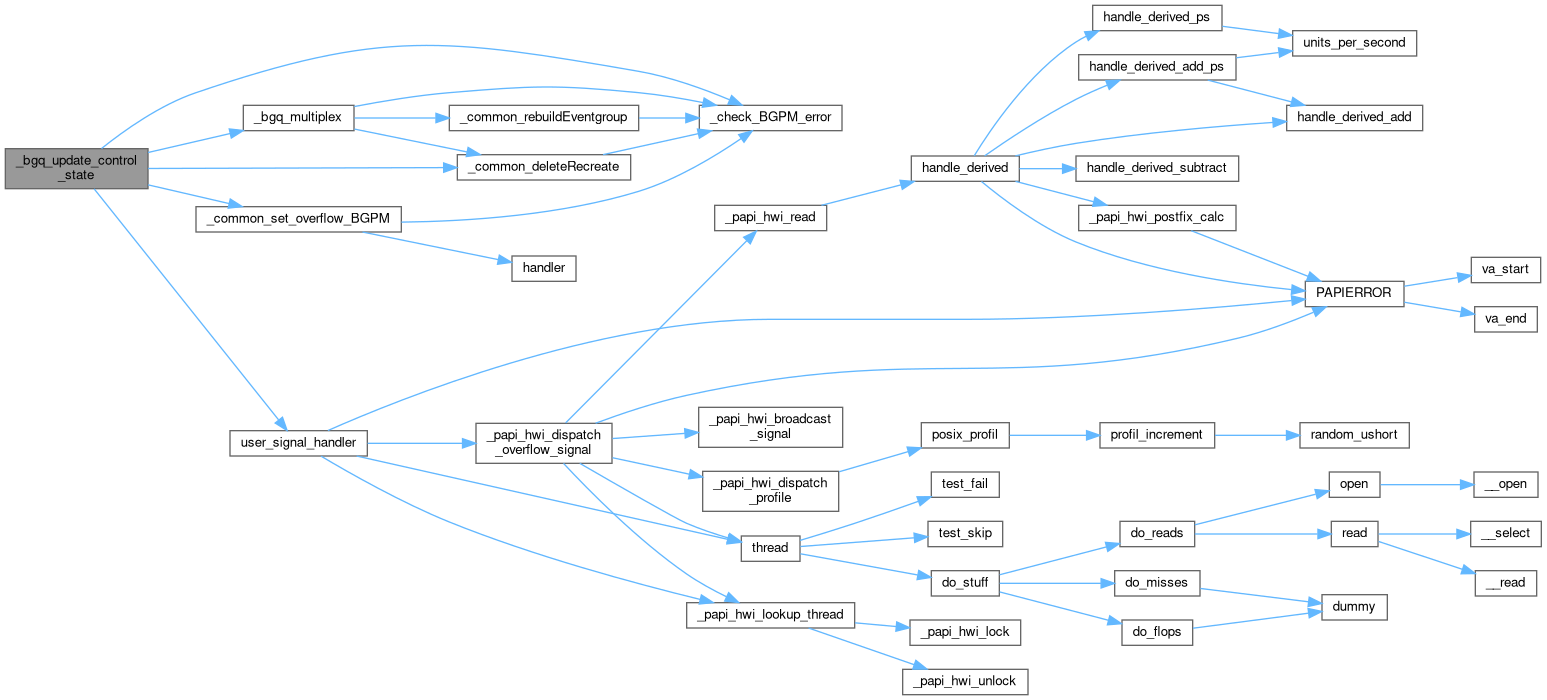
◆ _bgq_update_control_state()

int _bgq_update_control_state ( hwd_control_state_t ptr,
NativeInfo_t native,
int  count,
hwd_context_t ctx 
)

Definition at line 377 of file linux-bgq.c.
380{
381#ifdef DEBUG_BGQ
382 printf( _AT_ " _bgq_update_control_state: count = %d, EventGroup=%d\n", count, ptr->EventGroup );
383#endif
384 ( void ) ctx;
385 int i, j, k, index, retval;
386 unsigned evtIdx;
387
388 // Delete and re-create BGPM eventset
389 retval = _common_deleteRecreate( &ptr->EventGroup );
390 if ( retval < 0 ) return retval;
391
392#ifdef DEBUG_BGQ
393 printf( _AT_ " _bgq_update_control_state: EventGroup=%d, muxOn = %d, overflow = %d\n",
394 ptr->EventGroup, ptr->muxOn, ptr->overflow );
395#endif
396
397 // add the events to the eventset
398 for ( i = 0; i < count; i++ ) {
399 index = ( native[i].ni_event & PAPI_NATIVE_AND_MASK ) + 1;
400
401 ptr->EventGroup_local[i] = index;
402
403 // we found an opcode event
404 if ( index > BGQ_PUNIT_MAX_EVENTS ) {
405 for( j = 0; j < num_opcode_events; j++ ) {
406#ifdef DEBUG_BGQ
407 printf(_AT_ " _bgq_update_control_state: %d out of %d OPCODES\n",
409#endif
410#ifdef DEBUG_BGQ
411 printf(_AT_ " _bgq_update_control_state: j's idx = %d, index = %d\n",
412 GenericEvent[j].idx, index );
413#endif
414 if ( GenericEvent[j].idx == ( index - 1) ) {
415 /* Add events to the BGPM eventGroup */
416 retval = Bgpm_AddEvent( ptr->EventGroup, GenericEvent[j].eventId );
417 retval = _check_BGPM_error( retval, "Bgpm_AddEvent" );
418 if ( retval < 0 ) return retval;
419#ifdef DEBUG_BGQ
420 printf(_AT_ " _bgq_update_control_state: ADD event: i = %d, eventId = %d\n", i, GenericEvent[j].eventId );
421#endif
422
423 evtIdx = Bgpm_GetEventIndex( ptr->EventGroup,
425 i );
426#ifdef DEBUG_BGQ
427 printf(_AT_ " _bgq_update_control_state: evtIdx in EventGroup = %d\n",
428 evtIdx );
429#endif
430 if ( 0 == strcmp( GenericEvent[j].mask, "PEVT_INST_XU_GRP_MASK" ) ) {
431 retval = Bgpm_SetXuGrpMask( ptr->EventGroup,
432 evtIdx,
434 retval = _check_BGPM_error( retval, "Bgpm_SetXuGrpMask" );
435 if ( retval < 0 ) return retval;
436#ifdef DEBUG_BGQ
437 printf(_AT_ " _bgq_update_control_state: it's PEVT_INST_XU_GRP_MASK\n" );
438#endif
439 } else if ( 0 == strcmp( GenericEvent[j].mask, "PEVT_INST_QFPU_GRP_MASK" ) ) {
440 retval = Bgpm_SetQfpuGrpMask( ptr->EventGroup,
441 evtIdx,
443 retval = _check_BGPM_error( retval, "Bgpm_SetQfpuGrpMask" );
444 if ( retval < 0 ) return retval;
445#ifdef DEBUG_BGQ
446 printf(_AT_ " _bgq_update_control_state: it's PEVT_INST_QFPU_GRP_MASK\n" );
447#endif
448 }
449 }
450 }
451 }
452 else {
453#ifdef DEBUG_BGQ
454 printf(_AT_ " _bgq_update_control_state: no OPCODE\n" );
455#endif
456
457 /* Add events to the BGPM eventGroup */
458 retval = Bgpm_AddEvent( ptr->EventGroup, index );
459 retval = _check_BGPM_error( retval, "Bgpm_AddEvent" );
460 if ( retval < 0 ) return retval;
461#ifdef DEBUG_BGQ
462 printf(_AT_ " _bgq_update_control_state: ADD event: i = %d, index = %d\n", i, index );
463#endif
464
465 }
466 }
467
468 // store how many events we added to an EventSet
469 ptr->count = count;
470
471 // if muxOn and EventGroup is not empty -- which is required by BGPM before
472 // we can call SetMultiplex() -- then drain the events from the
473 // BGPM EventGroup, turn on multiplex flag, and rebuild BGPM EventGroup.
474 if ( 1 == ptr->muxOn ) {
475 retval = _bgq_multiplex( ptr );
476 }
477
478 // since update_control_state trashes overflow settings, this puts things
479 // back into balance for BGPM
480 if ( 1 == ptr->overflow ) {
481 for ( k = 0; k < ptr->overflow_count; k++ ) {
482 retval = _common_set_overflow_BGPM( ptr->EventGroup,
483 ptr->overflow_list[k].EventIndex,
484 ptr->overflow_list[k].threshold,
486 if ( retval < 0 ) return retval;
487 }
488 }
489
490 return ( PAPI_OK );
491}
static long count
static int native
Here is the call graph for this function:

◆ _bgq_write()

int _bgq_write ( hwd_context_t ctx,
hwd_control_state_t cntrl,
long_long from 
)

Definition at line 643 of file linux-bgq.c.

644{
645#ifdef DEBUG_BGQ
646 printf( "_bgq_write\n" );
647#endif
648 ( void ) ctx;
649 ( void ) cntrl;
650 ( void ) from;
651
652 return PAPI_ECMP;
653}

◆ _papi_hwd_lock()

void _papi_hwd_lock ( int  lock)

Definition at line 93 of file linux-bgq.c.

94{
95#ifdef DEBUG_BGQ
96 printf( _AT_ " _papi_hwd_lock %d\n", lock);
97#endif
98 assert( lock < PAPI_MAX_LOCK );
99#if 1
100 UPC_Lock( &thdLocks[lock] );
101#else
102 pthread_mutex_lock( &thdLocks[lock] );
103#endif
104
105#ifdef DEBUG_BGQ
106 printf( _AT_ " _papi_hwd_lock got lock %d\n", lock );
107#endif
108
109 return;
110}
atomic_p lock[]
Definition: aix.c:25

◆ _papi_hwd_unlock()

void _papi_hwd_unlock ( int  lock)

Definition at line 116 of file linux-bgq.c.

117{
118#ifdef DEBUG_BGQ
119 printf( _AT_ " _papi_hwd_unlock %d\n", lock );
120#endif
121 assert( lock < PAPI_MAX_LOCK );
122#if 1
123 UPC_Unlock( &thdLocks[lock] );
124#else
125 pthread_mutex_unlock( &thdLocks[lock] );
126#endif
127
128 return;
129}

◆ _papi_hwi_init_os()

int _papi_hwi_init_os ( void  )

Definition at line 1269 of file linux-bgq.c.

1269 {
1270
1271 struct utsname uname_buffer;
1272
1273 /* Get the kernel info */
1274 uname(&uname_buffer);
1275
1276 strncpy(_papi_os_info.name,uname_buffer.sysname,PAPI_MAX_STR_LEN);
1277
1278 strncpy(_papi_os_info.version,uname_buffer.release,PAPI_MAX_STR_LEN);
1279
1283
1284 return PAPI_OK;
1285}
#define PAPI_MAX_STR_LEN
Definition: f90papi.h:77
#define PAPI_INT_MPX_SIGNAL
Definition: papi_internal.h:51
#define PAPI_INT_ITIMER
Definition: papi_internal.h:53
char version[PAPI_MAX_STR_LEN]
char name[PAPI_MAX_STR_LEN]

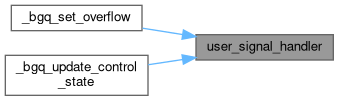
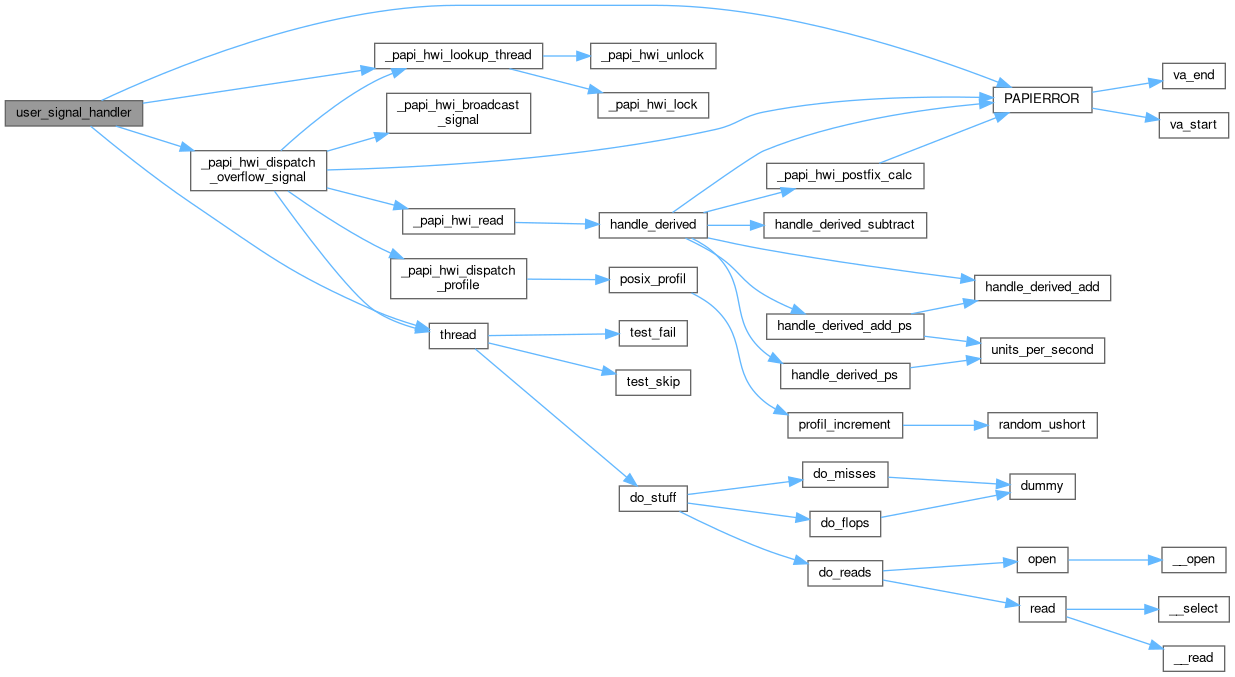
◆ user_signal_handler()

void user_signal_handler ( int  hEvtSet,
uint64_t  address,
uint64_t  ovfVector,
const ucontext_t pContext 
)

Definition at line 684 of file linux-bgq.c.
685{
686#ifdef DEBUG_BGQ
687 printf( "user_signal_handler start\n" );
688#endif
689 ( void ) address;
690 int retval;
691 unsigned i;
692 int isHardware = 1;
694 long_long overflow_bit = 0;
695 vptr_t address1;
697 ctx.ucontext = ( hwd_ucontext_t * ) pContext;
699
700 //printf(_AT_ " thread = %p\n", thread); // <<<<<<<<<<<<<<<<<<
701
702 EventSetInfo_t *ESI;
703 ESI = thread->running_eventset[cidx];
704 // Get the indices of all events which have overflowed.
705 unsigned ovfIdxs[BGPM_MAX_OVERFLOW_EVENTS];
706 unsigned len = BGPM_MAX_OVERFLOW_EVENTS;
707
708 retval = Bgpm_GetOverflowEventIndices( hEvtSet, ovfVector, ovfIdxs, &len );
709
710 if ( retval < 0 ) {
711#ifdef DEBUG_BGPM
712 printf ( "Error: ret value is %d for BGPM API function Bgpm_GetOverflowEventIndices.\n",
713 retval );
714#endif
715 return;
716 }
717
718 if ( thread == NULL ) {
719 PAPIERROR( "thread == NULL in user_signal_handler!" );
720 return;
721 }
722
723 if ( ESI == NULL ) {
724 PAPIERROR( "ESI == NULL in user_signal_handler!");
725 return;
726 }
727
728 if ( ESI->overflow.flags == 0 ) {
729 PAPIERROR( "ESI->overflow.flags == 0 in user_signal_handler!");
730 return;
731 }
732
733 for ( i = 0; i < len; i++ ) {
734 uint64_t hProf;
735 Bgpm_GetEventUser1( hEvtSet, ovfIdxs[i], &hProf );
736 if ( hProf ) {
737 overflow_bit ^= 1 << ovfIdxs[i];
738 break;
739 }
740
741 }
742
744#ifdef DEBUG_BGQ
745 printf("OVERFLOW_SOFTWARE\n");
746#endif
747 address1 = GET_OVERFLOW_ADDRESS( ctx );
748 _papi_hwi_dispatch_overflow_signal( ( void * ) &ctx, address1, NULL, 0, 0, &thread, cidx );
749 return;
750 }
751 else if ( ESI->overflow.flags & PAPI_OVERFLOW_HARDWARE ) {
752#ifdef DEBUG_BGQ
753 printf("OVERFLOW_HARDWARE\n");
754#endif
755 address1 = GET_OVERFLOW_ADDRESS( ctx );
756 _papi_hwi_dispatch_overflow_signal( ( void * ) &ctx, address1, &isHardware, overflow_bit, 0, &thread, cidx );
757 }
758 else {
759#ifdef DEBUG_BGQ
760 printf("OVERFLOW_NONE\n");
761#endif
762 PAPIERROR( "ESI->overflow.flags is set to something other than PAPI_OVERFLOW_HARDWARE or PAPI_OVERFLOW_FORCE_SW (%#x)", thread->running_eventset[cidx]->overflow.flags);
763 }
764}
#define GET_OVERFLOW_ADDRESS(ctx)
Definition: aix-context.h:12
int _papi_hwi_dispatch_overflow_signal(void *papiContext, vptr_t address, int *isHardware, long long overflow_bit, int genOverflowBit, ThreadInfo_t **t, int cidx)
Definition: extras.c:216
#define PAPI_OVERFLOW_FORCE_SW
Definition: f90papi.h:131
#define PAPI_OVERFLOW_HARDWARE
Definition: f90papi.h:157
void * thread(void *arg)
Definition: kufrin.c:38
#define long_long
Definition: papi.h:559
void * vptr_t
Definition: papi.h:576
void PAPIERROR(char *format,...)
EventSetOverflowInfo_t overflow
hwd_ucontext_t * ucontext
inline_static ThreadInfo_t * _papi_hwi_lookup_thread(int custom_tid)
Definition: threads.h:97
Here is the call graph for this function:
Here is the caller graph for this function:

Variable Documentation

◆ _bgq_vectors

papi_vector_t _bgq_vectors

Definition at line 60 of file linux-bgq.c.

◆ _papi_os_info

PAPI_os_info_t _papi_os_info

Definition at line 61 of file linux-bgq.c.

◆ _papi_os_vector

papi_os_vector_t _papi_os_vector
Initial value:
= {
.get_memory_info = _bgq_get_memory_info,
.get_dmem_info = _bgq_get_dmem_info,
.get_real_cycles = _bgq_get_real_cycles,
.get_real_usec = _bgq_get_real_usec,
.get_virt_cycles = _bgq_get_virt_cycles,
.get_virt_usec = _bgq_get_virt_usec,
.get_system_info = _bgq_get_system_info
}
long long _bgq_get_virt_usec(void)
Definition: linux-bgq.c:958
int _bgq_get_dmem_info(PAPI_dmem_info_t *pDmemInfo)
long long _bgq_get_virt_cycles(void)
Definition: linux-bgq.c:973

Definition at line 1351 of file linux-bgq.c.

◆ allocated_opcode_events

int allocated_opcode_events = 0
static

Definition at line 64 of file linux-bgq.c.

◆ GenericEvent

struct bgq_generic_events_t* GenericEvent
static

Definition at line 75 of file linux-bgq.c.

◆ num_opcode_events

int num_opcode_events = 0
static

Definition at line 65 of file linux-bgq.c.

◆ thdLocks

UPC_Lock_t thdLocks[PAPI_MAX_LOCK]

Definition at line 52 of file linux-bgq.c.