PAPI 7.1.0.0
Loading...
Searching...
No Matches
pfmlib_pentium4.c File Reference
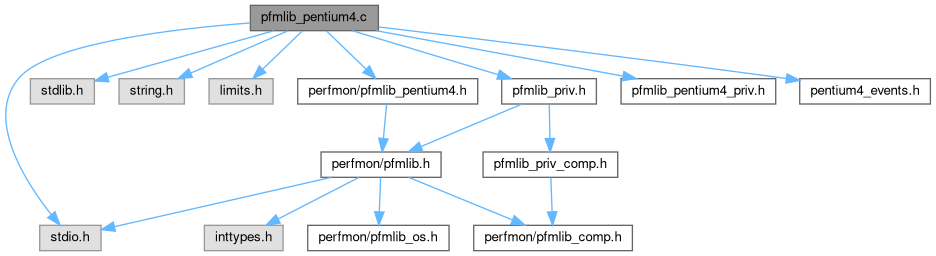
Include dependency graph for pfmlib_pentium4.c:

Go to the source code of this file.

Data Structures

struct  p4_regmap_t
 

Macros

#define _GNU_SOURCE   /* for getline */
 
#define P4_REGMAP(a, n)   { .addr = a, .name = n }
 
#define PMC_PEBS_MATRIX_VERT   63
 
#define PMC_PEBS_ENABLE   64
 
#define P4_REPLAY_REAL_MASK   0x00000003
 
#define P4_REPLAY_VIRT_MASK   0x00000FFC
 

Functions

static int pentium4_get_event_code (unsigned int event, unsigned int pmd, int *code)
 
static char * pentium4_get_event_name (unsigned int event)
 
static char * pentium4_get_event_mask_name (unsigned int event, unsigned int mask)
 
static void pentium4_get_event_counters (unsigned int event, pfmlib_regmask_t *counters)
 
static unsigned int pentium4_get_num_event_masks (unsigned int event)
 
static int pentium4_dispatch_events (pfmlib_input_param_t *input, void *model_input, pfmlib_output_param_t *output, void *model_output)
 
static int pentium4_pmu_detect (void)
 
static void pentium4_get_impl_pmcs (pfmlib_regmask_t *impl_pmcs)
 
static void pentium4_get_impl_pmds (pfmlib_regmask_t *impl_pmds)
 
static void pentium4_get_impl_counters (pfmlib_regmask_t *impl_counters)
 
static void pentium4_get_hw_counter_width (unsigned int *width)
 
static int pentium4_get_event_desc (unsigned int event, char **desc)
 
static int pentium4_get_event_mask_desc (unsigned int event, unsigned int mask, char **desc)
 
static int pentium4_get_event_mask_code (unsigned int event, unsigned int mask, unsigned int *code)
 
static int pentium4_get_cycle_event (pfmlib_event_t *e)
 
static int pentium4_get_inst_retired (pfmlib_event_t *e)
 

Variables

static p4_regmap_t p4_pmc_regmap []
 
static p4_regmap_t p4_pmd_regmap []
 
static pentium4_replay_regs_t p4_replay_regs []
 
static int p4_model
 
pfm_pmu_support_t pentium4_support
 

Macro Definition Documentation

◆ _GNU_SOURCE

#define _GNU_SOURCE   /* for getline */

Definition at line 30 of file pfmlib_pentium4.c.

◆ P4_REGMAP

#define P4_REGMAP (   a,
 
)    { .addr = a, .name = n }

Definition at line 48 of file pfmlib_pentium4.c.

◆ P4_REPLAY_REAL_MASK

#define P4_REPLAY_REAL_MASK   0x00000003

Definition at line 149 of file pfmlib_pentium4.c.

◆ P4_REPLAY_VIRT_MASK

#define P4_REPLAY_VIRT_MASK   0x00000FFC

Definition at line 150 of file pfmlib_pentium4.c.

◆ PMC_PEBS_ENABLE

#define PMC_PEBS_ENABLE   64

Definition at line 119 of file pfmlib_pentium4.c.

◆ PMC_PEBS_MATRIX_VERT

#define PMC_PEBS_MATRIX_VERT   63

Definition at line 118 of file pfmlib_pentium4.c.

Function Documentation

◆ pentium4_dispatch_events()

static int pentium4_dispatch_events ( pfmlib_input_param_t input,
void *  model_input,
pfmlib_output_param_t output,
void *  model_output 
)
static

pentium4_dispatch_events

Examine each desired event specified in "input" and find an appropriate ESCR/CCCR pair that can be used to count them.

Definition at line 317 of file pfmlib_pentium4.c.
321{
322 unsigned int assigned_pmcs[PENTIUM4_NUM_PMCS] = {0};
323 unsigned int event, event_mask, mask;
324 unsigned int bit, tag_value, tag_enable;
325 unsigned int plm;
326 unsigned int i, j, k, m, n;
327 int escr, escr_pmc;
328 int cccr, cccr_pmc, cccr_pmd;
329 int assigned;
330 pentium4_escr_value_t escr_value;
331 pentium4_cccr_value_t cccr_value;
332
333 if (input->pfp_event_count > PENTIUM4_NUM_PMDS) {
334 /* Can't specify more events than we have counters. */
335 return PFMLIB_ERR_TOOMANY;
336 }
337
338 if (input->pfp_dfl_plm & (PFM_PLM1|PFM_PLM2)) {
339 /* Can't specify privilege levels 1 or 2. */
340 return PFMLIB_ERR_INVAL;
341 }
342
343 /* Examine each event specified in input->pfp_events. i counts
344 * through the input->pfp_events array, and j counts through the
345 * PMCs in output->pfp_pmcs as they are set up.
346 */
347 for (i = 0, j = 0; i < input->pfp_event_count; i++) {
348
349 if (input->pfp_events[i].plm & (PFM_PLM1|PFM_PLM2)) {
350 /* Can't specify privilege levels 1 or 2. */
351 return PFMLIB_ERR_INVAL;
352 }
353
354 /*
355 * INSTR_COMPLETED event only exist for model 3, 4, 6 (Prescott)
356 */
357 if (input->pfp_events[i].event == PME_INSTR_COMPLETED &&
358 p4_model != 3 && p4_model != 4 && p4_model != 6)
360
361 event = input->pfp_events[i].event;
362 assigned = 0;
363
364 /* Use the event-specific privilege mask if set.
365 * Otherwise use the default privilege mask.
366 */
367 plm = input->pfp_events[i].plm ?
368 input->pfp_events[i].plm : input->pfp_dfl_plm;
369
370 /* Examine each ESCR that this event could be assigned to. */
371 for (k = 0; k < MAX_ESCRS_PER_EVENT && !assigned; k++) {
372 escr = pentium4_events[event].allowed_escrs[k];
373 if (escr < 0)
374 continue;
375
376 /* Make sure this ESCR isn't already assigned
377 * and isn't on the "unavailable" list.
378 */
379 escr_pmc = pentium4_escrs[escr].pmc;
380 if (assigned_pmcs[escr_pmc] ||
381 pfm_regmask_isset(&input->pfp_unavail_pmcs, escr_pmc)) {
382 continue;
383 }
384
385 /* Examine each CCCR that can be used with this ESCR. */
386 for (m = 0; m < MAX_CCCRS_PER_ESCR && !assigned; m++) {
387 cccr = pentium4_escrs[escr].allowed_cccrs[m];
388 if (cccr < 0) {
389 continue;
390 }
391
392 /* Make sure this CCCR isn't already assigned
393 * and isn't on the "unavailable" list.
394 */
395 cccr_pmc = pentium4_cccrs[cccr].pmc;
396 cccr_pmd = pentium4_cccrs[cccr].pmd;
397 if (assigned_pmcs[cccr_pmc] ||
398 pfm_regmask_isset(&input->pfp_unavail_pmcs, cccr_pmc)) {
399 continue;
400 }
401
402 /* Found an available ESCR/CCCR pair. */
403 assigned = 1;
404 assigned_pmcs[escr_pmc] = 1;
405 assigned_pmcs[cccr_pmc] = 1;
406
407 /* Calculate the event-mask value. Invalid masks
408 * specified by the caller are ignored.
409 */
410 event_mask = 0;
411 tag_value = 0;
412 tag_enable = 0;
413 for (n = 0; n < input->pfp_events[i].num_masks; n++) {
414 mask = input->pfp_events[i].unit_masks[n];
415 bit = pentium4_events[event].event_masks[mask].bit;
416 if (bit < EVENT_MASK_BITS &&
417 pentium4_events[event].event_masks[mask].name) {
418 event_mask |= (1 << bit);
419 }
420 if (bit >= EVENT_MASK_BITS &&
421 pentium4_events[event].event_masks[mask].name) {
422 tag_value |= (1 << (bit - EVENT_MASK_BITS));
423 tag_enable = 1;
424 }
425 }
426
427 /* Set up the ESCR and CCCR register values. */
428 escr_value.val = 0;
429
430 escr_value.bits.t1_usr = 0; /* controlled by kernel */
431 escr_value.bits.t1_os = 0; /* controlled by kernel */
432 escr_value.bits.t0_usr = (plm & PFM_PLM3) ? 1 : 0;
433 escr_value.bits.t0_os = (plm & PFM_PLM0) ? 1 : 0;
434 escr_value.bits.tag_enable = tag_enable;
435 escr_value.bits.tag_value = tag_value;
436 escr_value.bits.event_mask = event_mask;
437 escr_value.bits.event_select = pentium4_events[event].event_select;
438 escr_value.bits.reserved = 0;
439
440 cccr_value.val = 0;
441
442 cccr_value.bits.reserved1 = 0;
443 cccr_value.bits.enable = 1;
444 cccr_value.bits.escr_select = pentium4_events[event].escr_select;
445 cccr_value.bits.active_thread = 3; /* FIXME: This is set to count when either logical
446 * CPU is active. Need a way to distinguish
447 * between logical CPUs when HT is enabled. */
448 cccr_value.bits.compare = 0; /* FIXME: What do we do with "threshold" settings? */
449 cccr_value.bits.complement = 0; /* FIXME: What do we do with "threshold" settings? */
450 cccr_value.bits.threshold = 0; /* FIXME: What do we do with "threshold" settings? */
451 cccr_value.bits.force_ovf = 0; /* FIXME: Do we want to allow "forcing" overflow
452 * interrupts on all counter increments? */
453 cccr_value.bits.ovf_pmi_t0 = 1;
454 cccr_value.bits.ovf_pmi_t1 = 0; /* PMI taken care of by kernel typically */
455 cccr_value.bits.reserved2 = 0;
456 cccr_value.bits.cascade = 0; /* FIXME: How do we handle "cascading" counters? */
457 cccr_value.bits.overflow = 0;
458
459 /* Special processing for the replay event:
460 Remove virtual mask bits from actual mask;
461 scan mask bit list and OR bit values for each virtual mask
462 into the PEBS ENABLE and PEBS MATRIX VERT registers */
463 if (event == PME_REPLAY_EVENT) {
464 escr_value.bits.event_mask &= P4_REPLAY_REAL_MASK; /* remove virtual mask bits */
465 if (event_mask & P4_REPLAY_VIRT_MASK) { /* find a valid virtual mask */
466 output->pfp_pmcs[j].reg_value = 0;
467 output->pfp_pmcs[j].reg_num = PMC_PEBS_ENABLE;
469 output->pfp_pmcs[j+1].reg_value = 0;
472 for (n = 0; n < input->pfp_events[i].num_masks; n++) {
473 mask = input->pfp_events[i].unit_masks[n];
474 if (mask > 1 && mask < 11) { /* process each valid mask we find */
475 output->pfp_pmcs[j].reg_value |= p4_replay_regs[mask].enb;
476 output->pfp_pmcs[j+1].reg_value |= p4_replay_regs[mask].mat_vert;
477 }
478 }
479 j += 2;
480 output->pfp_pmc_count += 2;
481 }
482 }
483
484 /* Set up the PMCs in the
485 * output->pfp_pmcs array.
486 */
487 output->pfp_pmcs[j].reg_num = escr_pmc;
488 output->pfp_pmcs[j].reg_value = escr_value.val;
489 output->pfp_pmcs[j].reg_addr = p4_pmc_regmap[escr_pmc].addr;
490 j++;
491
492 __pfm_vbprintf("[%s(pmc%u)=0x%lx os=%u usr=%u tag=%u tagval=0x%x mask=%u sel=0x%x] %s\n",
493 p4_pmc_regmap[escr_pmc].name,
494 escr_pmc,
495 escr_value.val,
496 escr_value.bits.t0_os,
497 escr_value.bits.t0_usr,
498 escr_value.bits.tag_enable,
499 escr_value.bits.tag_value,
500 escr_value.bits.event_mask,
501 escr_value.bits.event_select,
502 pentium4_events[event].name);
503
504 output->pfp_pmcs[j].reg_num = cccr_pmc;
505 output->pfp_pmcs[j].reg_value = cccr_value.val;
506 output->pfp_pmcs[j].reg_addr = p4_pmc_regmap[cccr_pmc].addr;
507
508 output->pfp_pmds[i].reg_num = cccr_pmd;
509 output->pfp_pmds[i].reg_addr = p4_pmd_regmap[cccr_pmd].addr;
510
511 __pfm_vbprintf("[%s(pmc%u)=0x%lx ena=1 sel=0x%x cmp=%u cmpl=%u thres=%u edg=%u cas=%u] %s\n",
512 p4_pmc_regmap[cccr_pmc].name,
513 cccr_pmc,
514 cccr_value.val,
515 cccr_value.bits.escr_select,
516 cccr_value.bits.compare,
517 cccr_value.bits.complement,
518 cccr_value.bits.threshold,
519 cccr_value.bits.edge,
520 cccr_value.bits.cascade,
521 pentium4_events[event].name);
522 __pfm_vbprintf("[%s(pmd%u)]\n", p4_pmd_regmap[output->pfp_pmds[i].reg_num].name, output->pfp_pmds[i].reg_num);
523 j++;
524
525 output->pfp_pmc_count += 2;
526 }
527 }
528 if (k == MAX_ESCRS_PER_EVENT && !assigned) {
529 /* Couldn't find an available ESCR and/or CCCR. */
530 return PFMLIB_ERR_NOASSIGN;
531 }
532 }
533 output->pfp_pmd_count = input->pfp_event_count;
534
535 return PFMLIB_SUCCESS;
536}
int i
#define PME_REPLAY_EVENT
#define PENTIUM4_NUM_PMDS
#define PME_INSTR_COMPLETED
#define PENTIUM4_NUM_PMCS
pentium4_escr_reg_t pentium4_escrs[]
pentium4_cccr_reg_t pentium4_cccrs[]
pentium4_event_t pentium4_events[]
#define PFM_PLM2
Definition: pfmlib.h:52
#define PFMLIB_SUCCESS
Definition: pfmlib.h:283
#define PFM_PLM3
Definition: pfmlib.h:53
#define PFMLIB_ERR_EVTINCOMP
Definition: pfmlib.h:294
#define PFMLIB_ERR_INVAL
Definition: pfmlib.h:285
#define PFMLIB_ERR_TOOMANY
Definition: pfmlib.h:295
#define PFM_PLM0
Definition: pfmlib.h:50
static int pfm_regmask_isset(pfmlib_regmask_t *h, unsigned int b)
Definition: pfmlib.h:313
#define PFMLIB_ERR_NOASSIGN
Definition: pfmlib.h:288
#define PFM_PLM1
Definition: pfmlib.h:51
#define P4_REPLAY_REAL_MASK
#define PMC_PEBS_MATRIX_VERT
static p4_regmap_t p4_pmc_regmap[]
#define PMC_PEBS_ENABLE
static int p4_model
#define P4_REPLAY_VIRT_MASK
static pentium4_replay_regs_t p4_replay_regs[]
static p4_regmap_t p4_pmd_regmap[]
#define EVENT_MASK_BITS
#define MAX_CCCRS_PER_ESCR
#define MAX_ESCRS_PER_EVENT
void __pfm_vbprintf(const char *fmt,...)
Definition: pfmlib_priv.c:52
const char * name
Definition: rocs.c:225
unsigned long addr
int allowed_cccrs[MAX_CCCRS_PER_ESCR]
int allowed_escrs[MAX_ESCRS_PER_EVENT]
pentium4_event_mask_t event_masks[EVENT_MASK_BITS]
unsigned int num_masks
Definition: pfmlib.h:90
unsigned int plm
Definition: pfmlib.h:87
unsigned int unit_masks[PFMLIB_MAX_MASKS_PER_EVENT]
Definition: pfmlib.h:89
unsigned int event
Definition: pfmlib.h:86
unsigned int pfp_dfl_plm
Definition: pfmlib.h:110
pfmlib_regmask_t pfp_unavail_pmcs
Definition: pfmlib.h:114
pfmlib_event_t pfp_events[PFMLIB_MAX_PMCS]
Definition: pfmlib.h:113
unsigned int pfp_event_count
Definition: pfmlib.h:109
pfmlib_reg_t pfp_pmds[PFMLIB_MAX_PMDS]
Definition: pfmlib.h:130
pfmlib_reg_t pfp_pmcs[PFMLIB_MAX_PMCS]
Definition: pfmlib.h:129
unsigned int pfp_pmc_count
Definition: pfmlib.h:127
unsigned int pfp_pmd_count
Definition: pfmlib.h:128
unsigned long long reg_value
Definition: pfmlib.h:98
unsigned int reg_num
Definition: pfmlib.h:100
unsigned long long reg_addr
Definition: pfmlib.h:99
unsigned long escr_select
unsigned long complement
unsigned long ovf_pmi_t0
unsigned long ovf_pmi_t1
unsigned long active_thread
struct pentium4_cccr_value_t::@86 bits
unsigned long tag_enable
unsigned long reserved
unsigned long event_select
struct pentium4_escr_value_t::@85 bits
unsigned long tag_value
unsigned long event_mask
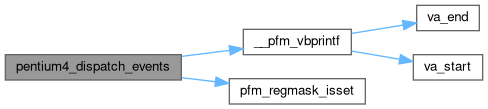
Here is the call graph for this function:

◆ pentium4_get_cycle_event()

static int pentium4_get_cycle_event ( pfmlib_event_t e)
static

Definition at line 689 of file pfmlib_pentium4.c.

690{
692 e->num_masks = 1;
693 e->unit_masks[0] = 0;
694 return PFMLIB_SUCCESS;
695
696}
#define PENTIUM4_CPU_CLK_UNHALTED

◆ pentium4_get_event_code()

static int pentium4_get_event_code ( unsigned int  event,
unsigned int  pmd,
int code 
)
static

pentium4_get_event_code

Return the event-select value for the specified event as needed for the specified PMD counter.

Definition at line 196 of file pfmlib_pentium4.c.

199{
200 int i, j, escr, cccr;
201 int rc = PFMLIB_ERR_INVAL;
202
203 if (pmd >= PENTIUM4_NUM_PMDS && pmd != PFMLIB_CNT_FIRST) {
204 goto out;
205 }
206
207 /* Check that the specified event is allowed for the specified PMD.
208 * Each event has a specific set of ESCRs it can use, which implies
209 * a specific set of CCCRs (and thus PMDs). A specified PMD of -1
210 * means assume any allowable PMD.
211 */
212 if (pmd == PFMLIB_CNT_FIRST) {
213 *code = pentium4_events[event].event_select;
215 goto out;
216 }
217
218 for (i = 0; i < MAX_ESCRS_PER_EVENT; i++) {
219 escr = pentium4_events[event].allowed_escrs[i];
220 if (escr < 0) {
221 continue;
222 }
223
224 for (j = 0; j < MAX_CCCRS_PER_ESCR; j++) {
225 cccr = pentium4_escrs[escr].allowed_cccrs[j];
226 if (cccr < 0) {
227 continue;
228 }
229
230 if (pmd == pentium4_cccrs[cccr].pmd) {
231 *code = pentium4_events[event].event_select;
233 goto out;
234 }
235 }
236 }
237
238out:
239 return rc;
240}
#define PFMLIB_CNT_FIRST
Definition: pfmlib_priv.h:62
rc
Definition: pscanf.h:23

◆ pentium4_get_event_counters()

static void pentium4_get_event_counters ( unsigned int  event,
pfmlib_regmask_t counters 
)
static

pentium4_get_event_counters

Fill in the 'counters' bitmask with all possible PMDs that could be used to count the specified event.

Definition at line 271 of file pfmlib_pentium4.c.

273{
274 int i, j, escr, cccr;
275
276 memset(counters, 0, sizeof(*counters));
277
278 for (i = 0; i < MAX_ESCRS_PER_EVENT; i++) {
279 escr = pentium4_events[event].allowed_escrs[i];
280 if (escr < 0) {
281 continue;
282 }
283
284 for (j = 0; j < MAX_CCCRS_PER_ESCR; j++) {
285 cccr = pentium4_escrs[escr].allowed_cccrs[j];
286 if (cccr < 0) {
287 continue;
288 }
289 pfm_regmask_set(counters, pentium4_cccrs[cccr].pmd);
290 }
291 }
292}
static int pfm_regmask_set(pfmlib_regmask_t *h, unsigned int b)
Definition: pfmlib.h:321
Here is the call graph for this function:

◆ pentium4_get_event_desc()

static int pentium4_get_event_desc ( unsigned int  event,
char **  desc 
)
static

pentium4_get_event_desc

Return the description for the specified event (if it has one).

FIXME: In this routine, we make a copy of the description string to return. But in get_event_name(), we just return the string directly. Why the difference?

Definition at line 654 of file pfmlib_pentium4.c.

655{
656 if (pentium4_events[event].desc) {
657 *desc = strdup(pentium4_events[event].desc);
658 } else {
659 *desc = NULL;
660 }
661
662 return PFMLIB_SUCCESS;
663}

◆ pentium4_get_event_mask_code()

static int pentium4_get_event_mask_code ( unsigned int  event,
unsigned int  mask,
unsigned int code 
)
static

Definition at line 681 of file pfmlib_pentium4.c.

683{
684 *code = 1U << pentium4_events[event].event_masks[mask].bit;
685 return PFMLIB_SUCCESS;
686}

◆ pentium4_get_event_mask_desc()

static int pentium4_get_event_mask_desc ( unsigned int  event,
unsigned int  mask,
char **  desc 
)
static

pentium4_get_event_mask_desc

Return the description for the specified event-mask (if it has one).

Definition at line 670 of file pfmlib_pentium4.c.

672{
673 if (mask >= EVENT_MASK_BITS || pentium4_events[event].event_masks[mask].desc == NULL)
674 return PFMLIB_ERR_INVAL;
675
676 *desc = strdup(pentium4_events[event].event_masks[mask].desc);
677
678 return PFMLIB_SUCCESS;
679}

◆ pentium4_get_event_mask_name()

static char * pentium4_get_event_mask_name ( unsigned int  event,
unsigned int  mask 
)
static

pentium4_get_event_mask_name

Return the name of the specified event-mask.

Definition at line 257 of file pfmlib_pentium4.c.

258{
259 if (mask >= EVENT_MASK_BITS || pentium4_events[event].event_masks[mask].name == NULL)
260 return NULL;
261
262 return pentium4_events[event].event_masks[mask].name;
263}

◆ pentium4_get_event_name()

static char * pentium4_get_event_name ( unsigned int  event)
static

pentium4_get_event_name

Return the name of the specified event.

Definition at line 247 of file pfmlib_pentium4.c.

248{
249 return pentium4_events[event].name;
250}

◆ pentium4_get_hw_counter_width()

static void pentium4_get_hw_counter_width ( unsigned int width)
static

pentium4_get_hw_counter_width

Return the number of usable bits in the PMD counters.

Definition at line 640 of file pfmlib_pentium4.c.

641{
642 *width = PENTIUM4_COUNTER_WIDTH;
643}
#define PENTIUM4_COUNTER_WIDTH

◆ pentium4_get_impl_counters()

static void pentium4_get_impl_counters ( pfmlib_regmask_t impl_counters)
static

pentium4_get_impl_counters

Set the appropriate bit in the impl_counters bitmask for each counter that's available on Pentium4.

For now, all PMDs are counters, so just call get_impl_pmds().

Definition at line 630 of file pfmlib_pentium4.c.

631{
632 pentium4_get_impl_pmds(impl_counters);
633}
static void pentium4_get_impl_pmds(pfmlib_regmask_t *impl_pmds)
Here is the call graph for this function:

◆ pentium4_get_impl_pmcs()

static void pentium4_get_impl_pmcs ( pfmlib_regmask_t impl_pmcs)
static

pentium4_get_impl_pmcs

Set the appropriate bit in the impl_pmcs bitmask for each PMC that's available on Pentium4.

FIXME: How can we detect when HyperThreading is enabled?

Definition at line 589 of file pfmlib_pentium4.c.
590{
591 unsigned int i;
592
593 for(i = 0; i < PENTIUM4_NUM_PMCS; i++) {
594 pfm_regmask_set(impl_pmcs, i);
595 }
596 /*
597 * IQ_ESCR0, IQ_ESCR1 only available on model 1 and 2
598 */
599 if (p4_model > 2) {
600 pfm_regmask_clr(impl_pmcs, 16);
601 pfm_regmask_clr(impl_pmcs, 48);
602 }
603}
static int pfm_regmask_clr(pfmlib_regmask_t *h, unsigned int b)
Definition: pfmlib.h:332
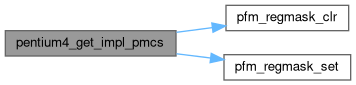
Here is the call graph for this function:

◆ pentium4_get_impl_pmds()

static void pentium4_get_impl_pmds ( pfmlib_regmask_t impl_pmds)
static

pentium4_get_impl_pmds

Set the appropriate bit in the impl_pmcs bitmask for each PMD that's available on Pentium4.

FIXME: How can we detect when HyperThreading is enabled?

Definition at line 613 of file pfmlib_pentium4.c.

614{
615 unsigned int i;
616
617 for(i = 0; i < PENTIUM4_NUM_PMDS; i++) {
618 pfm_regmask_set(impl_pmds, i);
619 }
620}
Here is the call graph for this function:
Here is the caller graph for this function:

◆ pentium4_get_inst_retired()

static int pentium4_get_inst_retired ( pfmlib_event_t e)
static

Definition at line 699 of file pfmlib_pentium4.c.

700{
701 /*
702 * some models do not implement INSTR_COMPLETED
703 */
704 if (p4_model != 3 && p4_model != 4 && p4_model != 6) {
706 e->num_masks = 2;
707 e->unit_masks[0] = 0;
708 e->unit_masks[1] = 1;
709 } else {
711 e->num_masks = 1;
712 e->unit_masks[0] = 0;
713 }
714 return PFMLIB_SUCCESS;
715}
#define PENTIUM4_INST_RETIRED

◆ pentium4_get_num_event_masks()

static unsigned int pentium4_get_num_event_masks ( unsigned int  event)
static

pentium4_get_num_event_masks

Count the number of available event-masks for the specified event. All valid masks in pentium4_events[].event_masks are contiguous in the array and have a non-NULL name.

Definition at line 301 of file pfmlib_pentium4.c.

302{
303 unsigned int i = 0;
304
305 while (pentium4_events[event].event_masks[i].name) {
306 i++;
307 }
308 return i;
309}

◆ pentium4_pmu_detect()

static int pentium4_pmu_detect ( void  )
static

pentium4_pmu_detect

Determine whether the system we're running on is a Pentium4 (or other CPU that uses the same PMU).

Definition at line 544 of file pfmlib_pentium4.c.

545{
546 int ret, family;
547 char buffer[128];
548
549 ret = __pfm_getcpuinfo_attr("vendor_id", buffer, sizeof(buffer));
550 if (ret == -1)
551 return PFMLIB_ERR_NOTSUPP;
552
553 if (strcmp(buffer, "GenuineIntel"))
554 return PFMLIB_ERR_NOTSUPP;
555
556 ret = __pfm_getcpuinfo_attr("cpu family", buffer, sizeof(buffer));
557 if (ret == -1)
558 return PFMLIB_ERR_NOTSUPP;
559
560 family = atoi(buffer);
561
562 ret = __pfm_getcpuinfo_attr("model", buffer, sizeof(buffer));
563 if (ret == -1)
564 return PFMLIB_ERR_NOTSUPP;
565
566 /*
567 * we use model to detect model 2 which has one more counter IQ_ESCR1
568 */
569 p4_model = atoi(buffer);
570 if (family != 15)
571 return PFMLIB_ERR_NOTSUPP;
572 /*
573 * IQ_ESCR0, IQ_ESCR1 only for model 1 and 2
574 */
575 if (p4_model >2)
577
579}
#define PFMLIB_ERR_NOTSUPP
Definition: pfmlib.h:284
int family
Definition: pfmlib_amd64.c:85
int __pfm_getcpuinfo_attr(const char *attr, char *ret_buf, size_t maxlen)
pfm_pmu_support_t pentium4_support
unsigned int pmc_count
Definition: pfmlib_priv.h:37
Here is the call graph for this function:

Variable Documentation

◆ p4_model

int p4_model
static

Definition at line 188 of file pfmlib_pentium4.c.

◆ p4_pmc_regmap

p4_regmap_t p4_pmc_regmap[]
static

Definition at line 50 of file pfmlib_pentium4.c.

◆ p4_pmd_regmap

p4_regmap_t p4_pmd_regmap[]
static
Initial value:
={
P4_REGMAP(0x300, "BPU_CTR0"),
P4_REGMAP(0x301, "BPU_CTR1"),
P4_REGMAP(0x304, "MS_CTR0"),
P4_REGMAP(0x305, "MS_CTR1"),
P4_REGMAP(0x308, "FLAME_CTR0"),
P4_REGMAP(0x309, "FLAME_CTR1"),
P4_REGMAP(0x30c, "IQ_CTR0"),
P4_REGMAP(0x30d, "IQ_CTR1"),
P4_REGMAP(0x310, "IQ_CTR4"),
P4_REGMAP(0x302, "BPU_CTR2"),
P4_REGMAP(0x303, "BPU_CTR3"),
P4_REGMAP(0x306, "MS_CTR2"),
P4_REGMAP(0x307, "MS_CTR3"),
P4_REGMAP(0x30a, "FLAME_CTR2"),
P4_REGMAP(0x30b, "FLAME_CTR3"),
P4_REGMAP(0x30d, "IQ_CTR2"),
P4_REGMAP(0x30f, "IQ_CTR3"),
P4_REGMAP(0x311, "IQ_CTR5"),
}
#define P4_REGMAP(a, n)

Definition at line 121 of file pfmlib_pentium4.c.

◆ p4_replay_regs

pentium4_replay_regs_t p4_replay_regs[]
static

Definition at line 152 of file pfmlib_pentium4.c.

◆ pentium4_support

pfm_pmu_support_t pentium4_support
Initial value:
= {
.pmu_name = "Pentium4/Xeon/EM64T",
.pmu_type = PFMLIB_PENTIUM4_PMU,
.pme_count = PENTIUM4_EVENT_COUNT,
.pmd_count = PENTIUM4_NUM_PMDS,
.pmc_count = PENTIUM4_NUM_PMCS,
.num_cnt = PENTIUM4_NUM_PMDS,
.get_event_code = pentium4_get_event_code,
.get_event_name = pentium4_get_event_name,
.get_event_mask_name = pentium4_get_event_mask_name,
.get_event_counters = pentium4_get_event_counters,
.get_num_event_masks = pentium4_get_num_event_masks,
.dispatch_events = pentium4_dispatch_events,
.pmu_detect = pentium4_pmu_detect,
.get_impl_pmcs = pentium4_get_impl_pmcs,
.get_impl_pmds = pentium4_get_impl_pmds,
.get_impl_counters = pentium4_get_impl_counters,
.get_hw_counter_width = pentium4_get_hw_counter_width,
.get_event_desc = pentium4_get_event_desc,
.get_event_mask_desc = pentium4_get_event_mask_desc,
.get_event_mask_code = pentium4_get_event_mask_code,
.get_cycle_event = pentium4_get_cycle_event,
.get_inst_retired_event = pentium4_get_inst_retired
}
#define PENTIUM4_EVENT_COUNT
#define PFMLIB_PENTIUM4_PMU
Definition: pfmlib.h:230
static void pentium4_get_impl_pmcs(pfmlib_regmask_t *impl_pmcs)
static char * pentium4_get_event_name(unsigned int event)
static int pentium4_get_event_code(unsigned int event, unsigned int pmd, int *code)
static int pentium4_dispatch_events(pfmlib_input_param_t *input, void *model_input, pfmlib_output_param_t *output, void *model_output)
static void pentium4_get_impl_counters(pfmlib_regmask_t *impl_counters)
static char * pentium4_get_event_mask_name(unsigned int event, unsigned int mask)
static int pentium4_pmu_detect(void)
static unsigned int pentium4_get_num_event_masks(unsigned int event)
static int pentium4_get_cycle_event(pfmlib_event_t *e)
static int pentium4_get_event_desc(unsigned int event, char **desc)
static void pentium4_get_hw_counter_width(unsigned int *width)
static int pentium4_get_event_mask_code(unsigned int event, unsigned int mask, unsigned int *code)
static void pentium4_get_event_counters(unsigned int event, pfmlib_regmask_t *counters)
static int pentium4_get_event_mask_desc(unsigned int event, unsigned int mask, char **desc)
static int pentium4_get_inst_retired(pfmlib_event_t *e)

pentium4_support

Definition at line 720 of file pfmlib_pentium4.c.