PLASMA  2.4.5
PLASMA - Parallel Linear Algebra for Scalable Multi-core Architectures
 All Data Structures Namespaces Files Functions Variables Typedefs Enumerations Enumerator Macros Groups
example_sgelqf.c File Reference

Example using LQ factorization. More...

#include <stdlib.h>
#include <stdio.h>
#include <string.h>
#include <math.h>
#include <plasma.h>
#include <cblas.h>
#include <lapacke.h>
#include <core_blas.h>
Include dependency graph for example_sgelqf.c:

Go to the source code of this file.

Macros

#define max(a, b)   ((a) > (b) ? (a) : (b))
#define min(a, b)   ((a) < (b) ? (a) : (b))

Functions

int check_orthogonality (int, int, int, float *)
int check_factorization (int, int, float *, float *, int, float *)
int main ()

Variables

int IONE = 1
int ISEED [4] = {0,0,0,1}

Detailed Description

Example using LQ factorization.

PLASMA testing routines PLASMA is a software package provided by Univ. of Tennessee, Univ. of California Berkeley and Univ. of Colorado Denver

Version:
2.4.5
Author:
Bilel Hadri
Date:
2010-11-15 s Tue Nov 22 14:35:52 2011

Definition in file example_sgelqf.c.


Macro Definition Documentation

#define max (   a,
 
)    ((a) > (b) ? (a) : (b))

Definition at line 28 of file example_sgelqf.c.

#define min (   a,
 
)    ((a) < (b) ? (a) : (b))

Definition at line 31 of file example_sgelqf.c.


Function Documentation

int check_factorization ( int  M,
int  N,
float *  A1,
float *  A2,
int  LDA,
float *  Q 
)

Definition at line 157 of file example_sgelqf.c.

References cblas_sgemm(), CblasColMajor, CblasNoTrans, L, lapack_const, max, and PlasmaInfNorm.

{
float Anorm, Rnorm;
float alpha, beta;
int info_factorization;
int i,j;
float eps;
eps = LAPACKE_slamch_work('e');
float *Ql = (float *)malloc(M*N*sizeof(float));
float *Residual = (float *)malloc(M*N*sizeof(float));
float *work = (float *)malloc(max(M,N)*sizeof(float));
alpha=1.0;
beta=0.0;
if (M >= N) {
/* Extract the R */
float *R = (float *)malloc(N*N*sizeof(float));
memset((void*)R, 0, N*N*sizeof(float));
LAPACKE_slacpy_work(LAPACK_COL_MAJOR,'u', M, N, A2, LDA, R, N);
/* Perform Ql=Q*R */
memset((void*)Ql, 0, M*N*sizeof(float));
cblas_sgemm(CblasColMajor, CblasNoTrans, CblasNoTrans, M, N, N, (alpha), Q, LDA, R, N, (beta), Ql, M);
free(R);
}
else {
/* Extract the L */
float *L = (float *)malloc(M*M*sizeof(float));
memset((void*)L, 0, M*M*sizeof(float));
LAPACKE_slacpy_work(LAPACK_COL_MAJOR,'l', M, N, A2, LDA, L, M);
/* Perform Ql=LQ */
memset((void*)Ql, 0, M*N*sizeof(float));
cblas_sgemm(CblasColMajor, CblasNoTrans, CblasNoTrans, M, N, M, (alpha), L, M, Q, LDA, (beta), Ql, M);
free(L);
}
/* Compute the Residual */
for (i = 0; i < M; i++)
for (j = 0 ; j < N; j++)
Residual[j*M+i] = A1[j*LDA+i]-Ql[j*M+i];
Rnorm = LAPACKE_slange_work(LAPACK_COL_MAJOR, lapack_const(PlasmaInfNorm), M, N, Residual, M, work);
Anorm = LAPACKE_slange_work(LAPACK_COL_MAJOR, lapack_const(PlasmaInfNorm), M, N, A2, LDA, work);
if (M >= N) {
printf("============\n");
printf("Checking the QR Factorization \n");
printf("-- ||A-QR||_oo/(||A||_oo.N.eps) = %e \n",Rnorm/(Anorm*N*eps));
}
else {
printf("============\n");
printf("Checking the LQ Factorization \n");
printf("-- ||A-LQ||_oo/(||A||_oo.N.eps) = %e \n",Rnorm/(Anorm*N*eps));
}
if (isnan(Rnorm / (Anorm * N *eps)) || (Rnorm / (Anorm * N * eps) > 10.0) ) {
printf("-- Factorization is suspicious ! \n");
info_factorization = 1;
}
else {
printf("-- Factorization is CORRECT ! \n");
info_factorization = 0;
}
free(work); free(Ql); free(Residual);
return info_factorization;
}

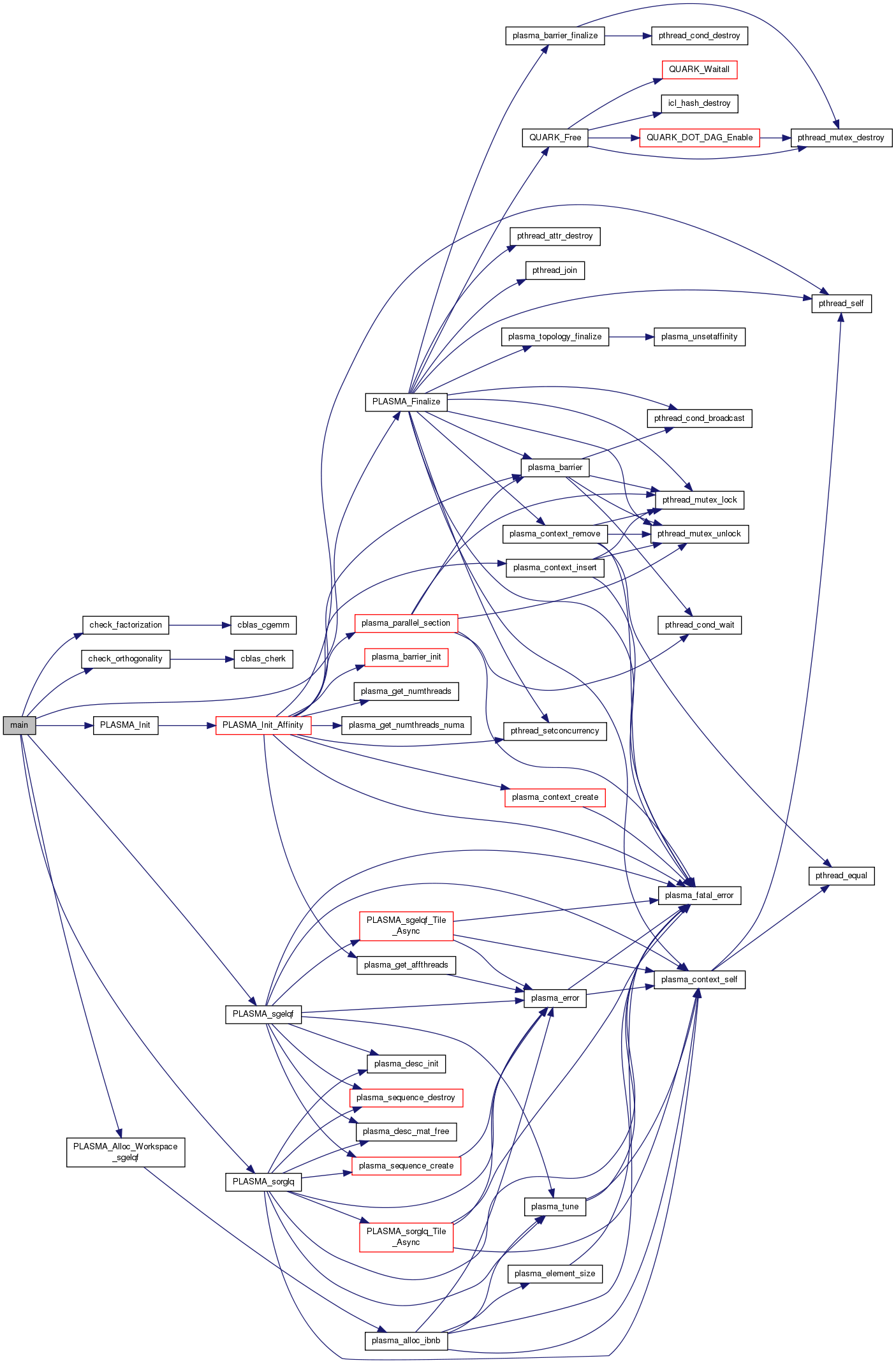
Here is the call graph for this function:

int check_orthogonality ( int  M,
int  N,
int  LDQ,
float *  Q 
)

Definition at line 107 of file example_sgelqf.c.

References cblas_ssyrk(), CblasColMajor, CblasNoTrans, CblasTrans, CblasUpper, lapack_const, min, and PlasmaInfNorm.

{
float alpha, beta;
float normQ;
int info_ortho;
int i;
int minMN = min(M, N);
float eps;
float *work = (float *)malloc(minMN*sizeof(float));
eps = LAPACKE_slamch_work('e');
alpha = 1.0;
beta = -1.0;
/* Build the idendity matrix USE DLASET?*/
float *Id = (float *) malloc(minMN*minMN*sizeof(float));
memset((void*)Id, 0, minMN*minMN*sizeof(float));
for (i = 0; i < minMN; i++)
Id[i*minMN+i] = (float)1.0;
/* Perform Id - Q'Q */
if (M >= N)
cblas_ssyrk(CblasColMajor, CblasUpper, CblasTrans, N, M, alpha, Q, LDQ, beta, Id, N);
else
cblas_ssyrk(CblasColMajor, CblasUpper, CblasNoTrans, M, N, alpha, Q, LDQ, beta, Id, M);
normQ = LAPACKE_slansy_work(LAPACK_COL_MAJOR, lapack_const(PlasmaInfNorm), 'u', minMN, Id, minMN, work);
printf("============\n");
printf("Checking the orthogonality of Q \n");
printf("||Id-Q'*Q||_oo / (N*eps) = %e \n",normQ/(minMN*eps));
if ( isnan(normQ / (minMN * eps)) || (normQ / (minMN * eps) > 10.0) ) {
printf("-- Orthogonality is suspicious ! \n");
info_ortho=1;
}
else {
printf("-- Orthogonality is CORRECT ! \n");
info_ortho=0;
}
free(work); free(Id);
return info_ortho;
}

Here is the call graph for this function:

int main ( )

Definition at line 40 of file example_sgelqf.c.

References check_factorization(), check_orthogonality(), IONE, ISEED, min, PLASMA_Alloc_Workspace_sgelqf(), PLASMA_Finalize(), PLASMA_Init(), PLASMA_sgelqf(), PLASMA_sorglq(), Q, and T.
{
int cores = 2;
int M = 10;
int N = 15;
int LDA = 10;
int K = min(M, N);
int info;
int info_ortho, info_factorization;
int i,j;
int LDAxN = LDA*N;
float *A1 = (float *)malloc(LDA*N*sizeof(float));
float *A2 = (float *)malloc(LDA*N*sizeof(float));
float *Q = (float *)malloc(LDA*N*sizeof(float));
float *T;
/* Check if unable to allocate memory */
if ((!A1)||(!A2)||(!Q)){
printf("Out of Memory \n ");
return EXIT_SUCCESS;
}
/* Plasma Initialization */
PLASMA_Init(cores);
printf("-- PLASMA is initialized to run on %d cores. \n",cores);
/* Allocate T */
/* Initialize A1 and A2 */
LAPACKE_slarnv_work(IONE, ISEED, LDAxN, A1);
for (i = 0; i < M; i++)
for (j = 0; j < N; j++)
A2[LDA*j+i] = A1[LDA*j+i] ;
/* Factorization QR of the matrix A2 */
info = PLASMA_sgelqf(M, N, A2, LDA, T);
/* Building the economy-size Q */
memset((void*)Q, 0, LDA*N*sizeof(float));
for (i = 0; i < K; i++)
Q[LDA*i+i] = 1.0;
PLASMA_sorglq(M, N, K, A2, LDA, T, Q, LDA);
/* Check the orthogonality, factorization and the solution */
info_ortho = check_orthogonality(M, N, LDA, Q);
info_factorization = check_factorization(M, N, A1, A2, LDA, Q);
if ((info_ortho != 0)|(info_factorization != 0)|(info != 0))
printf("-- Error in SGELQF example ! \n");
else
printf("-- Run of SGELQF example successful ! \n");
free(A1); free(A2); free(Q); free(T);
return EXIT_SUCCESS;
}

Here is the call graph for this function:


Variable Documentation

int IONE = 1

Definition at line 37 of file example_sgelqf.c.

int ISEED[4] = {0,0,0,1}

Definition at line 38 of file example_sgelqf.c.