News and Announcements
Dongarra Receives Turing Award
Jack Dongarra was formally presented with the ACM A.M. Turing Award at the annual ACM Awards Banquet, which was held this year on Saturday, June 11 at the Palace Hotel in San Francisco.
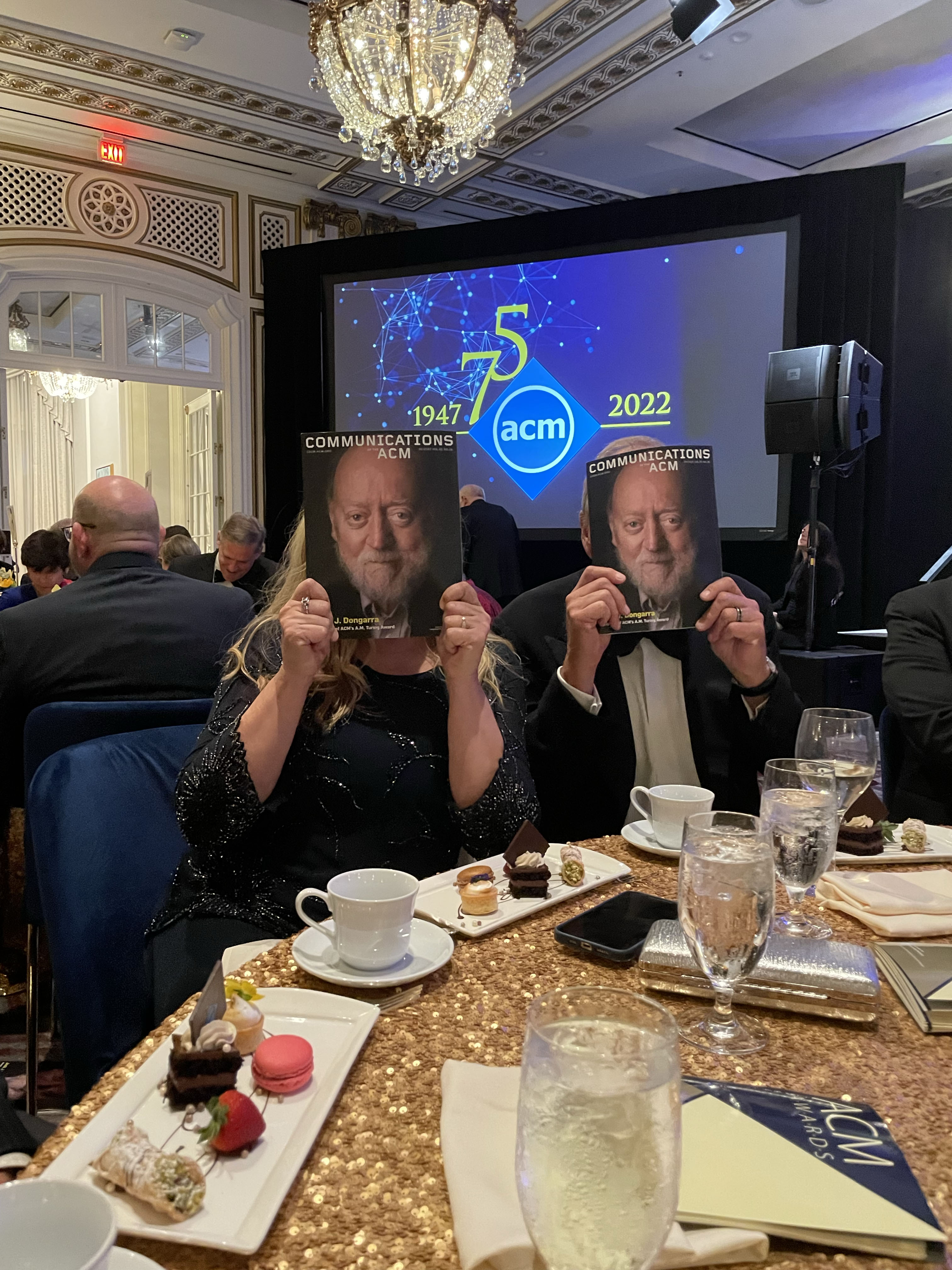
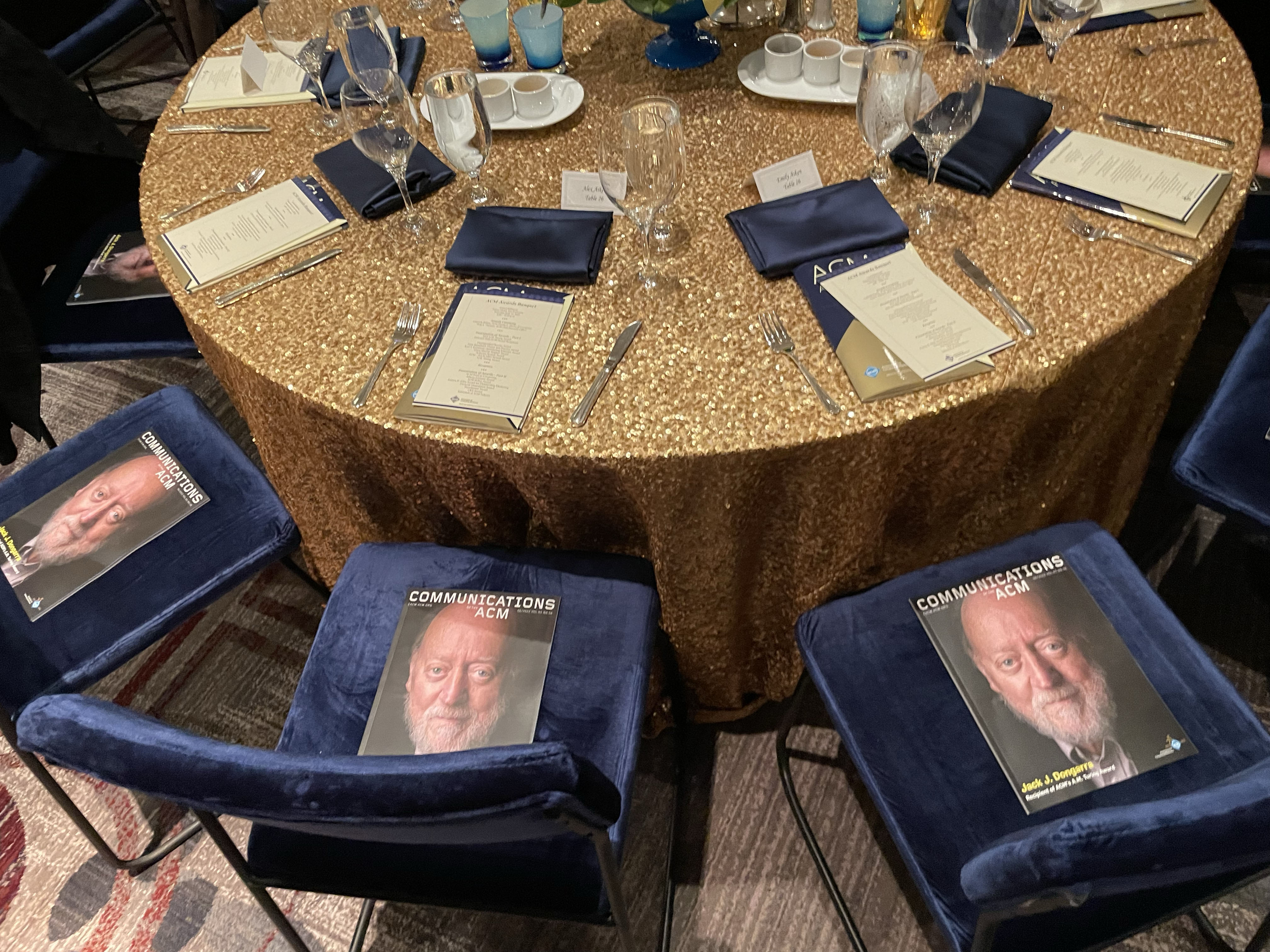
Jack met up with several ICL alumni on June 11th weekend following the ACM banquet in San Francisco. It was a great opportunity for ICLers on the West Coast to get a chance to congratulate Jack in person and catch up with former colleagues.

Dongarra Given Cover of Communications of the ACM
 Jack Dongarra is featured in the cover article in the latest issue of Communications of the ACM.
In a somewhat refreshing turn from the recent coverage of Dongarra’s looming retirement, the article delves deeper into his history prior to ICL. The author (Neil Savage) touches on Dongarra’s graduate education, internship at Argonne National Laboratory, and some of the challenges facing the HPC community at the time. The article eventually shifts focus toward more current HPC challenges and Dongarra’s dogged determination and exacting standards to meet these challenges.
Jack Visits Technical University of Darmstadt

On May 27th, Jack visited the Technical University of Darmstadt, a research university in the city of Darmstadt, Germany as a part of their 50th year anniversary celebrations. While there he gave a talk, “A not so simple matter of software,” which delved into the changes that have occurred in high performance computing and the impact on how algorithms and software libraries are designed for high-end computers.
Dongarra Goes to Sciencetown

Jack Dongarra chatted with KAUST colleagues David Keyes, Hatem Ltaief and Bilel Hadri about supercomputing developments and connections made throughout his career and at KAUST, on a recent episode of the podcast Sciencetown.
It should be noted that Hatem and Bilel are ICL alumni and talk some about their time at ICL. David Keyes refers to KAUST as “ICL east”
Conference Reports
ISC Returns to In-Person


This year’s International Supercomputing Conference (ISC’22) was held on May 29th through June 2nd in Hamburg, Germany. ICL’s Jack Dongarra and Piotr Luszczek were among 3,007 attendees and 137 exhibitors for the first in-person ISC in three years. The conference saw attendance from 59 countries This included close to 200 people who attended remotely.
On Sunday the 29th, Jack and Piotr were joined by incoming Mathworks Professor Hartwig Anzt to give a tutorial on Modern Mixed-Precision Methods wherein they spoke on recent algorithmic progress in exploiting multiple precisions for increased efficiency in performance, communication, and/or storage. Additionally, Jack Dongarra was recognized for receiving the 2021 ACM Turing Award, in a special session. Dongarra was also named as the ISC 2023 deputy chair.
Overall there were many good talks from industry, with keynote speeches coming from: Rev Lebardien, Vice President for Omniverse and Simulation Technology at NVIDIA; Michele Melchiorre, Senior Vice President for Product System, Technical Planning, and Tool Shop at BMW Group; Lorena Barba, Professor of Mechanical and Aerospace Engineering at The George Washington University; and Prof. Thomas Sterling.
The next ISC will be held from May 21 – 25, in Hamburg, under the slogan “Imagine Tomorrow.”
Recent Releases
SLATE release 2022.06.00
SLATE (Software for Linear Algebra Targeting Exascale) is being developed as part of the Exascale Computing Project (ECP), which is a joint project of the U.S. Department of Energy’s Office of Science and National Nuclear Security Administration (NNSA). The objective of SLATE is to provide distributed, GPU-accelerated dense linear algebra capabilities to the US Department of Energy and to the high-performance computing (HPC) community at large.
The new SLATE release:
- Fixed algorithm selection (issue #41)
- Fixed set for triangular, trapezoid, symmetric, Hermitian matrices (tzset)
- Fixed ScaLAPACK pdsgesv wrapper (issue #42)
- Fixed norm for general band matrix (gbnorm)
- Added macro for OpenMP default(none); by default empty since it causes unpredictable errors for some compilers or libraries
SLATE can be found here.
Interview

Rob Anderson
Where are you from?
I am originally from Arkansas, but I moved to Knoxville about 15 or so years ago.
Can you summarize your educational background?
I guess you could say I am a Volunteer. I received a BA in History from UTK, a Master’s in Information Science from UTK and pursued PhD at UTK as well.
Where did you work before joining ICL?
I worked as a Graduate Research Assistant and Graduate Teaching Assistant at CICS at UTK. Before that I spent years in entertainment and various labor jobs.
How did you first hear about the lab, and what made you want to work here?
I first learned about ICL from a job posting. I then started learning as much as I could about the department and lab. I thought I might be a good fit and applied. I have been learning about ICL ever since. It’s fascinating. People use algebra (linear) in real life. Who knew?
What is your focus here at ICL? What are you working on?
I work on IGMCS Program Administration, the Newsletter, NSF and DOE Project Reports, the Publications Database, Technical Editing, and the Friday Talks.
What are your interests/hobbies outside of work?
I enjoy creating and recording music. Mostly, I spend time with my three kids. We have a nine year old daughter, a three year old son and a nine month old baby girl. If I am not working on something ICL related, I am usually elbow deep in gross, dad stuff.
Tell us something about yourself that might surprise people.
I was a somewhat successful stand-up comic and managed to tour for six years before I gave it up.
If you weren’t working at ICL, where would you like to be working and why?
I would prefer to work somewhere I can do technical writing/editing and be a part of a group that is making significant contributions to the field.