News and Announcements
Employment Opportunities at ICL
ICL is seeking full-time Research Scientists (MS or PhD) to participate in the design, development, and maintenance of numerical software libraries for solving linear algebra problems on large, distributed-memory machines with multi-core processors, hardware accelerators, and performance monitoring capabilities for new and advanced hardware and software technologies.
The prospective researcher will coauthor papers to document research findings, present the team’s work at conferences and workshops, and help lead students and other team members in their research endeavors in ongoing and future projects. Given the nature of the work, there will be opportunities for publication, travel, and high-profile professional networking and collaboration across academia, labs, and industry.
An MS or PhD in computer science, computational sciences, or math is preferred. Background in at least one of the following areas is also preferred: numerical linear algebra, HPC, performance monitoring, machine learning, or data analytics.
For more information check out ICL’s jobs page: http://www.icl.utk.edu/jobs.
Conference Reports
Workshop on Variable Precision in Mathematical and Scientific Computing
The Workshop on Variable Precision in Mathematical and Scientific Computing was held virtually on May 7–8, 2020. Hosted by the Institute for Computational and Experimental Research in Mathematics (ICERM), the digital workshop drew over 60 attendees with 10 talks spanning the two-day meeting.
ICL’s Jack Dongarra presented the most recent efforts in “Using Mixed Precision in Numerical Computations to Speedup Linear Algebra Solvers,” where he describes how mixed-precision (FP16 and FP64) iterative refinement methods using half-precision Tensor Cores (FP16-TC) for the arithmetic can provide up to 4× speedup while preserving accuracy where possible.

Hartwig Anzt also “dialed in” to present the latest work in the “Multiprecision Effort in the US Exascale Computing Project,” which aims to deploy algorithms that combine different precision formats to increase the performance on modern hardware architectures without impacting the high quality of the final result.

Other attendees from ICL included Neil Lindquist, Piotr Luszczek, and Mike Tsai.
In what might become standard practice these days, ICERM recorded the workshop presentations and posted them on their website for your viewing pleasure. Enjoy.
PDSEC 2020
The 21st IEEE International Workshop on Parallel and Distributed Scientific and Engineering Computing (PDSEC 2020) was held online on May 22, 2020.
ICL’s very own Yu Pei presented the DisCo team’s work on “Communication Avoiding 2D Stencil Implementations over the PaRSEC Task-Based Runtime,” where they were able to minimize communication bottlenecks in distributed stencil computations by combing the computation and communication overlap inherent in PaRSEC with a communication-avoiding scheme.
The Editor would like to thank Yu Pei for his contribution to this article.
Interview
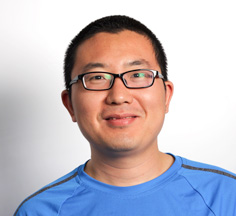
Qinglei Cao
Where are you from, originally?
I am originally from the Shandong province in China.
Can you summarize your educational background?
I earned my BS in Information and Computational Science from Hunan University in China and then worked at National University of Defense Technology. I earned my Master’s degree in Computer Application Technology from Ocean University of China in 2016. In the same year, I started my PhD study in Computer Science at the University of Tennessee and Joined ICL in August of 2017.
Where did you work before joining ICL?
I worked as a PhD student at the University of Tennessee.
How did you first hear about the lab, and what made you want to work here?
One of my friends told me about ICL when I joined the University of Tennessee, and this was the first time I heard about ICL; but the first time I heard about Jack was when I was at the National University of Defense Technology and worked around the TH-1A when it was targeting the TOP500.
What is your focus here at ICL? What are you working on?
I am working in the DisCo group, and my research focuses on the PaRSEC task-based runtime system, and I mainly work on the adaptive mesh refinement and Cholesky factorization in PaRSEC.
What are your interests/hobbies outside of work?
Basketball and delicious foods.
Tell us something about yourself that might surprise people.
During my first winter break when I was an undergraduate student, I stood more than 10 hours on the train back home because of the inexperience towards the Spring Festival travel rush.
If you weren’t working at ICL, where would you like to be working and why?
I’d like to be a research assistant working on image processing, machine learning, algorithms, or HPC in other research groups.