Loading...
Searching...
No Matches
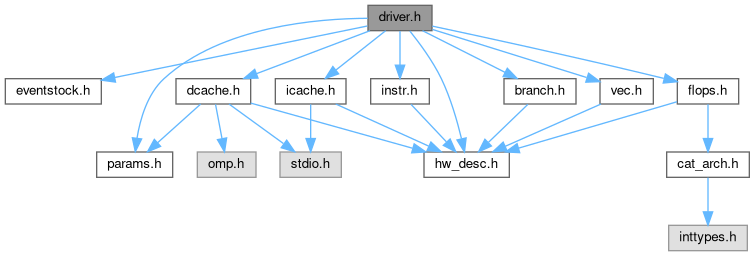
Include dependency graph for driver.h:
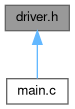
This graph shows which files directly or indirectly include this file:
Go to the source code of this file.
Macros | |
| #define | USE_ALL_EVENTS 0x0 |
| #define | READ_FROM_FILE 0x1 |
| #define | BENCH_FLOPS 0x01 |
| #define | BENCH_BRANCH 0x02 |
| #define | BENCH_DCACHE_READ 0x04 |
| #define | BENCH_DCACHE_WRITE 0x08 |
| #define | BENCH_ICACHE_READ 0x10 |
| #define | BENCH_VEC 0x20 |
| #define | BENCH_INSTR 0x40 |
Functions | |
| int | parseArgs (int argc, char **argv, cat_params_t *params) |
| int | setup_evts (char *inputfile, char ***basenames, int **cards) |
| unsigned long int | omp_get_thread_num_wrapper () |
| int | check_cards (cat_params_t mode, int **indexmemo, char **basenames, int *cards, int ct, int nevts, evstock *data) |
| void | combine_qualifiers (int n, int pk, int ct, char **list, char *name, char **allevts, int *track, int flag, int *bitmap) |
| void | trav_evts (evstock *stock, int pk, int *cards, int nevts, int selexnsize, int mode, char **allevts, int *track, int *indexmemo, char **basenames) |
| int | perm (int n, int k) |
| int | comb (int n, int k) |
| void | testbench (char **allevts, int cmbtotal, hw_desc_t *hw_desc, cat_params_t params, int myid, int nprocs) |
| void | print_usage () |
| static int | parse_line (FILE *input, char **key, long long *value) |
| static void | read_conf_file (char *conf_file, hw_desc_t *hw_desc) |
| static hw_desc_t * | obtain_hardware_description (char *conf_file_name) |
Macro Definition Documentation
◆ BENCH_BRANCH
◆ BENCH_DCACHE_READ
◆ BENCH_DCACHE_WRITE
◆ BENCH_FLOPS
◆ BENCH_ICACHE_READ
◆ BENCH_INSTR
◆ BENCH_VEC
◆ READ_FROM_FILE
◆ USE_ALL_EVENTS
Function Documentation
◆ check_cards()
| int check_cards | ( | cat_params_t | mode, |
| int ** | indexmemo, | ||
| char ** | basenames, | ||
| int * | cards, | ||
| int | ct, | ||
| int | nevts, | ||
| evstock * | data | ||
| ) |
Definition at line 196 of file main.c.
197{
201 int pk = params.subsetsize;
202
203 // User provided a file of events.
205 {
206 // Compute the total number of qualifier combinations and allocate memory to store them.
207 if (NULL == ((*indexmemo) = (int*)malloc(ct*sizeof(int)))) {
209 return 0;
210 }
211
212 // Find the index in the main stock whose event corresponds to that in the file provided.
213 // This simplifies looking up event qualifiers later.
215 {
217 {
218 (*indexmemo)[i] = -1;
219 cmbtotal -= 1;
220 continue;
221 }
222
223 // j is the index of the event name provided by the user.
224 for(j = 0; j < nevts; ++j)
225 {
228 {
229 break;
230 }
231 }
232
233 // If the event name provided by the user does not match any of the main event
234 // names in the architecture, then it either contains qualifiers or it does not
235 // exist.
237 {
238 fprintf(stderr, "The provided event '%s' is either not in the architecture or contains qualifiers.\n" \
240 cards[i] = 0;
241 }
242
243 // If an invalid (negative) qualifier count was given, use zero qualifiers.
245 {
246 fprintf(stderr, "The qualifier count (provided for event '%s') cannot be negative.\n", basenames[i]);
247 cards[i] = 0;
248 }
249
250 (*indexmemo)[i] = j;
251 }
252
253 // Count the total number of events to test.
255 {
256 // If no qualifiers are used, then just count the event itself.
258 {
259 cmbtotal += 1;
260 continue;
261 }
262
263 // Get the number of qualifiers which belong to the main event.
265 {
267 }
268 else
269 {
270 n = 0;
271 }
272
273 // If the user specifies to use more qualifiers than are available
274 // for the main event, do not use any qualifiers. Otherwise, count
275 // the number of combinations of qualifiers for the main event.
276 minim = cards[i];
278 {
279 minim = 0;
280 }
281 cmbtotal += comb(n, minim);
282 }
283 }
284 // User wants to inspect all events in the architecture.
285 else
286 {
288 {
289 // Get the number of qualifiers which belong to the main event.
291
292 // If the user specifies to use more qualifiers than are available
293 // for the main event, do not use any qualifiers. Otherwise, count
294 // the number of combinations of qualifiers for the main event.
295 minim = pk;
296 if(pk > n || pk < 0)
297 {
298 minim = 0;
299 }
300 cmbtotal += comb(n, minim);
301 }
302 }
303
304 return cmbtotal;
305}
FILE * stderr
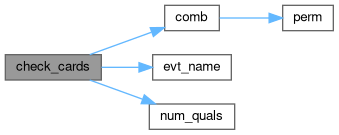
Here is the call graph for this function:
Here is the caller graph for this function:

◆ comb()


◆ combine_qualifiers()
| void combine_qualifiers | ( | int | n, |
| int | pk, | ||
| int | ct, | ||
| char ** | list, | ||
| char * | name, | ||
| char ** | allevts, | ||
| int * | track, | ||
| int | flag, | ||
| int * | bitmap | ||
| ) |
Definition at line 585 of file main.c.
586{
587 int original;
588 int counter;
590
591 // Set flag in the array.
592 original = bitmap[ct];
593 bitmap[ct] = flag;
594
595 // Only make recursive calls if there are more items.
596 // Ensure proper cardinality.
597 counter = 0;
599 {
600 counter += bitmap[i];
601 }
602
603 // Cannot use more qualifiers than are available.
604 if(ct+1 < n)
605 {
606 // Make recursive calls both with and without a given qualifier.
607 // Recursion cannot exceed the number of qualifiers specified by
608 // the user.
609 if(counter < pk)
610 {
612 }
614 }
615 // Qualifier count matches that specified by the user.
616 else
617 {
618 if(counter == pk)
619 {
620 // Construct the qualifier combination string.
621 char* chunk;
624 {
626 {
627 // Add one to account for the colon in front of the qualifier.
628 evtsize += strlen(list[i])+1;
629 }
630 }
631
632 if (NULL == (chunk = (char*)malloc((evtsize+1)*sizeof(char)))) {
634 return;
635 }
636
637 strcpy(chunk,name);
639 {
641 {
642 strcat(chunk,":");
643 strcat(chunk,list[i]);
644 }
645 }
646
647 // Add qualifier combination string to the list.
648 allevts[*track] = strdup(chunk);
649 *track += 1;
650
651 free(chunk);
652 }
653 }
654
655 // Undo effect of recursive call to combine other qualifiers.
656 bitmap[ct] = original;
657
658 return;
659}
void combine_qualifiers(int n, int pk, int ct, char **list, char *name, char **allevts, int *track, int flag, int *bitmap)
Definition: main.c:585
Here is the call graph for this function:
Here is the caller graph for this function:

◆ obtain_hardware_description()
|
static |
◆ omp_get_thread_num_wrapper()

◆ parse_line()
◆ parseArgs()
| int parseArgs | ( | int | argc, |
| char ** | argv, | ||
| cat_params_t * | params | ||
| ) |
Definition at line 988 of file main.c.
988 {
991 int dirlen = 0;
992 int kflag = 0;
993 int inflag = 0;
994 FILE *test = NULL;
995 int len, status = 0;
996
997 params->subsetsize = -1;
998
999 // Parse the command line arguments
1000 while(--argc){
1001 ++argv;
1002 if( !strcmp(argv[0],"-h") ){
1004 return -1;
1005 }
1006 if( argc > 1 && !strcmp(argv[0],"-k") ){
1007 params->subsetsize = atoi(argv[1]);
1009 {
1010 params->subsetsize = 0;
1012 }
1014 kflag = 1;
1015 --argc;
1016 ++argv;
1017 continue;
1018 }
1019 if( argc > 1 && !strcmp(argv[0],"-n") ){
1020 params->max_iter = atoi(argv[1]);
1021 --argc;
1022 ++argv;
1023 continue;
1024 }
1025 if( argc > 1 && !strcmp(argv[0],"-conf") ){
1026 params->conf_file = argv[1];
1027 --argc;
1028 ++argv;
1029 continue;
1030 }
1031 if( argc > 1 && !strcmp(argv[0],"-in") ){
1032 params->inputfile = argv[1];
1034 inflag = 1;
1035 --argc;
1036 ++argv;
1037 continue;
1038 }
1039 if( argc > 1 && !strcmp(argv[0],"-out") ){
1040 tmp = argv[1];
1041 --argc;
1042 ++argv;
1043 continue;
1044 }
1045 if( !strcmp(argv[0],"-verbose") ){
1046 params->show_progress = 1;
1047 continue;
1048 }
1049 if( !strcmp(argv[0],"-quick") ){
1050 params->quick = 1;
1051 continue;
1052 }
1053 if( !strcmp(argv[0],"-branch") ){
1055 continue;
1056 }
1057 if( !strcmp(argv[0],"-dcr") ){
1059 continue;
1060 }
1061 if( !strcmp(argv[0],"-dcw") ){
1063 continue;
1064 }
1065 if( !strcmp(argv[0],"-flops") ){
1067 continue;
1068 }
1069 if( !strcmp(argv[0],"-ic") ){
1071 continue;
1072 }
1073 if( !strcmp(argv[0],"-vec") ){
1075 continue;
1076 }
1077 if( !strcmp(argv[0],"-instr") ){
1079 continue;
1080 }
1081
1083 return -1;
1084 }
1085
1086 // MODE INFO: mode 1 uses file; mode 2 uses all native events.
1088 {
1090 if(test == NULL)
1091 {
1093 return -1;
1094 }
1095 fclose(test);
1096 }
1097
1098 // Make sure user does not specify both modes simultaneously.
1099 if(kflag == 1 && inflag == 1)
1100 {
1102 return -1;
1103 }
1104
1105 // Make sure user specifies mode explicitly.
1106 if(kflag == 0 && inflag == 0)
1107 {
1109 return -1;
1110 }
1111
1112 // Make sure output path was provided.
1114 {
1116 return -1;
1117 }
1118
1119 // Write output files in the user-specified directory.
1120 dirlen = strlen(tmp);
1122
1125 return -1;
1126 }
1127
1129 if( len < 1+dirlen )
1130 {
1132 return -1;
1133 }
1134
1135 // Make sure files can be written to the provided path.
1136 status = access(params->outputdir, W_OK);
1137 if(status != 0)
1138 {
1139 fprintf(stderr, "Permission to write files to \"%s\" denied. Make sure the path exists and is writable.\n", tmp);
1140 return -1;
1141 }
1142
1143 return 0;
1144}
void print_usage()
int fclose(FILE *__stream)
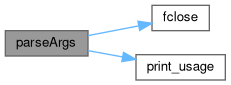
Here is the call graph for this function:
Here is the caller graph for this function:

◆ perm()

◆ print_usage()
| void print_usage | ( | ) |
Here is the caller graph for this function:

◆ read_conf_file()
|
static |
◆ setup_evts()
Definition at line 500 of file main.c.
501{
502 size_t linelen = 0;
503 int cnt = 0, status = 0;
504 char *line = NULL, *place;
505 FILE *input;
506 int evnt_count = 256;
507
509 int *cards = (int *)calloc(evnt_count, sizeof(int));
510
513 return 0;
514 }
515
516 // Read the base event name and cardinality columns.
517 input = fopen(inputfile, "r");
518 for(cnt=0; 1; cnt++)
519 {
520 ssize_t ret_val = getline(&line, &linelen, input);
521 if( ret_val < 0 )
522 break;
523 if( cnt >= evnt_count )
524 {
525 evnt_count *= 2;
527 cards = realloc(cards, evnt_count*sizeof(int));
528
531 return 0;
532 }
533 }
534
535 place = strstr(line, " ");
536
537 // If this line was commented, silently ignore it.
538 if(strlen(line) > 0 && line[0] == '#') {
539 names[cnt] = NULL;
540 cards[cnt] = -1;
541 cnt--;
542
543 free(line);
544 line = NULL;
545 linelen = 0;
546 continue;
547 } else if( NULL == place ) {
549 names[cnt] = NULL;
550 cards[cnt] = -1;
551 cnt--;
552
553 free(line);
554 line = NULL;
555 linelen = 0;
556 continue;
557 }
558
559 names[cnt] = NULL;
561
562 // If this line was malformed, ignore it.
563 if(2 != status)
564 {
566 names[cnt] = NULL;
567 cards[cnt] = -1;
568 cnt--;
569 }
570
571 free(line);
572 line = NULL;
573 linelen = 0;
574 }
575 free(line);
576 fclose(input);
577
578 *basenames = names;
579 *evnt_cards = cards;
580
581 return cnt;
582}
Here is the call graph for this function:

Here is the caller graph for this function:

◆ testbench()
| void testbench | ( | char ** | allevts, |
| int | cmbtotal, | ||
| hw_desc_t * | hw_desc, | ||
| cat_params_t | params, | ||
| int | myid, | ||
| int | nprocs | ||
| ) |
Definition at line 829 of file main.c.
830{
835 int offset = nprocs*(1+cmbtotal/nprocs)-cmbtotal;
836
837 // Divide the work as evenly as possible.
839 cap += myid-offset+1;
840 low += myid-offset;
841 }
842
843 // Make sure the user provided events and iterate through all events.
844 if( 0 == cmbtotal )
845 {
847 return;
848 }
849
850 // Run the branch benchmark by default if none are specified.
852 {
855 }
856
857 /* Benchmark I - Branch*/
859 {
861
863 {
865
868 }
870 }
871
872 /* Benchmark II - Data Cache Reads*/
874 {
876 {
878 {
879 printf("D-Cache Latencies: 0%%\b\b\b\b");
880 fflush(stdout);
881 }
884 }
885
888 {
890
893 }
894 }
896 }
897
898 /* Benchmark III - Data Cache Writes*/
900 {
901 // If the READ benchmark was run, do not recompute the latencies.
903 {
905 {
906 printf("D-Cache Latencies: 0%%\b\b\b\b");
907 fflush(stdout);
908 }
911 }
912
915 {
917
920 }
921 }
923 }
924
925 /* Benchmark IV - FLOPS*/
927 {
929
931 {
933
936 }
938 }
939
940 /* Benchmark V - Instruction Cache*/
942 {
944
946 {
948
951 }
953 }
954
955 /* Benchmark VI - Vector FLOPS*/
957 {
959
961 {
963
966 }
968 }
969
970 /* Benchmark VII - Instructions*/
972 {
974
976 {
978
981 }
983 }
984
985 return;
986}
void branch_driver(char *papi_event_name, int junk, hw_desc_t *hw_desc, char *outdir)
Definition: branch.c:15
void d_cache_driver(char *papi_event_name, cat_params_t params, hw_desc_t *hw_desc, int latency_only, int mode)
Definition: dcache.c:17
void flops_driver(char *papi_event_name, hw_desc_t *hw_desc, char *outdir)
Definition: flops.c:841
void i_cache_driver(char *papi_event_name, int junk, hw_desc_t *hw_desc, char *outdir, int show_progress)
Definition: icache.c:13
void instr_driver(char *papi_event_name, hw_desc_t *hw_desc, char *outdir)
Definition: instructions.c:1308
FILE * stdout
void vec_driver(char *papi_event_name, hw_desc_t *hw_desc, char *outdir)
Definition: vec.c:9
Here is the call graph for this function:

Here is the caller graph for this function:

◆ trav_evts()
| void trav_evts | ( | evstock * | stock, |
| int | pk, | ||
| int * | cards, | ||
| int | nevts, | ||
| int | selexnsize, | ||
| int | mode, | ||
| char ** | allevts, | ||
| int * | track, | ||
| int * | indexmemo, | ||
| char ** | basenames | ||
| ) |
Definition at line 662 of file main.c.
663{
665 char** chosen = NULL;
667 int* bitmap = NULL;
668
669 // User provided a file of events.
671 {
673 {
674 // Iterate through whole stock. If there are matches, proceed normally using the given cardinalities.
675 j = indexmemo[i];
676 if( -1 == j )
677 {
678 allevts[i] = NULL;
679 continue;
680 }
681
682 // Get event's name and qualifier count.
683 if(j == nevts)
684 {
685 // User a provided specific qualifier combination.
687 }
688 else
689 {
691 n = num_quals(stock, j);
692 }
693
694 // Create a list to contain the qualifiers.
696 {
697 chosen = (char**)malloc(n*sizeof(char*));
698 bitmap = (int*)calloc(n, sizeof(int));
699
700 if (NULL == chosen || NULL == bitmap) {
702 return;
703 }
704
705 // Store the qualifiers for the current event.
706 for(k = 0; k < n; ++k)
707 {
708 chosen[k] = strdup(stock->evts[j][k]);
709 }
710 }
711
712 // Get combinations of all current event's qualifiers.
714 {
717 }
718 else
719 {
720 allevts[*track] = strdup(name);
721 *track += 1;
722 }
723
724 // Free the space back up.
726 {
727 for(k = 0; k < n; ++k)
728 {
729 free(chosen[k]);
730 }
731 free(chosen);
732 free(bitmap);
733 }
734 }
735 }
736 // User wants to inspect all events in the architecture.
737 else
738 {
740 {
741 // Get event's name and qualifier count.
744
745 // Show progress to the user.
746 //fprintf(stderr, "CURRENT EVENT: %s (%d/%d)\n", name, (i+1), nevts);
747
748 // Create a list to contain the qualifiers.
749 chosen = (char**)malloc(n*sizeof(char*));
750 bitmap = (int*)calloc(n, sizeof(int));
751
752 if (NULL == chosen || NULL == bitmap) {
754 return;
755 }
756
757 // Store the qualifiers for the current event.
758 for(j = 0; j < n; ++j)
759 {
761 }
762
763 // Get combinations of all current event's qualifiers.
764 if (n!=0)
765 {
768 }
769 else
770 {
771 allevts[*track] = strdup(name);
772 *track += 1;
773 }
774
775 // Free the space back up.
776 for(j = 0; j < n; ++j)
777 {
778 free(chosen[j]);
779 }
780 free(chosen);
781 free(bitmap);
782 }
783 }
784
785 return;
786}
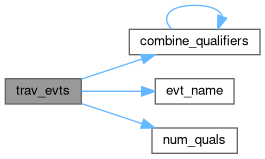
Here is the call graph for this function:
Here is the caller graph for this function: