Loading...
Searching...
No Matches
Include dependency graph for syst_smp.c:

Go to the source code of this file.
Macros | |
| #define | NUM_PMCS PFMLIB_MAX_PMCS |
| #define | NUM_PMDS PFMLIB_MAX_PMDS |
Functions | |
| static void | fatal_error (char *fmt,...) __attribute__((noreturn)) |
| static uint32_t | popcount (uint64_t c) |
| int | main (int argc, char **argv) |
Macro Definition Documentation
◆ NUM_PMCS
| #define NUM_PMCS PFMLIB_MAX_PMCS |
Definition at line 41 of file syst_smp.c.
◆ NUM_PMDS
| #define NUM_PMDS PFMLIB_MAX_PMDS |
Definition at line 42 of file syst_smp.c.
Function Documentation
◆ fatal_error()
|
static |
Definition at line 47 of file syst_smp.c.
48{
49 va_list ap;
50
53 va_end(ap);
54
55 exit(1);
56}
FILE * stderr
va_end(arg_list)
va_start(arg_list, fmt)
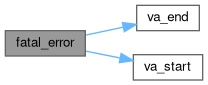
Here is the call graph for this function:
Here is the caller graph for this function:

◆ main()
Definition at line 71 of file syst_smp.c.
72{
73 pfarg_ctx_t ctx;
75 pfarg_pmd_t *pd;
76 pfmlib_input_param_t inp;
77 pfmlib_output_param_t outp;
78 uint64_t cpu_list;
79 void *desc;
80 unsigned int num_counters;
82 size_t len;
83 int ret;
85
88
91
92 memset(&ctx, 0, sizeof(ctx));
93 memset(pc, 0, sizeof(pc));
94
95 ncpus = (uint32_t)sysconf(_SC_NPROCESSORS_ONLN);
98
99 if (argc > 1) {
100 cpu_list = strtoul(argv[1],NULL,0);
103 } else {
104 cpu_list = ((1<<ncpus)-1);
105 }
106
107 /*
108 * use libpfm to prepare some decent PMC/PMD setup
109 */
110 memset(&inp,0, sizeof(inp));
111 memset(&outp,0, sizeof(outp));
112
113 pfm_get_num_counters(&num_counters);
114 pfm_get_max_event_name_len(&len);
115
116 name = malloc(len+1);
119
120
123
126
127 i = 2;
128
130
132 i = num_counters;
134 }
135 /*
136 * how many counters we use
137 */
139
140 /*
141 * indicate we are using the monitors for a system-wide session.
142 * This may impact the way the library sets up the PMC values.
143 */
145
146 /*
147 * let the library figure out the values for the PMCS
148 */
151
152
154
156
158 if (pd == NULL)
160
164 }
165
166 /*
167 * We use inp.pfp_event_count PMD registers for our events per-CPU.
168 * We need to setup the PMDs we use. They are determined based on the
169 * PMC registers used. The following loop prepares the pd[] array
170 * for pfm_write_pmds(). With libpfms, on PMD write we need to pass
171 * only pfp_event_count PMD registers. But on PMD read, we need
172 * to pass pfp_event_count PMD registers per-CPU because libpfms
173 * does not aggregate counts. To prepapre for PMD read, we therefore
174 * propagate the PMD setup beyond just the first pfp_event_count
175 * elements of pd[].
176 */
180 }
181
182 /*
183 * create a context on all CPUs we asked for
184 *
185 * libpfms only works for system-wide, so we set the flag in
186 * the master context. the context argument is not modified by
187 * call.
188 *
189 * desc is an opaque descriptor used to identify session.
190 */
192
193 ret = pfms_create(&cpu_list, 1, &ctx, NULL, &desc);
194 if (ret == -1)
196
197 /*
198 * program the PMC registers on all CPUs of interest
199 */
201 if (ret == -1)
203
204 /*
205 * program the PMD registers on all CPUs of interest
206 */
208 if (ret == -1)
210
211 /*
212 * load context on all CPUs of interest
213 */
214 ret = pfms_load(desc);
215 if (ret == -1)
217
218 printf("monitoring for 10s on all CPUs\n");
219
220 /*
221 * start monitoring on all CPUs of interest
222 */
223 ret = pfms_start(desc);
224 if (ret == -1)
226
227 /*
228 * stop and listen to activity for 10s
229 */
230 sleep(10);
231
232 /*
233 * stop monitoring on all CPUs of interest
234 */
235 ret = pfms_stop(desc);
236 if (ret == -1)
238
239 /*
240 * read the PMD registers on all CPUs of interest.
241 * The pd[] array must be organized such that to
242 * read 2 PMDs on each CPU you need:
243 * - 2 * number of CPUs of interest
244 * - the first 2 elements of pd[] read on CPU0
245 * - the next 2 elements of pd[] read on CPU1
246 * - and so on
247 */
248 ret = pfms_read_pmds(desc, pd, npmds);
249 if (ret == -1)
251
252 /*
253 * print per-CPU results
254 */
258 printf("CPU%-3d PMD%u %20"PRIu64" %s\n",
259 j,
260 pd[k].reg_num,
261 pd[k].reg_value,
262 name);
263 }
264 }
265
266 /*
267 * destroy context on all CPUs of interest.
268 * After this call desc is invalid
269 */
270 ret = pfms_close(desc);
271 if (ret == -1)
273
274 free(name);
275
276 return 0;
277}
int pfms_write_pmcs(void *desc, pfarg_pmc_t *pmcs, uint32_t n)
Definition: libpfms.c:596
int pfms_write_pmds(void *desc, pfarg_pmd_t *pmds, uint32_t n)
Definition: libpfms.c:602
int pfms_create(uint64_t *cpu_list, size_t n, pfarg_ctx_t *ctx, pfms_ovfl_t *ovfl, void **desc)
Definition: libpfms.c:327
int pfms_read_pmds(void *desc, pfarg_pmd_t *pmds, uint32_t n)
Definition: libpfms.c:660
pfm_err_t pfm_get_inst_retired_event(pfmlib_event_t *e)
Definition: pfmlib_common.c:962
pfm_err_t pfm_dispatch_events(pfmlib_input_param_t *p, void *model_in, pfmlib_output_param_t *q, void *model_out)
Definition: pfmlib_common.c:721
pfm_err_t pfm_get_full_event_name(pfmlib_event_t *e, char *name, size_t maxlen)
Definition: pfmlib_common.c:1026
pfm_err_t pfm_get_max_event_name_len(size_t *len)
Definition: pfmlib_common.c:903
pfm_err_t pfm_get_num_counters(unsigned int *num)
Definition: pfmlib_common.c:770
Definition: perfmon_v2.h:18
Definition: perfmon_v2.h:27
Definition: perfmon_v2.h:38
Definition: pfmlib.h:108
Definition: pfmlib.h:126
static void fatal_error(char *fmt,...) __attribute__((noreturn))
Definition: syst_smp.c:47
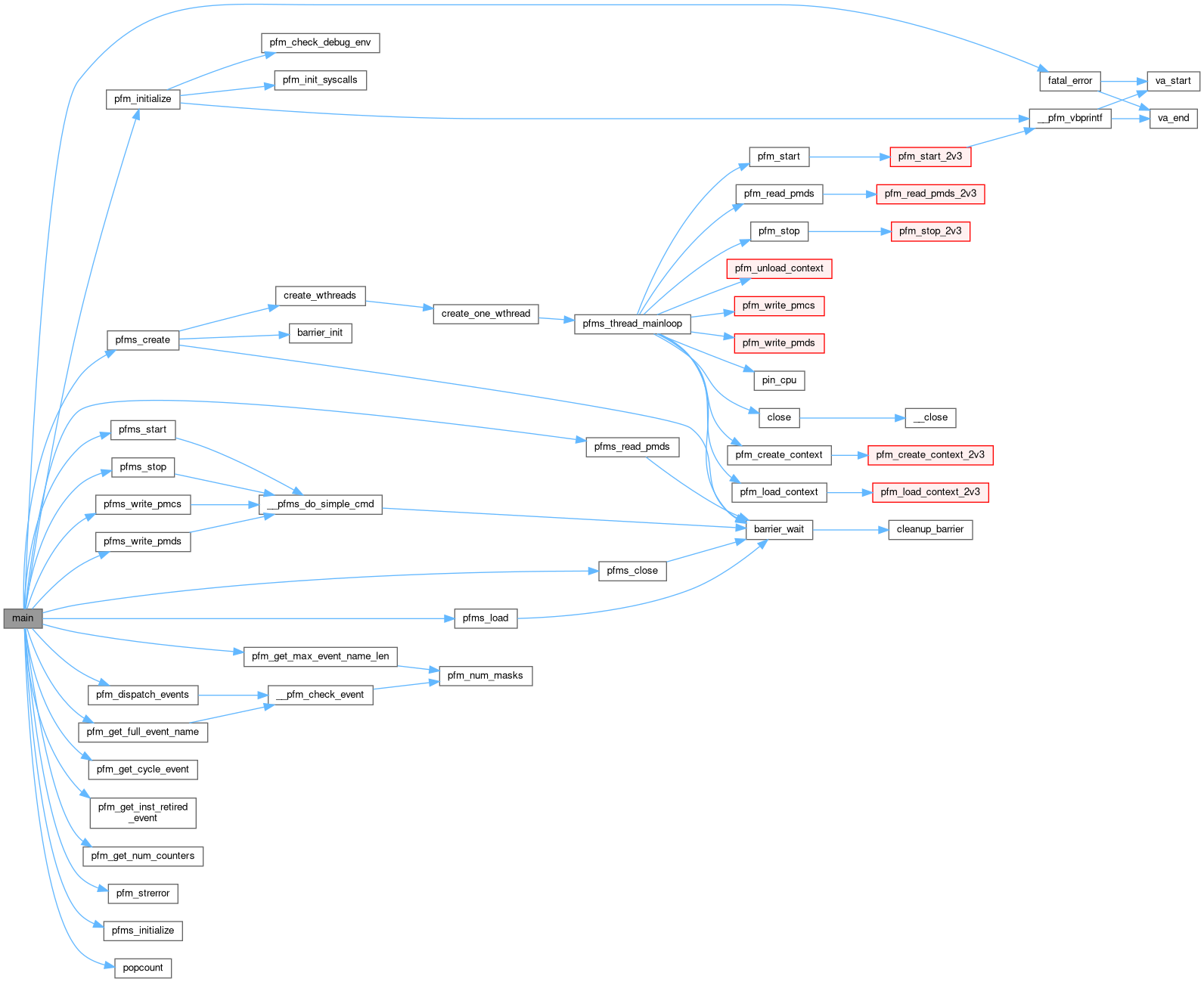
Here is the call graph for this function:
◆ popcount()
|
static |
Definition at line 59 of file syst_smp.c.
Here is the caller graph for this function: