Loading...
Searching...
No Matches
libpfms.c File Reference
Include dependency graph for libpfms.c:

Go to the source code of this file.
Data Structures | |
| struct | barrier_t |
| struct | pfms_cpu_t |
| struct | pfms_thread_t |
| struct | pfms_session_t |
Macros | |
| #define | dprint(format, arg...) |
Enumerations | |
| enum | pfms_cmd_t { CMD_NONE , CMD_CTX , CMD_LOAD , CMD_UNLOAD , CMD_WPMCS , CMD_WPMDS , CMD_RPMDS , CMD_STOP , CMD_START , CMD_CLOSE } |
Functions | |
| static int | barrier_init (barrier_t *b, uint32_t count) |
| static void | cleanup_barrier (void *arg) |
| static int | barrier_wait (barrier_t *b) |
| static int | pin_cpu (uint32_t cpu) |
| static void | pfms_thread_mainloop (void *arg) |
| static int | create_one_wthread (int cpu) |
| static int | create_wthreads (uint64_t *cpu_list, uint32_t n) |
| int | pfms_initialize (void) |
| int | pfms_create (uint64_t *cpu_list, size_t n, pfarg_ctx_t *ctx, pfms_ovfl_t *ovfl, void **desc) |
| int | pfms_load (void *desc) |
| static int | __pfms_do_simple_cmd (pfms_cmd_t cmd, void *desc, void *data, uint32_t n) |
| int | pfms_unload (void *desc) |
| int | pfms_start (void *desc) |
| int | pfms_stop (void *desc) |
| int | pfms_write_pmcs (void *desc, pfarg_pmc_t *pmcs, uint32_t n) |
| int | pfms_write_pmds (void *desc, pfarg_pmd_t *pmds, uint32_t n) |
| int | pfms_close (void *desc) |
| int | pfms_read_pmds (void *desc, pfarg_pmd_t *pmds, uint32_t n) |
Variables | |
| static uint32_t | ncpus |
| static pfms_thread_t * | tds |
| static pthread_mutex_t | tds_lock = PTHREAD_MUTEX_INITIALIZER |
Macro Definition Documentation
◆ dprint
Enumeration Type Documentation
◆ pfms_cmd_t
| enum pfms_cmd_t |
Function Documentation
◆ __pfms_do_simple_cmd()
|
static |
Definition at line 528 of file libpfms.c.
529{
530 size_t k;
532 int ret;
533
534 if (desc == NULL) {
536 return -1;
537 }
539
542 return -1;
543 }
544 /*
545 * send create context order
546 */
552 sem_post(&tds[k].cmd_sem);
553 }
554 }
556
557 ret = 0;
558
559 /*
560 * check for errors
561 */
565 if (ret) {
567 break;
568 }
569 }
570 }
571 /*
572 * simple commands cannot be undone
573 */
574 return ret ? -1 : 0;
575}
Definition: libpfms.c:58
Here is the call graph for this function:

Here is the caller graph for this function:
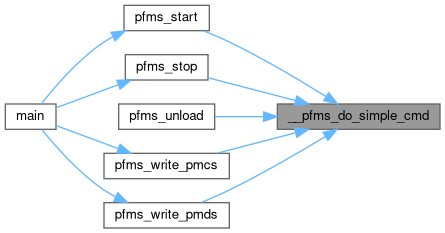
◆ barrier_init()

◆ barrier_wait()
Definition at line 95 of file libpfms.c.
96{
97 uint64_t generation;
98 int oldstate;
99
101
102 pthread_mutex_lock(&b->mutex);
103
104 pthread_testcancel();
105
107
108 /* reset barrier */
110 /*
111 * bump generation number, this avoids thread getting stuck in the
112 * wake up loop below in case a thread just out of the barrier goes
113 * back in right away before all the thread from the previous "round"
114 * have "escaped".
115 */
116 b->generation++;
117
118 pthread_cond_broadcast(&b->cond);
119 } else {
120
121 generation = b->generation;
122
123 pthread_setcancelstate(PTHREAD_CANCEL_ENABLE, &oldstate);
124
127 }
128
129 pthread_setcancelstate(oldstate, NULL);
130 }
131 pthread_mutex_unlock(&b->mutex);
132
133 pthread_cleanup_pop(0);
134
135 return 0;
136}
Here is the call graph for this function:

Here is the caller graph for this function:
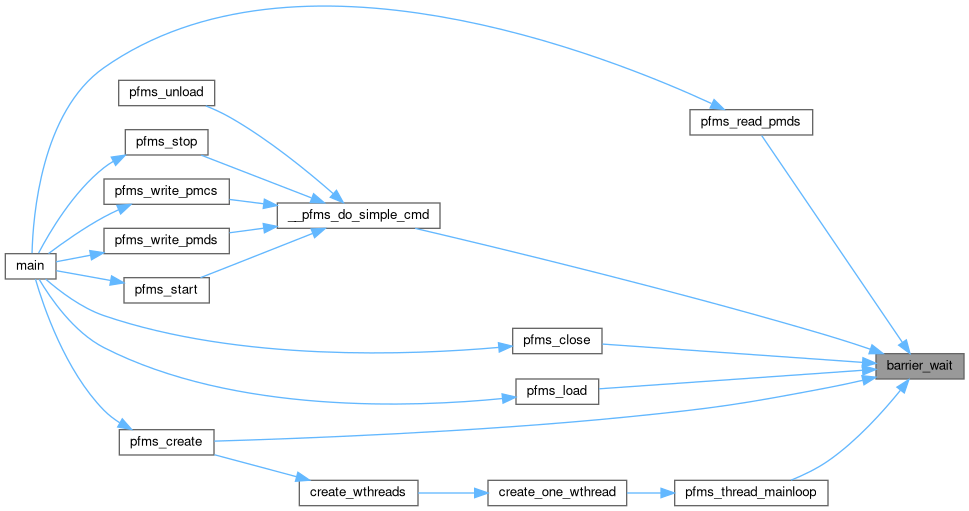
◆ cleanup_barrier()
|
static |

◆ create_one_wthread()
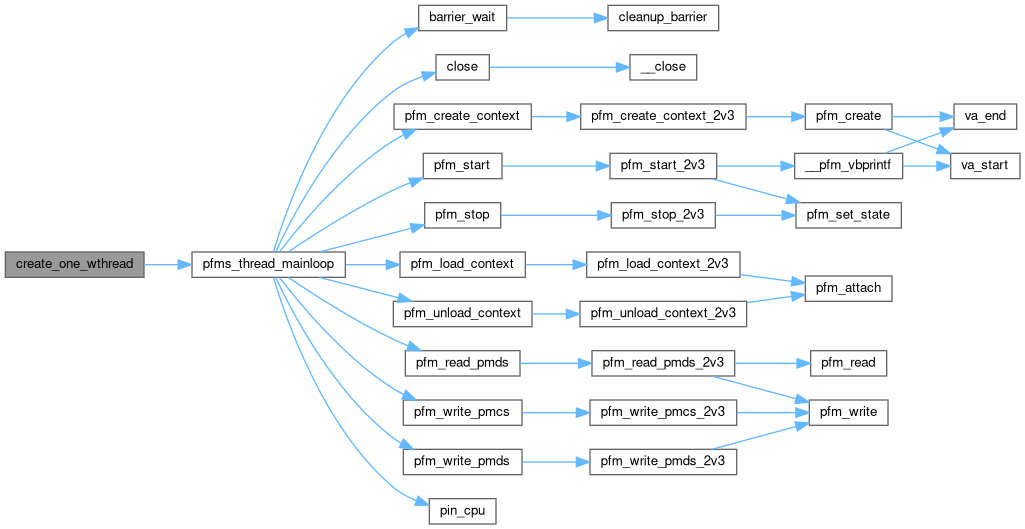

◆ create_wthreads()
|
static |
Definition at line 277 of file libpfms.c.
278{
279 uint64_t v;
280 uint32_t i,k, cpu;
281 int ret = 0;
282
283 for(k=0, cpu = 0; k < n; k++, cpu+= 64) {
284 v = cpu_list[k];
287 ret = create_one_wthread(cpu);
288 if (ret) break;
289 }
290 }
291 }
292
293 if (ret)
295
296 return ret;
297}
Here is the call graph for this function:
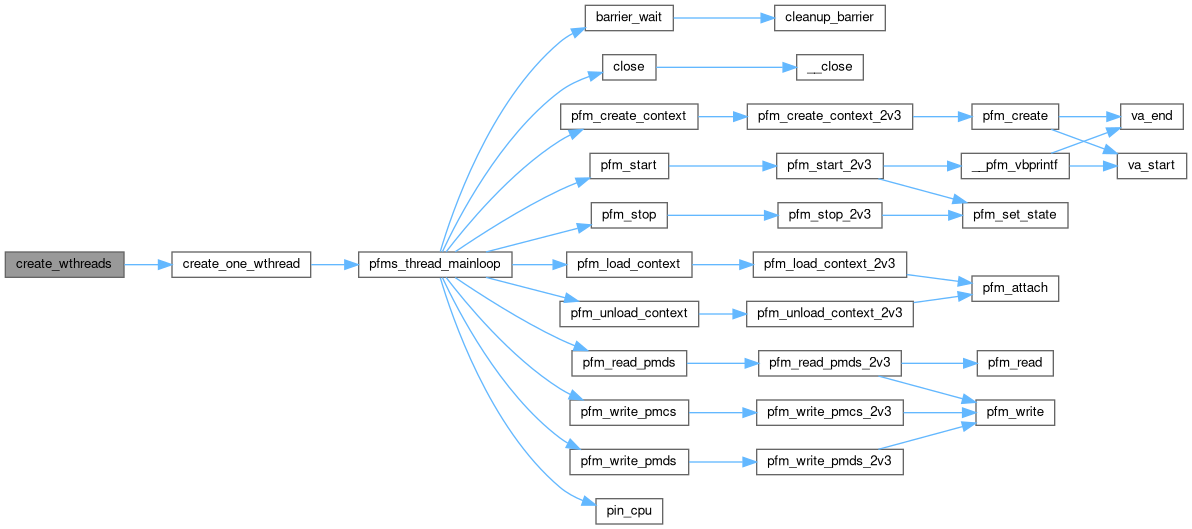
Here is the caller graph for this function:

◆ pfms_close()
| int pfms_close | ( | void * | desc | ) |
Definition at line 608 of file libpfms.c.
609{
610 size_t k;
612 int ret;
613
614 if (desc == NULL) {
616 return -1;
617 }
619
622 return -1;
623 }
624
628 sem_post(&tds[k].cmd_sem);
629 }
630 }
632
633 ret = 0;
634
635 pthread_mutex_lock(&tds_lock);
636 /*
637 * check for errors
638 */
643 }
646 }
647 }
648
649 pthread_mutex_unlock(&tds_lock);
650
651 free(s);
652
653 /*
654 * XXX: we cannot undo close
655 */
656 return ret ? -1 : 0;
657}
Here is the call graph for this function:

Here is the caller graph for this function:

◆ pfms_create()
| int pfms_create | ( | uint64_t * | cpu_list, |
| size_t | n, | ||
| pfarg_ctx_t * | ctx, | ||
| pfms_ovfl_t * | ovfl, | ||
| void ** | desc | ||
| ) |
Definition at line 327 of file libpfms.c.
328{
329 uint64_t v;
331 uint32_t num, cpu;
333 int ret;
334
335 if (cpu_list == NULL || n == 0 || ctx == NULL || desc == NULL) {
337 return -1;
338 }
339
342 return -1;
343 }
344
345 *desc = NULL;
346
347 /*
348 * XXX: assuming CPU are contiguously indexed
349 */
350 num = 0;
351 for(k=0, cpu = 0; k < n; k++, cpu+=64) {
352 v = cpu_list[k];
354 if (v & 0x1) {
357 return -1;
358 }
359 num++;
360 }
361 }
362 }
363
364 if (num == 0)
365 return 0;
366
370 return -1;
371 }
372 s->ncpus = num;
373
374 printf("%u-way session\n", num);
375
376 /*
377 * +1 to account for main thread waiting
378 */
380 if (ret) {
382 goto error_free;
383 }
384
385 /*
386 * lock thread descriptor table, no other create_session, close_session
387 * can occur
388 */
389 pthread_mutex_lock(&tds_lock);
390
392 goto error_free_unlock;
393
394 /*
395 * check all needed threads are available
396 */
397 for(k=0, cpu = 0; k < n; k++, cpu += 64) {
398 v = cpu_list[k];
400 if (v & 0x1) {
403 goto error_free_unlock;
404 }
405
406 }
407 }
408 }
409
410 /*
411 * send create context order
412 */
413 for(k=0, cpu = 0; k < n; k++, cpu += 64) {
414 v = cpu_list[k];
416 if (v & 0x1) {
420 sem_post(&tds[cpu].cmd_sem);
421 }
422 }
423 }
425
426 ret = 0;
427
428 /*
429 * check for errors
430 */
434 if (ret)
435 break;
436 }
437 }
438 /*
439 * undo if error found
440 */
446 sem_post(&tds[k].cmd_sem);
447 }
448 /* mark as free */
450 }
451 }
452 }
453 pthread_mutex_unlock(&tds_lock);
454
456
457 return ret ? -1 : 0;
458
459error_free_unlock:
460 pthread_mutex_unlock(&tds_lock);
461
462error_free:
463 free(s);
464 return -1;
465}
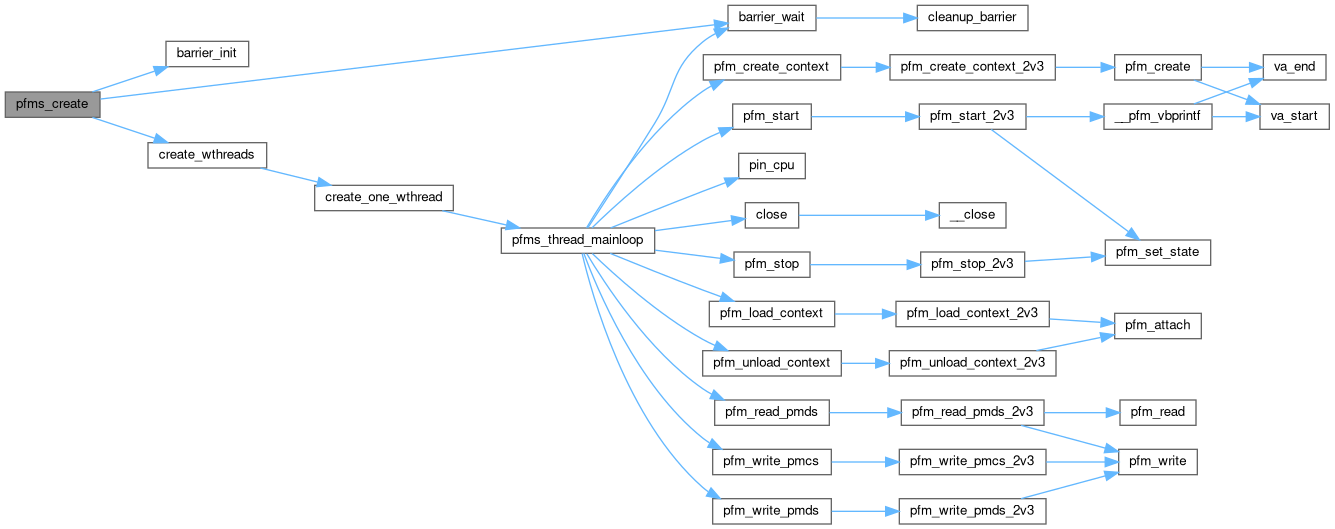
Here is the call graph for this function:
Here is the caller graph for this function:

◆ pfms_initialize()
| int pfms_initialize | ( | void | ) |
Definition at line 300 of file libpfms.c.
301{
302 printf("cpu_t=%zu thread=%zu session_t=%zu\n",
306
307 ncpus = (uint32_t)sysconf(_SC_NPROCESSORS_ONLN);
310 return -1;
311 }
312
314
315 /*
316 * XXX: assuming CPU are contiguously indexed
317 */
321 return -1;
322 }
323 return 0;
324}
Definition: libpfms.c:40
Definition: libpfms.c:47
Here is the caller graph for this function:

◆ pfms_load()
| int pfms_load | ( | void * | desc | ) |
Definition at line 468 of file libpfms.c.
469{
470 uint32_t k;
472 int ret;
473
474 if (desc == NULL) {
476 return -1;
477 }
479
482 return -1;
483 }
484 /*
485 * send create context order
486 */
490 sem_post(&tds[k].cmd_sem);
491 }
492 }
493
495
496 ret = 0;
497
498 /*
499 * check for errors
500 */
504 if (ret) {
506 break;
507 }
508 }
509 }
510
511 /*
512 * if error, unload all others
513 */
519 sem_post(&tds[k].cmd_sem);
520 }
521 }
522 }
523 }
524 return ret ? -1 : 0;
525}
Here is the call graph for this function:

Here is the caller graph for this function:

◆ pfms_read_pmds()
| int pfms_read_pmds | ( | void * | desc, |
| pfarg_pmd_t * | pmds, | ||
| uint32_t | n | ||
| ) |
Definition at line 660 of file libpfms.c.
661{
663 uint32_t k, pmds_per_cpu;
664 int ret;
665
666 if (desc == NULL) {
668 return -1;
669 }
671
674 return -1;
675 }
678 return -1;
679 }
680 pmds_per_cpu = n / s->ncpus;
681
683
689 sem_post(&tds[k].cmd_sem);
690 pmds += pmds_per_cpu;
691 }
692 }
694
695 ret = 0;
696
697 /*
698 * check for errors
699 */
703 if (ret) {
705 break;
706 }
707 }
708 }
709 /*
710 * cannot undo pfm_read_pmds
711 */
712 return ret ? -1 : 0;
713}
Here is the call graph for this function:

Here is the caller graph for this function:

◆ pfms_start()
| int pfms_start | ( | void * | desc | ) |
Definition at line 584 of file libpfms.c.
585{
587}
static int __pfms_do_simple_cmd(pfms_cmd_t cmd, void *desc, void *data, uint32_t n)
Definition: libpfms.c:528
Here is the call graph for this function:

Here is the caller graph for this function:

◆ pfms_stop()
| int pfms_stop | ( | void * | desc | ) |


◆ pfms_thread_mainloop()
|
static |
Definition at line 172 of file libpfms.c.
173{
175 uint32_t mycpu = (uint32_t)k;
176 pfarg_ctx_t myctx, *ctx;
177 pfarg_load_t load_args;
178 int fd = -1;
179 pfms_thread_t *td;
180 sem_t *cmd_sem;
181 int ret = 0;
182
183 memset(&load_args, 0, sizeof(load_args));
184 load_args.load_pid = mycpu;
185 td = tds+mycpu;
186
187 ret = pin_cpu(mycpu);
189
191
192 for(;;) {
194
195 sem_wait(cmd_sem);
196
199 ret = 0;
200 break;
201
203
204 /*
205 * copy context to get private fd
206 */
207 ctx = td->data;
208 myctx = *ctx;
209
210 fd = pfm_create_context(&myctx, NULL, NULL, 0);
211 ret = fd < 0 ? -1 : 0;
213 break;
214
216 ret = pfm_load_context(fd, &load_args);
218 break;
220 ret = pfm_unload_context(fd);
222 break;
224 ret = pfm_start(fd, NULL);
226 break;
228 ret = pfm_stop(fd);
230 break;
234 break;
238 break;
242 break;
245 ret = close(fd);
246 fd = -1;
247 break;
248 default:
249 break;
250 }
251 td->ret = ret;
252
254
256 }
257}
int errno
os_err_t pfm_write_pmds(int fd, pfarg_pmd_t *pmds, int count)
Definition: pfmlib_os_linux_v2.c:528
os_err_t pfm_write_pmcs(int fd, pfarg_pmc_t *pmcs, int count)
Definition: pfmlib_os_linux_v2.c:520
os_err_t pfm_create_context(pfarg_ctx_t *ctx, char *smpl_name, void *smpl_arg, size_t smpl_size)
Definition: pfmlib_os_linux_v2.c:483
os_err_t pfm_load_context(int fd, pfarg_load_t *load)
Definition: pfmlib_os_linux_v2.c:417
os_err_t pfm_read_pmds(int fd, pfarg_pmd_t *pmds, int count)
Definition: pfmlib_os_linux_v2.c:536
Definition: perfmon_v2.h:18
Definition: perfmon_v2.h:68
Definition: perfmon_v2.h:27
Definition: perfmon_v2.h:38
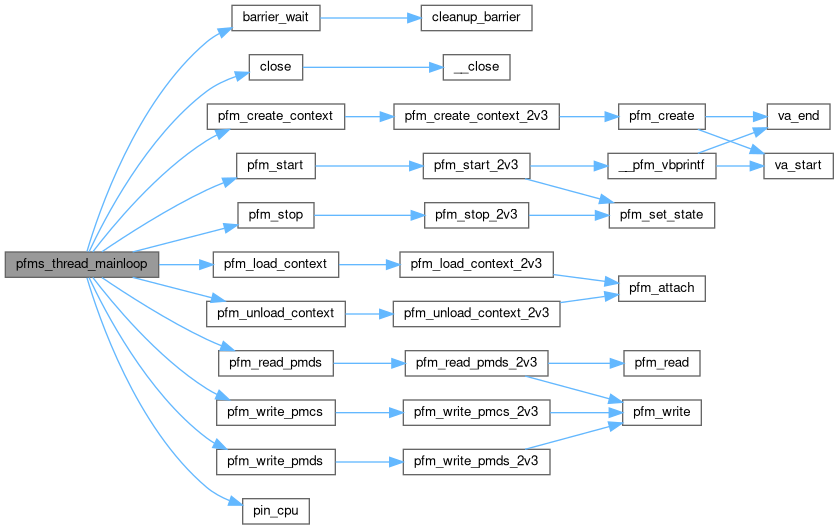
Here is the call graph for this function:
Here is the caller graph for this function:

◆ pfms_unload()
| int pfms_unload | ( | void * | desc | ) |

◆ pfms_write_pmcs()
| int pfms_write_pmcs | ( | void * | desc, |
| pfarg_pmc_t * | pmcs, | ||
| uint32_t | n | ||
| ) |


◆ pfms_write_pmds()
| int pfms_write_pmds | ( | void * | desc, |
| pfarg_pmd_t * | pmds, | ||
| uint32_t | n | ||
| ) |


◆ pin_cpu()
|
static |
Definition at line 146 of file libpfms.c.
147{
148 uint64_t *mask;
149 size_t size;
150 pid_t pid;
151 int ret;
152
153 pid = syscall(__NR_gettid);
154
156
157 mask = calloc(1, size);
158 if (mask == NULL) {
160 return -1;
161 }
162 mask[cpu>>6] = 1ULL << (cpu & 63);
163
164 ret = syscall(__NR_sched_setaffinity, pid, size, mask);
165
166 free(mask);
167
168 return ret;
169}
Here is the caller graph for this function:

Variable Documentation
◆ ncpus
◆ tds
|
static |
◆ tds_lock
|
static |