Loading...
Searching...
No Matches
x86_cpuid_info.c File Reference
Include dependency graph for x86_cpuid_info.c:

Go to the source code of this file.
Data Structures | |
| struct | _intel_cache_info |
Macros | |
| #define | TLB_SIZES 3 /* number of different page sizes for a single TLB descriptor */ |
Functions | |
| static void | init_mem_hierarchy (PAPI_mh_info_t *mh_info) |
| static int | init_amd (PAPI_mh_info_t *mh_info, int *levels) |
| static short int | _amd_L2_L3_assoc (unsigned short int pattern) |
| static int | init_intel (PAPI_mh_info_t *mh_info, int *levels) |
| static void | cpuid (unsigned int *a, unsigned int *b, unsigned int *c, unsigned int *d) |
| int | _x86_cache_info (PAPI_mh_info_t *mh_info) |
| static void | print_intel_cache_table () |
| static void | intel_decode_descriptor (struct _intel_cache_info *d, PAPI_mh_level_t *L) |
| static void | cpuid2 (unsigned int *eax, unsigned int *ebx, unsigned int *ecx, unsigned int *edx, unsigned int index, unsigned int ecx_in) |
| static int | init_intel_leaf4 (PAPI_mh_info_t *mh_info, int *num_levels) |
| static int | init_intel_leaf2 (PAPI_mh_info_t *mh_info, int *num_levels) |
| int | _x86_detect_hypervisor (char *vendor_name) |
Variables | |
| static struct _intel_cache_info | intel_cache [] |
Macro Definition Documentation
◆ TLB_SIZES
| #define TLB_SIZES 3 /* number of different page sizes for a single TLB descriptor */ |
Definition at line 359 of file x86_cpuid_info.c.
Function Documentation
◆ _amd_L2_L3_assoc()
Definition at line 115 of file x86_cpuid_info.c.
116{
117 /* From "CPUID Specification" #25481 Rev 2.28, April 2008 */
118 short int assoc[16] =
119 { 0, 1, 2, -1, 4, -1, 8, -1, 16, -1, 32, 48, 64, 96, 128, SHRT_MAX };
120 if ( pattern > 0xF )
121 return -1;
122 return ( assoc[pattern] );
123}
Here is the caller graph for this function:

◆ _x86_cache_info()
| int _x86_cache_info | ( | PAPI_mh_info_t * | mh_info | ) |
Definition at line 50 of file x86_cpuid_info.c.
51{
53 union
54 {
55 struct
56 {
57 unsigned int ax, bx, cx, dx;
58 } e;
59 char vendor[20]; /* leave room for terminator bytes */
60 } reg;
61
62 /* Don't use cpu_type to determine the processor.
63 * get the information directly from the chip.
64 */
65 reg.e.ax = 0; /* function code 0: vendor string */
66 /* The vendor string is composed of EBX:EDX:ECX.
67 * by swapping the register addresses in the call below,
68 * the string is correctly composed in the char array.
69 */
70 cpuid( ®.e.ax, ®.e.bx, ®.e.dx, ®.e.cx );
71 reg.vendor[16] = 0;
73
74 init_mem_hierarchy( mh_info );
75
76 if ( !strncmp( "GenuineIntel", ®.vendor[4], 12 ) ) {
78 } else if ( !strncmp( "AuthenticAMD", ®.vendor[4], 12 ) ) {
80 } else {
83 }
84
85 /* This works only because an empty cache element is initialized to 0 */
91}
static void cpuid(unsigned int *a, unsigned int *b, unsigned int *c, unsigned int *d)
Definition: x86_cpuid_info.c:35
static int init_intel(PAPI_mh_info_t *mh_info, int *levels)
Definition: x86_cpuid_info.c:1484
static void init_mem_hierarchy(PAPI_mh_info_t *mh_info)
Definition: x86_cpuid_info.c:94
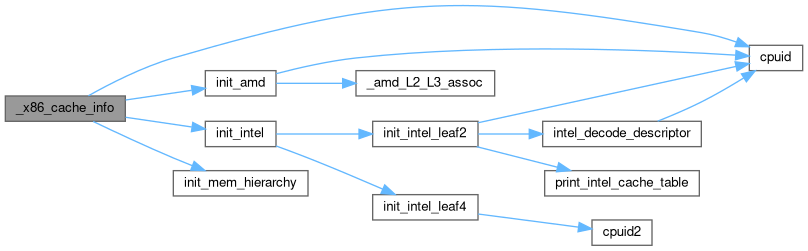
Here is the call graph for this function:
◆ _x86_detect_hypervisor()
| int _x86_detect_hypervisor | ( | char * | vendor_name | ) |
Definition at line 1507 of file x86_cpuid_info.c.
1508{
1509 unsigned int eax, ebx, ecx, edx;
1510 char hyper_vendor_id[13];
1511
1512 cpuid2(&eax, &ebx, &ecx, &edx,0x1,0);
1513 /* This is the hypervisor bit, ecx bit 31 */
1514 if (ecx&0x80000000) {
1515 /* There are various values in the 0x4000000X range */
1516 /* It is questionable how standard they are */
1517 /* For now we just return the name. */
1518 cpuid2(&eax, &ebx, &ecx, &edx, 0x40000000,0);
1519 memcpy(hyper_vendor_id + 0, &ebx, 4);
1520 memcpy(hyper_vendor_id + 4, &ecx, 4);
1521 memcpy(hyper_vendor_id + 8, &edx, 4);
1522 hyper_vendor_id[12] = '\0';
1523 strncpy(vendor_name,hyper_vendor_id,PAPI_MAX_STR_LEN);
1524 return 1;
1525 }
1526 else {
1528 }
1529 return 0;
1530}
static void cpuid2(unsigned int *eax, unsigned int *ebx, unsigned int *ecx, unsigned int *edx, unsigned int index, unsigned int ecx_in)
Definition: x86_cpuid_info.c:1272
Here is the call graph for this function:

Here is the caller graph for this function:

◆ cpuid()
|
inlinestatic |
Definition at line 35 of file x86_cpuid_info.c.
36{
38 // .byte 0x53 == push ebx. it's universal for 32 and 64 bit
39 // .byte 0x5b == pop ebx.
40 // Some gcc's (4.1.2 on Core2) object to pairing push/pop and ebx in 64 bit mode.
41 // Using the opcode directly avoids this problem.
42 __asm__ __volatile__( ".byte 0x53\n\tcpuid\n\tmovl %%ebx, %%esi\n\t.byte 0x5b":"=a"( *a ), "=S"( *b ), "=c"( *c ),
43 "=d"
44 ( *d )
45 : "a"( op ) );
46}
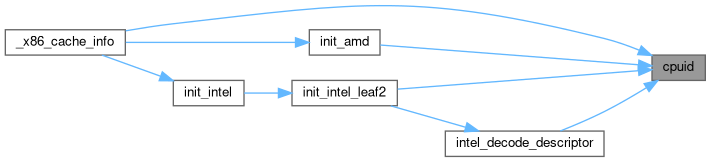
Here is the caller graph for this function:
◆ cpuid2()
|
inlinestatic |
Definition at line 1272 of file x86_cpuid_info.c.
1275{
1277 __asm__ __volatile__ (".byte 0x53\n\tcpuid\n\tmovl %%ebx, %%esi\n\t.byte 0x5b"
1279 : "0" (index), "2"(ecx_in) );
1281}
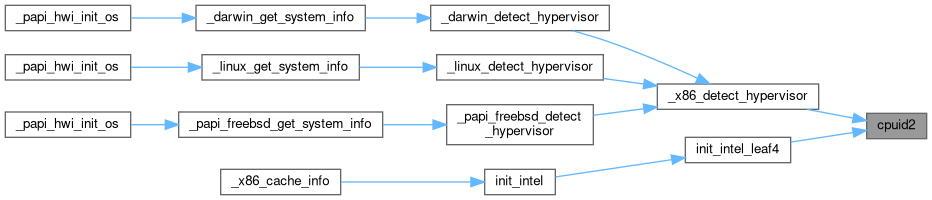
Here is the caller graph for this function:
◆ init_amd()
|
static |
Definition at line 127 of file x86_cpuid_info.c.
128{
129 union
130 {
131 struct
132 {
133 unsigned int ax, bx, cx, dx;
134 } e;
135 unsigned char byt[16];
136 } reg;
139
140 /*
141 * Layout of CPU information taken from :
142 * "CPUID Specification" #25481 Rev 2.28, April 2008 for most current info.
143 */
144
146 /* AMD level 1 cache info */
147 reg.e.ax = 0x80000005; /* extended function code 5: L1 Cache and TLB Identifiers */
148 cpuid( ®.e.ax, ®.e.bx, ®.e.cx, ®.e.dx );
149
151 reg.e.ax, reg.e.bx, reg.e.cx, reg.e.dx );
152 MEMDBG
153 ( ":\neax: %#x %#x %#x %#x\nebx: %#x %#x %#x %#x\necx: %#x %#x %#x %#x\nedx: %#x %#x %#x %#x\n",
154 reg.byt[0], reg.byt[1], reg.byt[2], reg.byt[3], reg.byt[4],
155 reg.byt[5], reg.byt[6], reg.byt[7], reg.byt[8], reg.byt[9],
156 reg.byt[10], reg.byt[11], reg.byt[12], reg.byt[13], reg.byt[14],
157 reg.byt[15] );
158
159 /* NOTE: We assume L1 cache and TLB always exists */
160 /* L1 TLB info */
161
162 /* 4MB memory page information; half the number of entries as 2MB */
167
172
173 /* 2MB memory page information */
178
183
184 /* 4k page information */
189
194
198 }
199
200 /* L1 D-cache info */
206 /* Byt[9] is "Lines per tag" */
207 /* Is that == lines per cache? */
208 /* L[0].cache[1].num_lines = reg.byt[9]; */
209 if ( L[0].cache[0].line_size )
212 L[0].cache[0].num_lines );
213
214 /* L1 I-cache info */
219 /* Byt[13] is "Lines per tag" */
220 /* Is that == lines per cache? */
221 /* L[0].cache[1].num_lines = reg.byt[13]; */
222 if ( L[0].cache[1].line_size )
225 L[0].cache[1].num_lines );
226
230 }
231
232 /* AMD L2/L3 Cache and L2 TLB info */
233 /* NOTE: For safety we assume L2 and L3 cache and TLB may not exist */
234
235 reg.e.ax = 0x80000006; /* extended function code 6: L2/L3 Cache and L2 TLB Identifiers */
236 cpuid( ®.e.ax, ®.e.bx, ®.e.cx, ®.e.dx );
237
239 reg.e.ax, reg.e.bx, reg.e.cx, reg.e.dx );
240 MEMDBG
241 ( ":\neax: %#x %#x %#x %#x\nebx: %#x %#x %#x %#x\necx: %#x %#x %#x %#x\nedx: %#x %#x %#x %#x\n",
242 reg.byt[0], reg.byt[1], reg.byt[2], reg.byt[3], reg.byt[4],
243 reg.byt[5], reg.byt[6], reg.byt[7], reg.byt[8], reg.byt[9],
244 reg.byt[10], reg.byt[11], reg.byt[12], reg.byt[13], reg.byt[14],
245 reg.byt[15] );
246
247 /* L2 TLB info */
248
249 if ( reg.byt[0] | reg.byt[1] ) { /* Level 2 ITLB exists */
250 /* 4MB ITLB page information; half the number of entries as 2MB */
253 ( ( ( short ) ( reg.byt[1] & 0xF ) << 8 ) + reg.byt[0] ) / 2;
256 _amd_L2_L3_assoc( ( reg.byt[1] & 0xF0 ) >> 4 );
257
258 /* 2MB ITLB page information */
263 }
264
265 if ( reg.byt[2] | reg.byt[3] ) { /* Level 2 DTLB exists */
266 /* 4MB DTLB page information; half the number of entries as 2MB */
269 ( ( ( short ) ( reg.byt[3] & 0xF ) << 8 ) + reg.byt[2] ) / 2;
272 _amd_L2_L3_assoc( ( reg.byt[3] & 0xF0 ) >> 4 );
273
274 /* 2MB DTLB page information */
279 }
280
281 /* 4k page information */
282 if ( reg.byt[4] | reg.byt[5] ) { /* Level 2 ITLB exists */
285 ( ( short ) ( reg.byt[5] & 0xF ) << 8 ) + reg.byt[4];
286 L[1].tlb[4].page_size = 4 << 10;
287 L[1].tlb[4].associativity =
288 _amd_L2_L3_assoc( ( reg.byt[5] & 0xF0 ) >> 4 );
289 }
290 if ( reg.byt[6] | reg.byt[7] ) { /* Level 2 DTLB exists */
293 ( ( short ) ( reg.byt[7] & 0xF ) << 8 ) + reg.byt[6];
294 L[1].tlb[5].page_size = 4 << 10;
295 L[1].tlb[5].associativity =
296 _amd_L2_L3_assoc( ( reg.byt[7] & 0xF0 ) >> 4 );
297 }
298
299 /* AMD Level 2 cache info */
300 if ( reg.e.cx ) {
303 L[1].cache[0].size = ( int ) ( ( reg.e.cx & 0xffff0000 ) >> 6 ); /* right shift by 16; multiply by 2^10 */
305 _amd_L2_L3_assoc( ( reg.byt[9] & 0xF0 ) >> 4 );
307/* L[1].cache[0].num_lines = reg.byt[9]&0xF; */
308 if ( L[1].cache[0].line_size )
312 L[1].cache[0].num_lines );
313 }
314
315 /* AMD Level 3 cache info (shared across cores) */
316 if ( reg.e.dx ) {
321 _amd_L2_L3_assoc( ( reg.byt[13] & 0xF0 ) >> 4 );
323/* L[2].cache[0].num_lines = reg.byt[13]&0xF; */
324 if ( L[2].cache[0].line_size )
328 L[1].cache[0].num_lines );
329 }
332 /* Compute the number of levels of hierarchy actually used */
335 levels = i + 1;
336 }
337 }
338 *num_levels = levels;
340}
Definition: papi.h:760
static short int _amd_L2_L3_assoc(unsigned short int pattern)
Definition: x86_cpuid_info.c:115
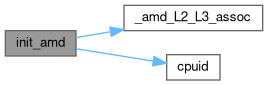
Here is the call graph for this function:
Here is the caller graph for this function:

◆ init_intel()
|
static |
Definition at line 1484 of file x86_cpuid_info.c.
1485{
1486
1488 int num_levels;
1489
1490 /* try using the oldest leaf2 method first */
1492
1494 /* All Core2 and newer also support leaf4 detection */
1495 /* Starting with Westmere *only* leaf4 is supported */
1497 }
1498
1499 *levels=num_levels;
1501}
static int init_intel_leaf2(PAPI_mh_info_t *mh_info, int *num_levels)
Definition: x86_cpuid_info.c:1395
static int init_intel_leaf4(PAPI_mh_info_t *mh_info, int *num_levels)
Definition: x86_cpuid_info.c:1286
Here is the call graph for this function:
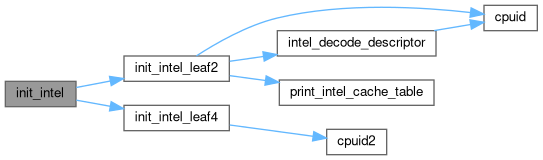
Here is the caller graph for this function:

◆ init_intel_leaf2()
|
static |
Definition at line 1395 of file x86_cpuid_info.c.
1396{
1397 /* cpuid() returns memory copies of 4 32-bit registers
1398 * this union allows them to be accessed as either registers
1399 * or individual bytes. Remember that Intel is little-endian.
1400 */
1401 union
1402 {
1403 struct
1404 {
1405 unsigned int ax, bx, cx, dx;
1406 } e;
1407 unsigned char descrip[16];
1408 } reg;
1409
1410 int r; /* register boundary index */
1413 int t; /* table index into the static descriptor table */
1415 int size; /* size of the descriptor table */
1416 int last_level = 0; /* how many levels in the cache hierarchy */
1417
1418 /* All of Intel's cache info is in 1 call to cpuid
1419 * however it is a table lookup :(
1420 */
1422
1423#ifdef DEBUG
1425 print_intel_cache_table( );
1426#endif
1427
1428 reg.e.ax = 0x2; /* function code 2: cache descriptors */
1429 cpuid( ®.e.ax, ®.e.bx, ®.e.cx, ®.e.dx );
1430
1432 reg.e.ax, reg.e.bx, reg.e.cx, reg.e.dx );
1433 MEMDBG
1434 ( ":\nd0: %#x %#x %#x %#x\nd1: %#x %#x %#x %#x\nd2: %#x %#x %#x %#x\nd3: %#x %#x %#x %#x\n",
1435 reg.descrip[0], reg.descrip[1], reg.descrip[2], reg.descrip[3],
1436 reg.descrip[4], reg.descrip[5], reg.descrip[6], reg.descrip[7],
1437 reg.descrip[8], reg.descrip[9], reg.descrip[10], reg.descrip[11],
1438 reg.descrip[12], reg.descrip[13], reg.descrip[14], reg.descrip[15] );
1439
1441
1442 /* Knights Corner at least returns 0 here */
1444
1447 count );
1450 }
1451
1452 for ( r = 0; r < 4; r++ ) { /* walk the registers */
1453 if ( ( reg.descrip[r * 4 + 3] & 0x80 ) == 0 ) { /* only process if high order bit is 0 */
1460 /* we might continue instead */
1461 /* in order to get TLB info */
1462 /* continue; */
1463 }
1464 for ( t = 0; t < size; t++ ) { /* walk the descriptor table */
1469 mh_info->level );
1470 }
1471 }
1472 }
1473 }
1474 }
1475 }
1476early_exit:
1478 *num_levels=last_level;
1480}
FILE * stderr
Definition: x86_cpuid_info.c:361
static void intel_decode_descriptor(struct _intel_cache_info *d, PAPI_mh_level_t *L)
Definition: x86_cpuid_info.c:1210
Here is the call graph for this function:
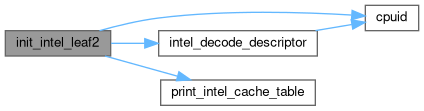
Here is the caller graph for this function:

◆ init_intel_leaf4()
|
static |
Definition at line 1286 of file x86_cpuid_info.c.
1287{
1288
1289 unsigned int eax, ebx, ecx, edx;
1290 unsigned int maxidx, ecx_in;
1291 int next;
1292
1293 int cache_type,cache_level,cache_selfinit,cache_fullyassoc;
1294 int cache_linesize,cache_partitions,cache_ways,cache_sets;
1295
1297
1298 *num_levels=0;
1299
1300 cpuid2(&eax,&ebx,&ecx,&edx, 0, 0);
1301 maxidx = eax;
1302
1303 if (maxidx<4) {
1306 }
1307
1308 ecx_in=0;
1309 while(1) {
1310 cpuid2(&eax,&ebx,&ecx,&edx, 4, ecx_in);
1311
1312
1313
1314 /* decoded as per table 3-12 in Intel Software Developer's Manual Volume 2A */
1315
1316 cache_type=eax&0x1f;
1317 if (cache_type==0) break;
1318
1319 cache_level=(eax>>5)&0x3;
1320 cache_selfinit=(eax>>8)&0x1;
1321 cache_fullyassoc=(eax>>9)&0x1;
1322
1323 cache_linesize=(ebx&0xfff)+1;
1324 cache_partitions=((ebx>>12)&0x3ff)+1;
1325 cache_ways=((ebx>>22)&0x3ff)+1;
1326
1327 cache_sets=(ecx)+1;
1328
1329 /* should we export this info?
1330
1331 cache_maxshare=((eax>>14)&0xfff)+1;
1332 cache_maxpackage=((eax>>26)&0x3f)+1;
1333
1334 cache_wb=(edx)&1;
1335 cache_inclusive=(edx>>1)&1;
1336 cache_indexing=(edx>>2)&1;
1337 */
1338
1339 if (cache_level>*num_levels) *num_levels=cache_level;
1340
1341 /* find next slot available to hold cache info */
1344 }
1345
1347
1348 switch(cache_type) {
1351 break;
1354 break;
1357 break;
1358 }
1359
1362
1363 //MEMDBG("\tMax logical processors sharing cache: %d\n",cache_maxshare);
1364 //MEMDBG("\tMax logical processors sharing package: %d\n",cache_maxpackage);
1365
1367
1370
1373 (cache_ways*cache_partitions*cache_linesize*cache_sets)/1024);
1374
1375 //MEMDBG("\tWBINVD/INVD acts on lower caches: %d\n",cache_wb);
1376 //MEMDBG("\tCache is not inclusive: %d\n",cache_inclusive);
1377 //MEMDBG("\tComplex cache indexing: %d\n",cache_indexing);
1378
1379 c->line_size=cache_linesize;
1380 if (cache_fullyassoc) {
1381 c->associativity=SHRT_MAX;
1382 }
1383 else {
1384 c->associativity=cache_ways;
1385 }
1386 c->size=(cache_ways*cache_partitions*cache_linesize*cache_sets);
1387 c->num_lines=cache_ways*cache_partitions*cache_sets;
1388
1389 ecx_in++;
1390 }
1392}
Definition: papi.h:751
Here is the call graph for this function:

Here is the caller graph for this function:

◆ init_mem_hierarchy()
|
static |
Definition at line 94 of file x86_cpuid_info.c.
95{
98
99 /* initialize entire memory hierarchy structure to benign values */
110 }
111 }
112}
Here is the caller graph for this function:

◆ intel_decode_descriptor()
|
static |
Definition at line 1210 of file x86_cpuid_info.c.
1211{
1214 PAPI_mh_tlb_info_t *t;
1216
1218 unsigned int r_eax, r_ebx, r_ecx, r_edx;
1219 r_eax = 0x1; /* function code 1: family & model */
1220 cpuid( &r_eax, &r_ebx, &r_ecx, &r_edx );
1221 /* override table for Family F, model 6 only */
1222 if ( ( r_eax & 0x0FFF3FF0 ) == 0xF60 )
1223 level = 3;
1224 }
1228 break;
1229 }
1230 /* expand TLB entries for multiple possible page sizes */
1232 i++, next++ ) {
1233// printf("Level %d Descriptor: %#x TLB type %#x next: %d, i: %d\n", level, d->descriptor, d->type, next, i);
1234 t = &L[level].tlb[next];
1239 /* another special case */
1242 }
1243 } else {
1246 break;
1247 }
1248// printf("Level %d Descriptor: %#x Cache type %#x next: %d\n", level, d->descriptor, d->type, next);
1256 }
1257 }
1258}
Definition: papi.h:743
Here is the call graph for this function:

Here is the caller graph for this function:

◆ print_intel_cache_table()
|
static |
Definition at line 1183 of file x86_cpuid_info.c.
1184{
1192 printf( "\t Size(s): " );
1195 printf( "\n" );
1200 printf( "\n" );
1201 }
1202}
Here is the caller graph for this function:

Variable Documentation
◆ intel_cache
|
static |
Definition at line 372 of file x86_cpuid_info.c.