Loading...
Searching...
No Matches
Include dependency graph for ppc/tests/powercap_limit.c:
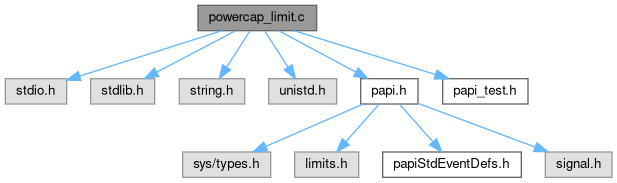
Go to the source code of this file.
Macros | |
| #define | MAX_powercap_EVENTS 64 |
| Tests basic functionality of powercap component. | |
Functions | |
| int | main (int argc, char **argv) |
Macro Definition Documentation
◆ MAX_powercap_EVENTS
| #define MAX_powercap_EVENTS 64 |
Definition at line 16 of file ppc/tests/powercap_limit.c.
Function Documentation
◆ main()
Definition at line 18 of file ppc/tests/powercap_limit.c.
19{
20 (void) argv;
21 (void) argc;
26 int code;
30
32 PAPI_event_info_t evinfo;
33
35
36 /* PAPI Initialization */
40
41 numcmp = PAPI_num_components();
42
43 for( cid=0; cid<numcmp; cid++ ) {
46
48 powercap_cid=cid;
52 printf( "powercap_ppc component disabled: %s\n",
53 cmpinfo->disabled_reason );
54 }
56 }
57 break;
58 }
59 }
60
61 /* Component not found */
62 if ( cid==numcmp )
64
65 /* Skip if component has no counters */
68
69 /* Create EventSet */
73
74 /* Add all events */
75 code = PAPI_NATIVE_MASK;
81
85
87
89 break; /* We've hit an event limit */
90 num_events++;
91
93 }
94
96
99
101
102 long long Pmin = 424242, Pmax = 42, Pcurrent = 42, Ptarget, Pold;
103
105 int iPcurrent = -1;
110
113
116
118 iPcurrent = i;
120 }
121 }
122
123
124 if (Pmin <= Pmax) {
125 Pold = Pcurrent;
126 /* Let's try to cap at 40% */
127 Ptarget = Pmin + 0.4 * (Pmax - Pmin);
128 /* Ok, current cap was 40%, so let's make it 60% */
129 if (Pold == Ptarget) Ptarget = Pmin + 0.6 * (Pmax - Pmin);
130
132 fprintf(stdout, "Current capping is Pcurrent = %lld W.\nCapping with Ptarget = %lld W\n", Pold, Ptarget);
133
134 values[iPcurrent] = Ptarget;
135
137 long long after = before;
138
140
141 if (!quiet) fprintf(stdout, "Changing the power capping might take some time.\nThe test will time out after 10 seconds.\n");
142 do {
143 /* Give everyone some time to realize it */
144 usleep(100000);
145 after = PAPI_get_real_nsec();
149
151 /* test failure */
152 if (!quiet) fprintf(stdout, "\nPcurrent read = %lld W, target was %lld W\n", values[iPcurrent], Ptarget);
153 } else {
154 /* we have a success here */
155 if (!quiet) fprintf(stdout, "\nPcurrent read = %lld W, target was %lld W\n", values[iPcurrent], Ptarget);
156 /* let's clean behind us, revert to previous capping */
157 values[iPcurrent] = Pold;
160
161 do {
162 usleep(100000);
165 passed = 1;
166 }
167 }
168 else {
169 passed = 0;
170 fprintf(stderr, "Power capping values read seems wrong: Pmin = %lld W; Pmax = %lld W; Pcurrent = %lld W\n",
171 Pmin, Pmax, Pcurrent);
172 }
173
175
176 if (passed)
178 else
180
181 /* Done, clean up */
185
189
190 return 0;
191}
add PAPI preset or native hardware event to an event set
Empty and destroy an EventSet.
Create a new empty PAPI EventSet.
Empty and destroy an EventSet.
Enumerate PAPI preset or native events for a given component.
Convert a numeric hardware event code to a name.
get information about a specific software component
Get the event's name and description info.
Get real time counter value in nanoseconds.
initialize the PAPI library.
Get the number of components available on the system.
Read hardware counters from an event set.
Start counting hardware events in an event set.
Stop counting hardware events in an event set.
Write counter values into counters.
FILE * stdout
FILE * stderr
#define MAX_powercap_EVENTS
Tests basic functionality of powercap component.
Definition: ppc/tests/powercap_limit.c:16
Definition: papi.h:626
Definition: papi.h:957