Loading...
Searching...
No Matches
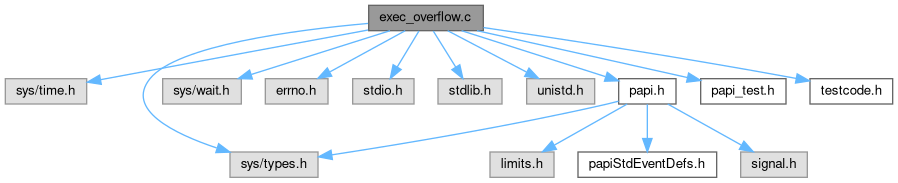
Include dependency graph for exec_overflow.c:
Go to the source code of this file.
Macros | |
| #define | MAX_EVENTS 3 |
Functions | |
| static void | my_handler (int EventSet, void *pc, long long ovec, void *context) |
| static void | print_rate (const char *str) |
| static void | run (const char *str, int len) |
| int | main (int argc, char **argv) |
Variables | |
| static int | Event [MAX_EVENTS] |
| static int | Threshold [MAX_EVENTS] |
| static struct timeval start | last |
| static long | count |
| static long | total |
Macro Definition Documentation
◆ MAX_EVENTS
| #define MAX_EVENTS 3 |
Definition at line 17 of file exec_overflow.c.
Function Documentation
◆ main()
Definition at line 94 of file exec_overflow.c.
95{
100
101 /* Used to be able to set this via command line */
102 num_events=1;
103
104 /* Set TESTS_QUIET variable */
106
107 do_cycles( 1 );
108
109 /* Zero out the Counters */
110 gettimeofday( &start, NULL );
112 count = 0;
113 total = 0;
114
115 /* Initialize PAPI */
119 }
120
121 name = argv[0];
123 printf( "[%d] %s, num_events = %d\n", getpid(),
125 }
126
127 /* Create eventset */
130 }
131
132 /* Add events */
137 }
138 }
139
140 /* Set overflow */
144 != PAPI_OK ) {
146 }
147 }
148
149 /* Start measuring */
152 }
153
154
155
156 /* Tun a bit */
158
159 /* Stop measuring */
162 }
163
166 }
167
169 printf("[%d] %s, %s\n", getpid(),
171 }
172
173 /* exec the child_overflow helper program */
174 /* we should never return from this */
175 if ( access( "./child_overflow", X_OK ) == 0 )
176 execl( "./child_overflow", "./child_overflow",
178 else if ( access( "./ctests/child_overflow", X_OK ) == 0 )
179 execl( "./ctests/child_overflow", "./ctests/child_overflow",
181
183
184 return 0;
185}
add PAPI preset or native hardware event to an event set
Create a new empty PAPI EventSet.
initialize the PAPI library.
Set up an event set to begin registering overflows.
Start counting hardware events in an event set.
Stop counting hardware events in an event set.
static void my_handler(int EventSet, void *pc, long long ovec, void *context)
Definition: exec_overflow.c:35
void PAPI_NORETURN test_fail(const char *file, int line, const char *call, int retval)
Definition: test_utils.c:491
void PAPI_NORETURN test_skip(const char *file, int line, const char *call, int retval)
Definition: test_utils.c:584
Here is the call graph for this function:

◆ my_handler()
Definition at line 35 of file exec_overflow.c.
36{
37 ( void ) EventSet;
38 ( void ) pc;
39 ( void ) ovec;
40 ( void ) context;
41
42 count++;
43 total++;
44}
Here is the caller graph for this function:

◆ print_rate()
|
static |
Definition at line 51 of file exec_overflow.c.
52{
53 static int last_count = -1;
55 double st_secs, last_secs;
56
57 gettimeofday( &now, NULL );
62 if ( last_secs <= 0.001 )
63 last_secs = 0.001;
64
66 printf( "[%d] %s, time = %.3f, total = %ld, last = %ld, rate = %.1f/sec\n",
69 }
70
71 if ( last_count != -1 ) {
74 exit( 1 );
75 }
76 }
78 count = 0;
79 last = now;
80}
Definition: papi_fwrappers_.c:1278
Here is the call graph for this function:

Here is the caller graph for this function:

◆ run()
|
static |
Definition at line 83 of file exec_overflow.c.
84{
85 int n;
86
87 for ( n = 1; n <= len; n++ ) {
88 do_cycles( 1 );
89 print_rate( str );
90 }
91}
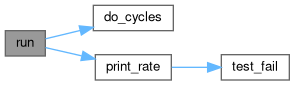
Here is the call graph for this function:
Here is the caller graph for this function:

Variable Documentation
◆ count
|
static |
Definition at line 32 of file exec_overflow.c.
◆ Event
|
static |
Initial value:
= {
}
Definition at line 19 of file exec_overflow.c.
◆ last
Definition at line 31 of file exec_overflow.c.
◆ Threshold
|
static |
Initial value:
= {
8000000,
4000000,
4000000,
}
Definition at line 25 of file exec_overflow.c.
◆ total
|
static |
Definition at line 32 of file exec_overflow.c.