PLASMA  2.4.5
PLASMA - Parallel Linear Algebra for Scalable Multi-core Architectures
 All Data Structures Namespaces Files Functions Variables Typedefs Enumerations Enumerator Macros Groups
pzgbrdb.c File Reference
#include "common.h"
#include <lapacke.h>
Include dependency graph for pzgbrdb.c:

Go to the source code of this file.

Macros

#define COMPLEX
#define DEP(m)   &(DEP[m])
#define A(_m, _n)   (PLASMA_Complex64_t *)plasma_geteltaddr(&A, (_m), (_n), eltsize)

Functions

void plasma_pzgbrdb_quark (PLASMA_enum uplo, PLASMA_desc A, double *D, double *E, PLASMA_desc T, PLASMA_sequence *sequence, PLASMA_request *request)

Detailed Description

PLASMA auxiliary routines PLASMA is a software package provided by Univ. of Tennessee, Univ. of California Berkeley and Univ. of Colorado Denver

Version:
2.4.5
Author:
Azzam Haidar
Date:
2011-05-15 normal z -> c d s

Definition in file pzgbrdb.c.


Macro Definition Documentation

#define A (   _m,
  _n 
)    (PLASMA_Complex64_t *)plasma_geteltaddr(&A, (_m), (_n), eltsize)

Definition at line 22 of file pzgbrdb.c.

#define COMPLEX

Definition at line 19 of file pzgbrdb.c.

#define DEP (   m)    &(DEP[m])

Definition at line 21 of file pzgbrdb.c.


Function Documentation

void plasma_pzgbrdb_quark ( PLASMA_enum  uplo,
PLASMA_desc  A,
double *  D,
double *  E,
PLASMA_desc  T,
PLASMA_sequence sequence,
PLASMA_request request 
)

Parallel Reduction from BAND Bidiagonal to the final condensed form - dynamic scheduler

Definition at line 26 of file pzgbrdb.c.

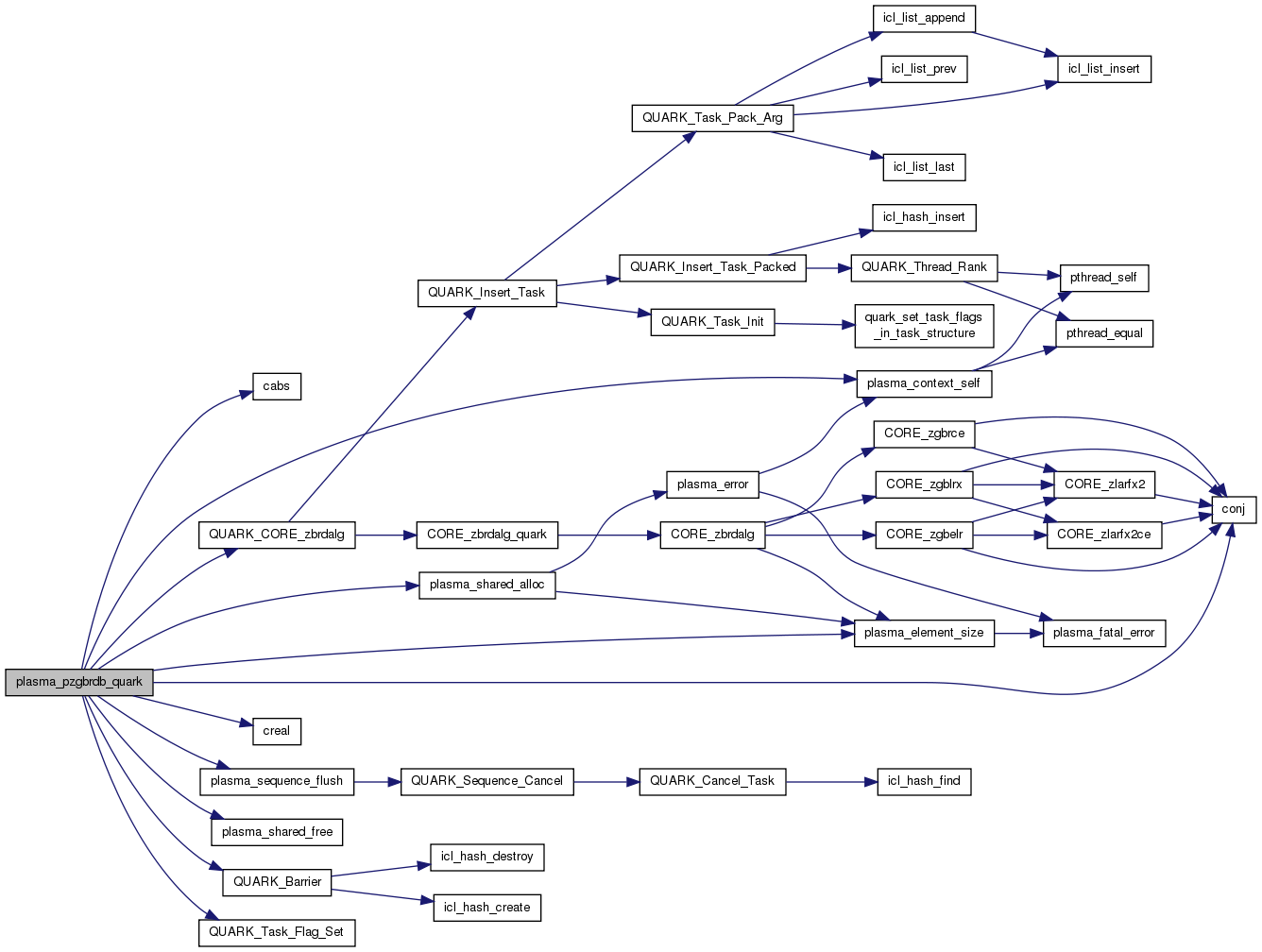
References A, C, cabs(), conj(), creal(), DEP, plasma_desc_t::dtyp, plasma_desc_t::lm, plasma_desc_t::m, plasma_desc_t::mb, min, plasma_desc_t::n, plasma_context_self(), plasma_element_size(), plasma_sequence_flush(), plasma_shared_alloc(), plasma_shared_free(), PLASMA_SUCCESS, PlasmaComplexDouble, PlasmaInteger, PlasmaLower, plasma_context_struct::quark, QUARK_Barrier(), QUARK_CORE_zbrdalg(), plasma_sequence_t::quark_sequence, QUARK_Task_Flag_Set(), Quark_Task_Flags_Initializer, plasma_sequence_t::status, TASK_SEQUENCE, TAU, and V.

{
#ifdef COMPLEX
static double dzero = (double) 0.0;
double absztmp;
#endif
static PLASMA_Complex64_t zzero = (PLASMA_Complex64_t) 0.0;
int M, N, NB, MINMN, INgrsiz, INthgrsiz, BAND;
int myid, grsiz, shift=3, stt, st, ed, stind, edind;
int blklastind, colpt, PCOL, ACOL, MCOL;
int stepercol,mylastid,grnb,grid;
int *DEP,*MAXID;
int i, j, m;
int thgrsiz, thgrnb, thgrid, thed;
size_t eltsize = plasma_element_size(A.dtyp);
plasma = plasma_context_self();
if (sequence->status != PLASMA_SUCCESS)
return;
QUARK_Task_Flag_Set(&task_flags, TASK_SEQUENCE, (intptr_t)sequence->quark_sequence);
M = A.m;
N = A.n;
NB = A.mb;
MINMN = min(M,N);
/* Quick return */
if ( MINMN == 0 ){
return;
}
if ( NB == 0 ) {
memset(D, 0, MINMN *sizeof(double));
memset(E, 0, (MINMN-1)*sizeof(double));
#ifdef COMPLEX
for (i=0; i<MINMN; i++)
D[i] = cabs(*A(i,i));
#else
for (i=0; i<MINMN; i++)
D[i] = *A(i,i);
#endif
return;
}
/*
* Barrier is used because the bulge have to wait until
* the reduction to band has been finish.
* otherwise, I can remove this BARRIER when I integrate
* the function dependencies link inside the reduction to
* band. Keep in mind the case when NB=1, where no bulge-chasing.
*/
/***************************************************************/
QUARK_Barrier(plasma->quark);
/***************************************************************/
/*
* Case NB=1 ==> matrix is already Bidiagonal. no need to bulge.
* Make diagonal and superdiagonal elements real, storing them in
* D and E. if PlasmaLower, first transform lower bidiagonal form
* to upper bidiagonal by applying plane rotations/ Householder
* from the left, overwriting superdiagonal elements then make
* elements real of the resulting upper Bidiagonal. if PlasmaUpper
* then make its elements real. For Q, PT: ZSCAL should be done
* in case of WANTQ.
*/
if ( NB == 1 ) {
memset(D, 0, MINMN*sizeof(double));
memset(E, 0, (MINMN-1)*sizeof(double));
for (i=0; i<(MINMN-1); i++)
{
/* generate Householder to annihilate a(i+1,i) and create a(i,i+1) */
V = *A((i+1), i);
*A((i+1), i) = zzero;
LAPACKE_zlarfg_work( 2, A(i, i), &V, 1, &TAU);
/* apply Left*/
TAU = conj(TAU);
ztmp = TAU*V;
V = conj(V);
*A(i, i+1) = - V * TAU * (*A(i+1, i+1));
*A(i+1, i+1) = *(A(i+1, i+1)) * (zone - V * ztmp);
}
}
/* PlasmaLower or PlasmaUpper, both are now upper */
/* Make diagonal and superdiagonal elements real,
* storing them in D and E
*/
#ifdef COMPLEX
ztmp = zone;
for (i=0; i<MINMN; i++)
{
ztmp = *A(i, i) * conj(ztmp);
absztmp = cabs(ztmp);
D[i] = absztmp; /* diag value */
if(absztmp != dzero)
ztmp = (PLASMA_Complex64_t) (ztmp / absztmp);
else
ztmp = zone;
if(i<(MINMN-1)) {
ztmp = *A(i, (i+1)) * conj(ztmp);
absztmp = cabs(ztmp);
E[i] = absztmp; /* upper off-diag value */
if(absztmp != dzero)
ztmp = (PLASMA_Complex64_t) (ztmp / absztmp);
else
ztmp = zone;
}
}
#else
for (i=0; i < MINMN-1; i++) {
D[i] = *A(i, i );
E[i] = *A(i, i+1);
}
D[i] = *A(i, i);
#endif
return;
}
/*
* Case MINMN<NB ==> matrix is very small and better to call lapack ZGETRD.
*
* Use fact that one row of block is stored the same way than in LAPACK
* Doesn't work if M > NB because of tile storage
*/
if ( MINMN <= 0 )
{
PLASMA_Complex64_t *work, *taup, *tauq;
int info, ldwork = N*N;
info = LAPACKE_zgebrd_work(LAPACK_COL_MAJOR, M, N,
A(0,0), A.lm, D, E, taup, tauq, work, ldwork);
plasma_shared_free(plasma, (void*) work);
plasma_shared_free(plasma, (void*) taup);
plasma_shared_free(plasma, (void*) tauq);
if( info == 0 )
sequence->status = PLASMA_SUCCESS;
else
plasma_sequence_flush(plasma->quark, sequence, request, info);
return;
}
/* General case NB > 1 && N > NB */
DEP = (int *) plasma_shared_alloc(plasma, MINMN+1, PlasmaInteger );
MAXID = (int *) plasma_shared_alloc(plasma, MINMN+1, PlasmaInteger );
memset(MAXID,0,(MINMN+1)*sizeof(int));
/***************************************************************************
* START BULGE CHASING CODE
**************************************************************************/
/*
* Initialisation of local parameter. those parameter should be
* input or tuned parameter.
*/
INgrsiz = 1;
if( NB > 160 ) {
INgrsiz = 2;
}
else if( NB > 100 ) {
if( MINMN < 5000 )
INgrsiz = 2;
else
INgrsiz = 4;
} else {
INgrsiz = 6;
}
INthgrsiz = MINMN;
BAND = 0;
grsiz = INgrsiz;
thgrsiz = INthgrsiz;
if( grsiz == 0 ) grsiz = 6;
if( thgrsiz == 0 ) thgrsiz = MINMN;
i = shift/grsiz;
stepercol = i*grsiz == shift ? i:i+1;
i = (MINMN-2)/thgrsiz;
thgrnb = i*thgrsiz == (MINMN-2) ? i:i+1;
for (thgrid = 1; thgrid<=thgrnb; thgrid++){
stt = (thgrid-1)*thgrsiz+1;
thed = min( (stt + thgrsiz -1), (MINMN-2));
for (i = stt; i <= MINMN-2; i++){
ed=min(i,thed);
if(stt>ed)break;
for (m = 1; m <=stepercol; m++){
st=stt;
for (j = st; j <=ed; j++){
/* PCOL: dependency on the ID of the master of the group of the previous column. (Previous Column:PCOL). */
/* ACOL: dependency on the ID of the master of the previous group of my column. (Acctual Column:ACOL). (it is 0(NULL) for myid=1) */
/* MCOL: OUTPUT dependency on the my ID, to be used by the next ID. (My Column: MCOL). I am the master of this group. */
myid = (i-j)*(stepercol*grsiz) +(m-1)*grsiz + 1;
mylastid = myid+grsiz-1;
PCOL = mylastid+shift-1; /* to know the dependent ID of the previous column. need to know the master of its group*/
MAXID[j] = myid;
PCOL = min(PCOL,MAXID[j-1]); /* for the last columns, we might do only 1 or 2 kernel, so the PCOL will be wrong. this is to force it to the last ID of the previous col.*/
grnb = PCOL/grsiz;
grid = grnb*grsiz == PCOL ? grnb:grnb+1;
PCOL = (grid-1)*grsiz +1; /* give me the ID of the master of the group of the previous column.*/
ACOL = myid-grsiz;
if(myid==1)ACOL=0;
MCOL = myid;
plasma->quark, &task_flags,
uplo, MINMN, NB,
&A, C, S, i, j, m, grsiz, BAND,
DEP(PCOL), DEP(ACOL), DEP(MCOL) );
if(mylastid%2 ==0){
blklastind = (mylastid/2)*NB+1+j-1;
}else{
colpt = ((mylastid+1)/2)*NB + 1 +j -1 ;
stind = colpt-NB+1;
edind = min(colpt,MINMN);
if( (stind>=edind-1) && (edind==MINMN) )
blklastind=MINMN;
else
blklastind=0;
}
if(blklastind >= (MINMN-1)) stt=stt+1;
} /* END for j=st:ed */
} /* END for m=1:stepercol */
} /* END for i=1:MINMN-2 */
} /* END for thgrid=1:thgrnb */
/*
* Barrier used only for now, to be sure that everything
* is done before copying the D and E and free workspace.
* this will be removed later when D and E are directly filled
* during the bulge process.
*/
QUARK_Barrier(plasma->quark);
plasma_shared_free(plasma, (void*) DEP);
plasma_shared_free(plasma, (void*) MAXID);
plasma_shared_free(plasma, (void*) C);
plasma_shared_free(plasma, (void*) S);
/*
* STORE THE RESULTING diagonal/off-diagonal in D AND E
*/
memset(D, 0, MINMN*sizeof(double));
memset(E, 0, (MINMN-1)*sizeof(double));
/*
* If PlasmaLower, first transform lower bidiagonal form
* to upper bidiagonal by applying plane rotations/ Householder
* from the left, overwriting superdiagonal elements then make
* elements real of the resulting upper Bidiagonal. if PlasmaUpper
* then make its elements real.
* For Q, PT: ZSCAL should be done in case of WANTQ.
*/
for (i=0; i<(MINMN-1); i++)
{
/* generate Householder to annihilate a(i+1,i) and create a(i,i+1)*/
V = *A((i+1), i);
*A((i+1), i) = zzero;
LAPACKE_zlarfg_work( 2, A(i, i), &V, 1, &TAU);
/* apply Left */
TAU = conj(TAU);
ztmp = TAU*V;
V = conj(V);
*A(i, (i+1)) = - V * TAU * (*A((i+1), (i+1)));
*A((i+1), (i+1)) = (*A((i+1), (i+1))) * (zone - V * ztmp);
}
}
/* PlasmaLower or PlasmaUpper, both are upper, now*/
/* Make diagonal and superdiagonal elements real,
* storing them in D and E
*/
/* In complex case, the element off diagonal element are
* not necessary real and we have to make off-diagonal
* elements real and copy them to E.
* When using HouseHolder elimination,
* the ZLARFG give us a real as output so, all the
* diagonal/off-diagonal element except the last one are already
* real and thus we need only to take the abs of the last
* one.
* */
#ifdef COMPLEX
ztmp =zone;
for (i=0; i < MINMN-1; i++) {
D[i] = creal( *A(i, i) );
/*
* Alternative for Householder case, all diag/superdiag
* are real except the last diag and superdiag, where we
* have to take the abs
*/
if(i<(MINMN-2))
E[i] = creal(*A(i, i+1));
else
E[i] = cabs( *A(i, i+1)); /* last upper value is complex */
}
D[i] = cabs( *A(i, i) );
#else
for (i=0; i < MINMN-1; i++) {
D[i] = *A(i, i );
E[i] = *A(i, i+1);
}
D[i] = *A(i, i);
#endif
} /* END FUNCTION */

Here is the call graph for this function:
