News and Announcements
TOP500 – November 2018

Image courtesy of the US Department of Energy’s Oak Ridge National Laboratory.
In November 2018, the 52nd TOP500 list was unveiled at the International Conference for High Performance Computing, Networking, Storage, and Analysis (SC18) in Dallas, TX. The United States remains on top with Oak Ridge National Laboratory’s Summit machine. Summit submitted new HPL benchmark results for the November list and achieved 143.5 petaFLOP/s (vs. 122.3 petaFLOP/s in June 2018).
Summit wasn’t the only machine to submit new results, with Lawrence Livermore National Laboratory’s Sierra hitting 94.6 petaFLOP/s on the latest list (vs. 71.6 petaFLOP/s in June 2018). This move puts Sierra at No. 2 on the list—now above China’s Sunway TaihuLight system, which sits at No. 3.
MAGMA Mentioned in NVIDIA Keynote
[1] Azzam Haidar, Panruo Wu, Stanimire Tomov, and Jack Dongarra. 2017. Investigating Half Precision Arithmetic to Accelerate Dense Linear System Solvers. In Proceedings of the 8th Workshop on Latest Advances in Scalable Algorithms for Large-Scale Systems (ScalA ’17). ACM, New York, NY, USA.
The Editor would like to thank Azzam Haidar for sharing this video.
30 Years of SC
Now THAT’S dedication! Past conference chairs and perennials (folks who have attended SC since its 1988 beginnings) gathered for a celebratory reception. Thank you, all! #HPCinspires #SC18 pic.twitter.com/nL4JlE9RIu
— SC18 (@Supercomputing) November 13, 2018
ICL’s Jack Dongarra is among a select few (pictured above) to have attended all 30 SC meetings.
HPCG Results – November 2018
The latest results for the HPC Preconditioned Conjugate Gradient (HPCG) benchmark were released on November 13th at SC18 in Dallas, TX. A joint effort between ICL and Sandia National Laboratories, HPCG is designed to measure performance that is representative of modern HPC capability by simulating compute and communication patterns from sparse iterative solvers commonly found in science and engineering applications.
HPCG results are released twice per year alongside the TOP500 rankings to show how real-world applications might fare on a given machine. The full list of HPCG rankings is available here.
| Rank | Computer | HPL (PFLOP/s) | TOP500 Rank | HPCG (PFLOP/s) | %Peak |
|---|---|---|---|---|---|
| 1 | Summit – IBM, POWER9, NVIDIA Volta V100
DOE/SC/ORNL, USA |
143.5 | 1 | 2.926 | 1.5% |
| 2 | Sierra – IBM, Power9, NVIDIA Tesla V100
DOE/NNSA/LLNL, USA |
94.64 | 2 | 1.796 | 1.4% |
| 3 | K Computer – Fujitsu, SPARC64
RIKEN/AIST, Japan |
10.51 | 18 | 0.603 | 5.3% |
| 4 | Trinity – Cray XC40, Intel Xeon E5-2698 v3, Xeon Phi 7250
DOE/NNSA/LANL/SNL, USA |
20.159 | 6 | 0.546 | 1.3% |
| 5 | AI Bridging Cloud Infrastructure – PRIMERGY CX2570 M4, Xeon Gold 6148 20C 2.4GHz, NVIDIA Tesla V100
AIST, Japan |
16.859 | 10 | 0.509 | 1.7% |
ISC 2019 Workshops

Submitted workshop proposals will be reviewed by the ISC 2019 Workshops Committee, which is headed by Dr. Sadaf Alam, Swiss National Supercomputing Center (CSCS), with Dr. Heike Jagode, University of Tennessee–Knoxville, as Deputy Chair.
The workshops will be held on Thursday, June 20, 2019 and will be either half-day (9:00 a.m. to 1:00 p.m. or 2:00 p.m. to 6:00 p.m.) or full-day (9:00 a.m. to 6:00 p.m.). Attendance will require a Workshop Pass.
Workshop proposals should be submitted via the ISC 2019 submission site by Wednesday, November 28, 2018. Check out the ISC-HPC workshops site for more information.
Conference Reports
SC18
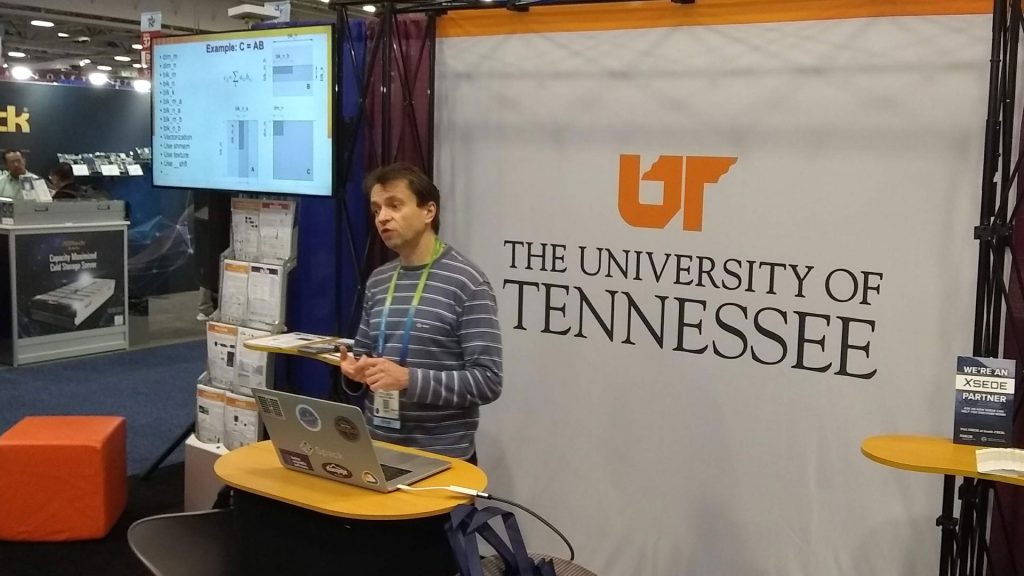

The International Conference for High Performance Computing Networking, Storage, and Analysis (SC18), now celebrating 30 years, is a staple of ICL’s November itinerary. SC18 was held in Dallas, TX on November 11–16.
Four computational science research centers from the University of Tennessee—the Bredesen Center, the Global Computing Laboratory, the Innovative Computing Laboratory, and the SimCenter—represented the university by anchoring a newly minted University of Tennessee booth. As usual, ICL had a significant presence at SC, with faculty, research staff, and students giving talks, presenting papers, and leading “Birds of a Feather” sessions.
In addition to having a new booth on the floor, ICL also leveraged an online “virtual booth” through which interested parties could keep tabs on ICL-related events—including a list of attendees, detailed schedule of talks, and the latest project handouts.
The editor would like to thank Piotr Luszczek, Jack Dongarra, Terry Moore, and Gerald Ragghianti for their contributions to this article.
Recent Releases
MAGMA 2.5.0 RC1
MAGMA 2.5.0 RC1 is now available. Matrix Algebra on GPU and Multicore Architectures (MAGMA) is a collection of next-generation linear algebra (LA) libraries for heterogeneous architectures. The MAGMA package supports interfaces for current LA packages and standards (e.g., LAPACK and BLAS) to allow computational scientists to easily port any LA-reliant software components to heterogeneous architectures.
MAGMA 2.5.0 RC1 features LAPACK-compliant routines for multi-core CPUs enhanced with NVIDIA GPUs (including the Volta V100). MAGMA now includes more than 400 routines, covering one-sided dense matrix factorizations and solvers, and two-sided factorizations and eigen/singular-value problem solvers, as well as a subset of highly optimized BLAS for GPUs.
Updates and features in MAGMA 2.5.0 RC1 include:
- New routine:
magmablas_Xgemm_batched_strided(X = {s, d, c, z}), which is the stride-based variant ofmagmablas_Xgemm_batched; - New routine:
magma_Xgetrf_native(X = {s, d, c, z}) performs the LU factorization with partial pivoting using the GPU only. It has the same interface as the hybrid (CPU + GPU) implementation provided bymagma_Xgetrf_gpu. Testing the performance of this routine is possible through runningtesting_Xgetrf_gpuwith the option(--version 3); - New routine:
magma_Xpotrf_native(X = {s, d, c, z}) performs the Cholesky factorization using the GPU only. It has the same interface as the hybrid (CPU + GPU) implementation provided bymagma_Xpotrf_gpu. Testing the performance of this routine is possible through runningtesting_Xpotrf_gpuwith the option(--version 2); and - Added benchmark for GEMM in FP16 arithmetic (HGEMM) as well as auxiliary functions to cast matrices from FP32 to FP16 storage (
magmablas_slag2h) and from FP16 to FP32 (magmablas_hlag2s).
Click here to download the tarball.
SC18 Project Handouts
The new project handouts from SC18 are available for download in PDF format.


Interview
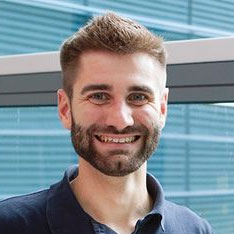
Joseph Schuchart
Where are you from, originally?
I was born in the Eastern German coastal city of Stralsund but spent most of my early years in a small village in Eastern Thuringia. Even though I have no recollection of life on the coast, I have always been attracted to the sea and water in general (of which there is plenty around here).
Can you summarize your educational background?
I received my German diploma in Computer Science (similar to M.Sc.) from the Dresden University of Technology (TUD), where I became interested in HPC. As a student, I worked at ZIH with Prof. Nagel and Andreas Knüpfer on their in-house performance analysis tools—Vampir, VampirTrace, and Score-P. I am currently working towards my PhD at the High-Performance Computing Center (HLRS) at the University of Stuttgart.
Tell us how you first learned about ICL.
After graduating from TUD, I was fortunate enough to become the on-site support for Vampir at Oak Ridge National Laboratory (ORNL), where I worked from 2012–2013. This was probably also the time I first learned about ICL.
What made you want to visit ICL?
In the course of my PhD work, I am cutting across many topics in parallel programming: from task-based parallelization down to the PGAS programming model and, specifically, MPI-3 RMA, which we use as a basis in the DASH project. ICL seemed to be a natural fit with the task-based runtime system PaRSEC and its ties to Open MPI. There is also a certain attraction to Knoxville and the surrounding area that I have felt ever since I first worked at ORNL.
What are your research interests?
My main research interests range from parallel programming models to performance analysis tools, and—even though I am not a computational scientist—I am fascinated by the applications that sit in between the two and drive our research.
What are you working on during your visit with ICL?
So far I have been exploring different techniques for task schedulers to communicate task states across process boundaries, which is relevant for both PaRSEC and DASH. I am also trying to contribute to both Open MPI and the MPI standard to improve certain aspects we noticed during the last two years of working with MPI RMA.
What are your interests/hobbies outside work?
I love being outdoors, and I enjoy rock climbing and hiking. I am also a passionate hobby photographer—one who is happy about every luck shot he gets.
Tell us something about yourself that might surprise people.
I am a really bad chef, but I enjoy baking breads and cakes.