
News and Announcements
SLATE: An Interview with Jakub Kurzak
ICL’s Jakub Kurzak, a co-PI for ECP’s Software for Linear Algebra Targeting Exascale (SLATE) effort, recently sat down with ECP Communications Manager Mike Bernhardt to discuss SLATE’s endeavor to replace the aging Scalable Linear Algebra PACKage (ScaLAPACK) and the challenges faced in creating an exascale-ready software platform.
HPCwire also published a breakdown of the interview and of the SLATE effort itself.
Employment Opportunities at ICL

ICL is seeking full-time scientists (MS or PhD) or postdoctoral researchers to participate in the design, development, and maintenance of numerical software libraries for solving linear algebra problems on large, distributed-memory machines with multi-core processors, hardware accelerators, and performance monitoring capabilities for new and advanced hardware and software technologies. The prospective researcher will coauthor papers to document research findings, present the team’s work at conferences and workshops, and help lead students and other team members in their research endeavors in ongoing and future projects. Given the nature of the work, there will be opportunities for publication, travel, and high-profile professional networking and collaboration across academia, labs, and industry.
An MS or PhD in computer science, computational sciences, or math is preferred. Background in at least one of the following areas is also preferred: numerical linear algebra, HPC, performance monitoring, machine learning, or data analytics. Full-time employment for up to 4 years with the possibility of further extensions based on funding availability and performance.
Joining this team will offer qualified candidates exciting career opportunities as they participate in the US Department of Energy’s Exascale Computing Project (ECP). ICL is involved in several ECP projects, including SLATE (http://icl.utk.edu/slate/), PEEKS (http://icl.utk.edu/peeks/), xSDK (http://www.icl.utk.edu/research/xsdk4ecp), Exa-PAPI (http://icl.utk.edu/exa-papi/), CEED (https://ceed.exascaleproject.org/), Distributed Tasking for Exascale (PaRSEC) (http://icl.utk.edu/dte/), MAGMA (http://icl.cs.utk.edu/magma/), FFT-ECP, and others.
Starting date is July 1, 2018 or later. All qualified candidates, be it fresh (MS or PhD) graduates or seasoned HPC veterans, are encouraged to apply.
For more information, contact Jack Dongarra (dongarra@icl.utk.edu) or check out ICL’s jobs page: http://www.icl.utk.edu/jobs.
SLATE now on Twitter
SLATE, your favorite ScaLAPACK replacement, is now on the Executive platform—Twitter!
Wanted: Exa-PAPI Beta Testers
Exa-PAPI offers a new PAPI component, called “pcp,” which interfaces to the Performance Co-Pilot (PCP). It enables PAPI users to monitor IBM Power9 hardware performance events, particularly shared “NEST” events without root access. The PAPI team is looking for beta testers and feedback of the new PAPI PCP component.
For access to the code, follow these steps:
1. $ git clone https://bitbucket.org/icl/papi.git
2. $ cd papi/src
3. $ ./configure --with-components=pcp
4. $ make && make install
Please email your questions and comments to perfapi-devel@icl.utk.edu.
Conference Reports
PASC18
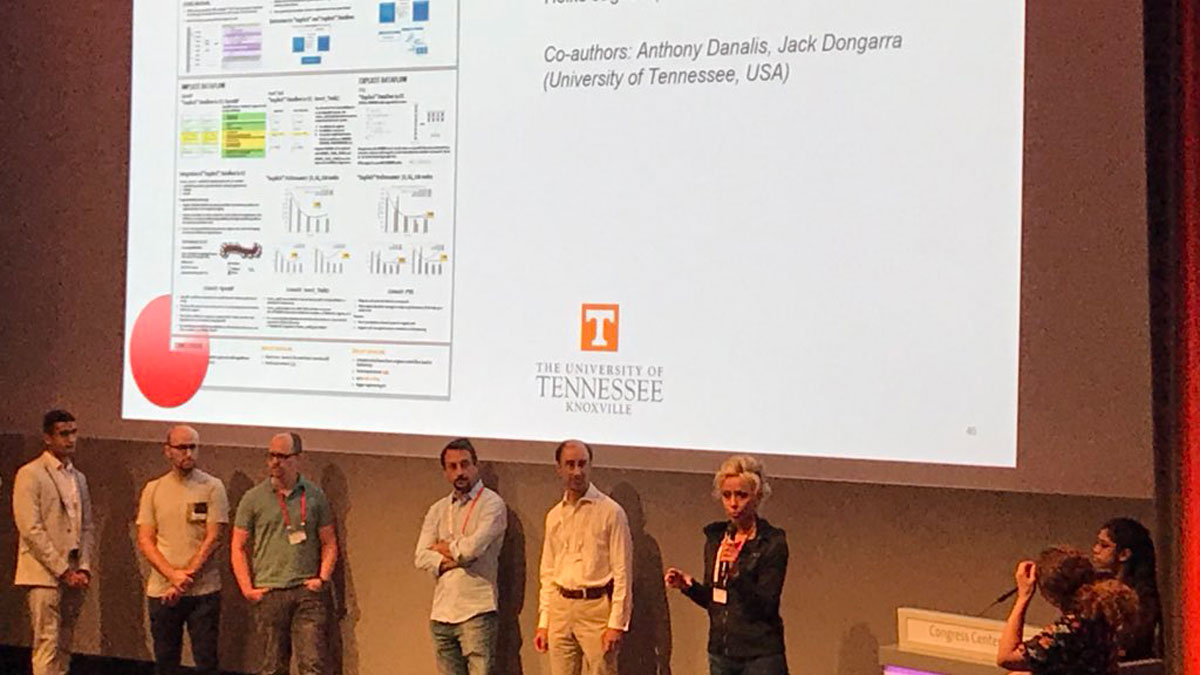
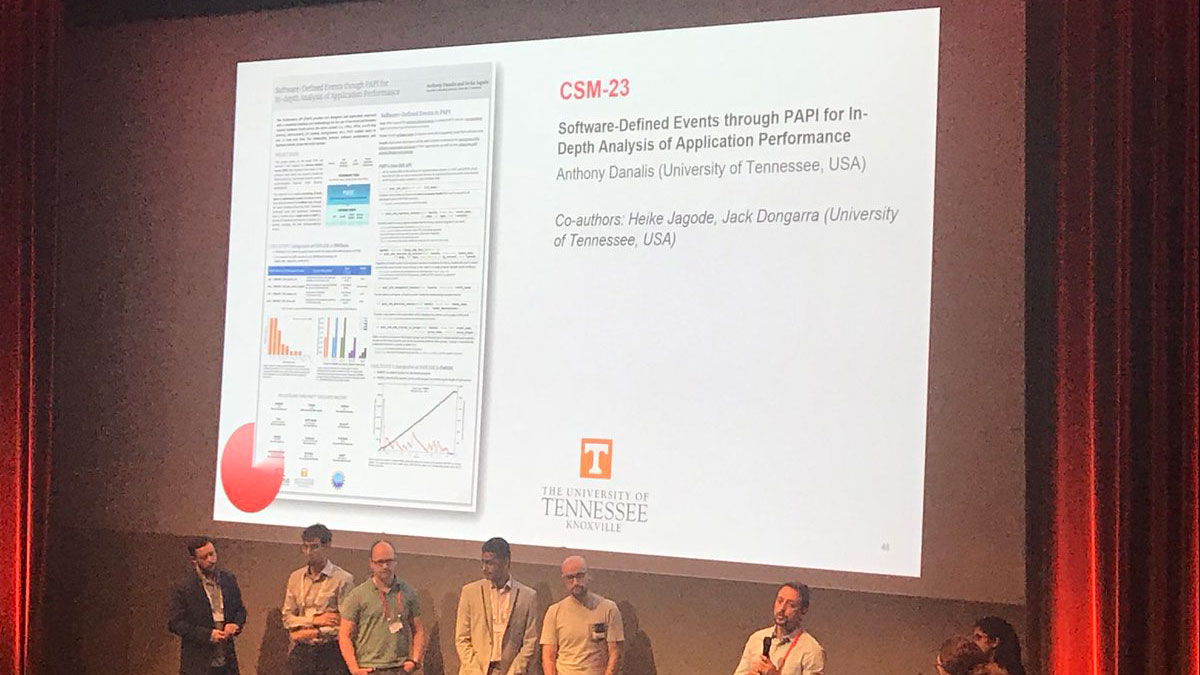
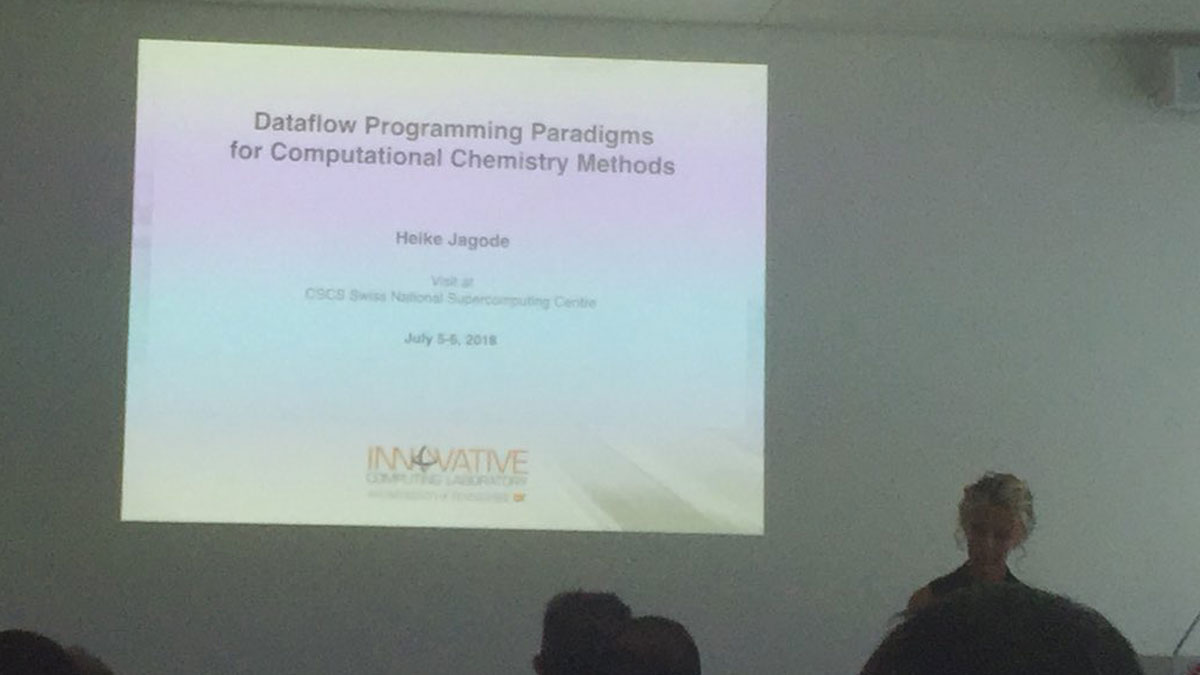

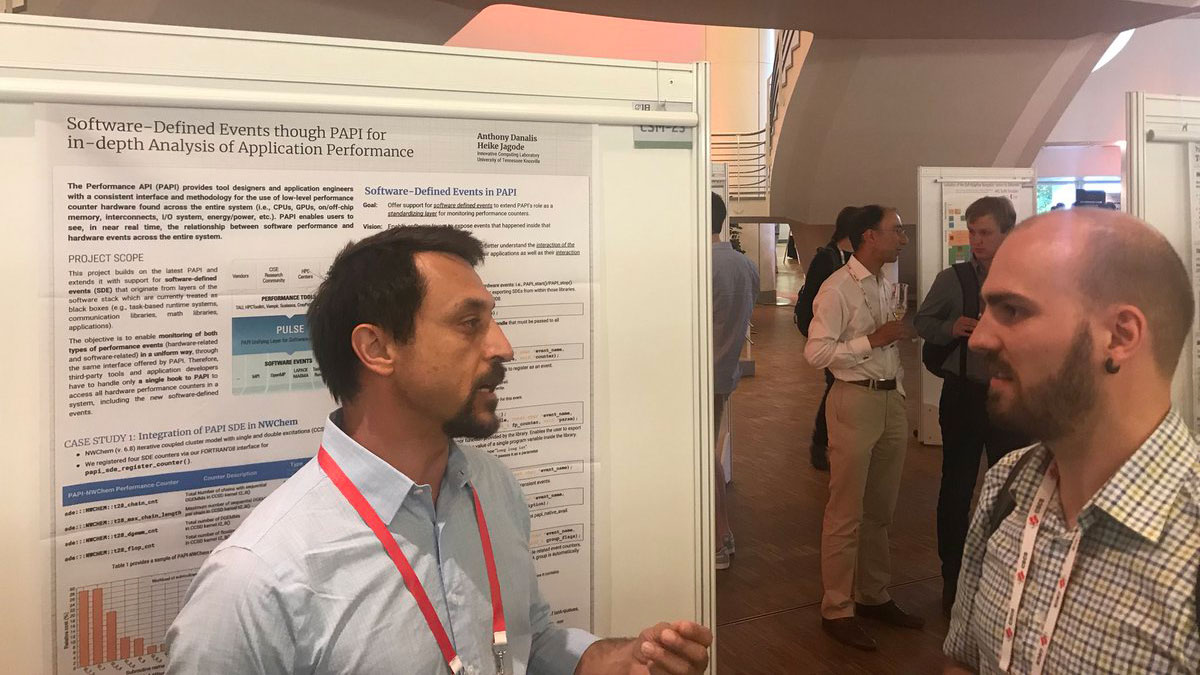
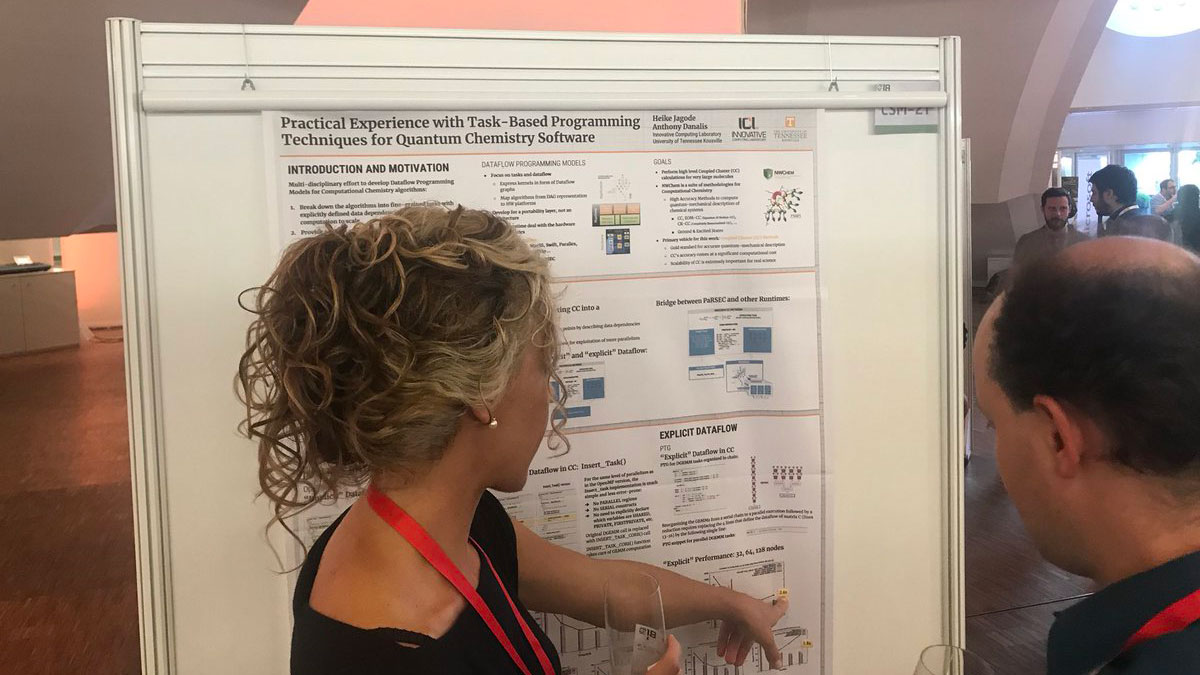
Heike Jagode and Anthony Danalis recently attended the Platform for Advanced Scientific Computing (PASC) conference in Basel, Switzerland. Held on July 2–4, PASC18 is the fifth in the series sponsored by ACM and the Swiss National Supercomputing Centre and brings together experts from domain sciences, applied mathematics, and computer science “to help close the chasm between compute-driven and data-driven research with an inclusive high quality technical program and broad interest contributions at the intersection of high performance algorithms and implementations that form the scientific computing field.”
With about 400 participants—including ICL alum Hatem Ltaief and frequent collaborator Mike Heroux—and a well-structured mixture of paper, poster, panel, and mini-symposia sessions focusing on tools, algorithms, application challenges, novel techniques, and high-performance computing, PASC18 provided a rich environment for “organic” intellectual exchanges and collaboration.
For their part, Heike presented ICL’s latest work and practical experience with task-based programming techniques for quantum chemistry software, and Anthony presented a poster on PAPI’s newest support for software-defined events. The next conference, PASC19, will be held in Zurich, Switzerland.
The editor would like to thank Heike Jagode and Anthony Danalis for their contributions to this article.
Interview

Ali Charara
Where are you from, originally?
I am from Lebanon, a small beautiful country at the shores of the Mediterranean sea.
Can you summarize your educational background?
I earned my Bachelor’s degree in Computer Science from the American University of Beirut (AUB) back in 1999, where I focussed on computer graphics. After working in the industry as a team leader and R&D assistant manager for almost 10 years, I went back to AUB in pursuit of a Master’s degree in computer graphics. This is the time where I met with a prominent scholar from the King Abdullah University of Science and Technology (KAUST) in Saudi Arabia. I was fascinated by the facilities at KAUST and the academic caliber of the faculty and staff, so I joined KAUST in 2011 to finish my Master’s degree. I then went on to earn a PhD in high-performance computing (HPC) under the supervision of Prof. David Keyes and ICL alumnus Dr. Hatem Ltaief.
Where did you work before joining ICL?
Between my graduation in 1999 and my coming back to academia in 2010, I worked in a couple of software companies as a software engineer, a team lead, and an R&D assistant manager in Beirut, Lebanon. Most of the projects I led/developed at that time served the publishing industry. During my PhD studies, I interned at NVIDIA (at the headquarter branch in Santa Clara, CA) as a software engineer, where I worked on improving the performance of numerical software libraries produced at NVIDIA.
How did you first hear about the lab, and what made you want to work here?
Working in HPC during my studies at KAUST, I could not miss the prominent reputation that ICL has earned in this field. We had several collaborations with ICL members, where I used many ICL-developed libraries/projects for my research. Working at ICL is a perfect fit for my career path and a great opportunity for me to sharpen my skills in HPC.
What is your focus here at ICL? What are you working on?
I’m very much interested in developing numerical libraries on GPUs. I’m currently involved in the SLATE project.
What are your interests/hobbies outside of work?
I spend most of my time outside work enjoying raising my four kids; it is fascinating to help them grow and develop. I enjoy reading science, history, and literature genres and even more so reading to my kids.
Tell us something about yourself that might surprise people.
During my undergraduate years, I was studying three majors in parallel, Computer Science, Arabic Literature, and Social Studies, while working part time to support myself. I don’t have that much energy anymore.
If you weren’t working at ICL, where would you like to be working and why?
If I’m not working at ICL, I would be applying to work at ICL! Otherwise, in an academic setting; I would like to work at KAUST, where leading edge research meets advanced facilities. If I considered a job in industry, I would like to work at NVIDIA, where cutting-edge technologies are being developed.


