
News and Announcements
2012 ICL Winter Reception
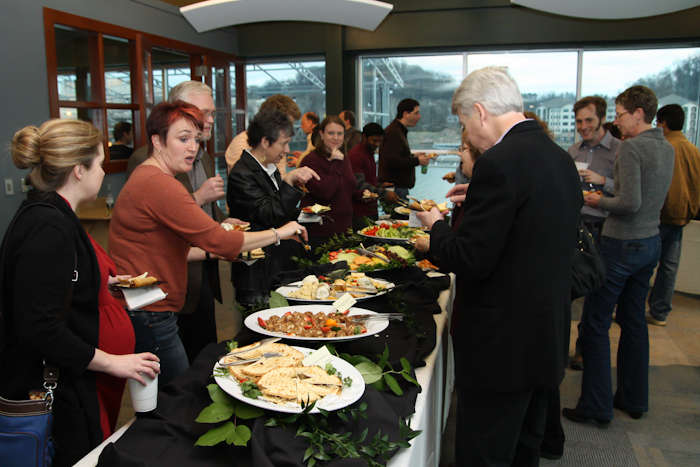
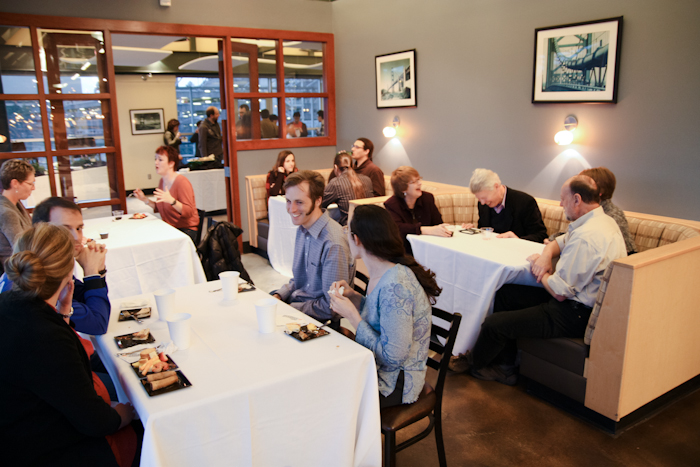
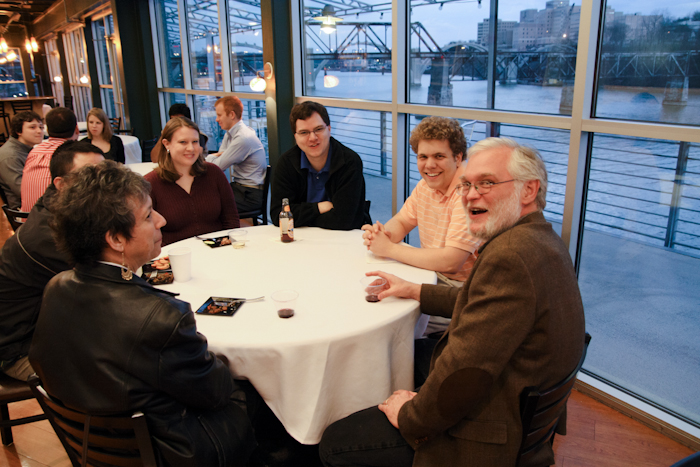
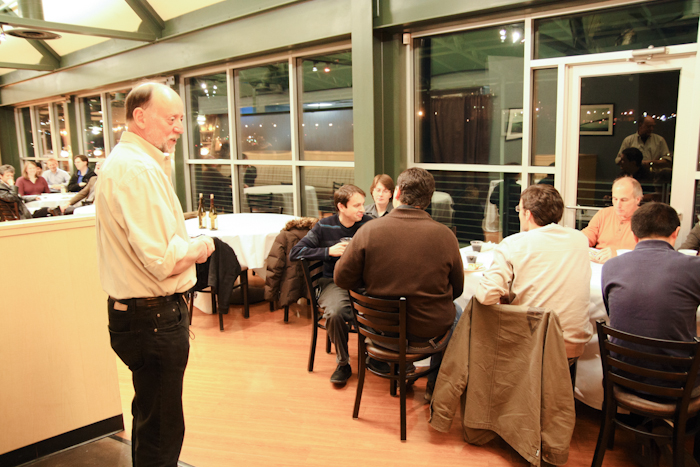
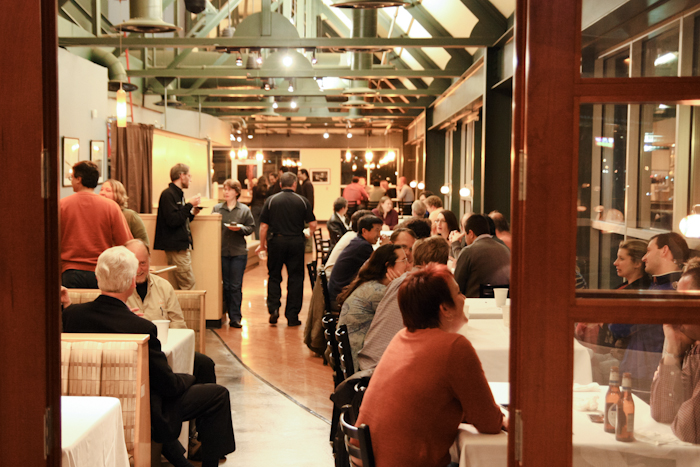
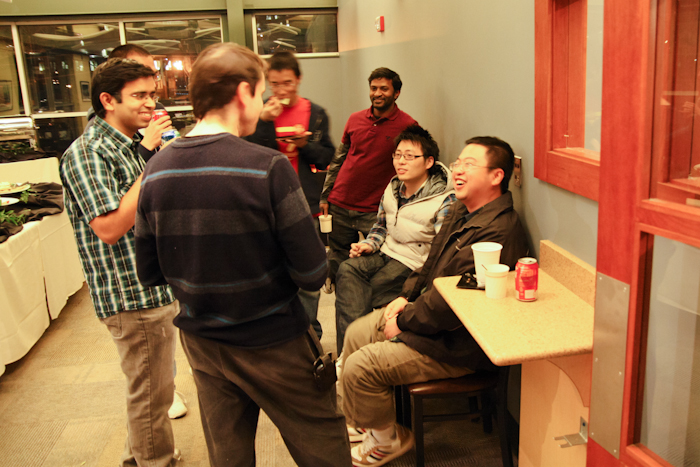
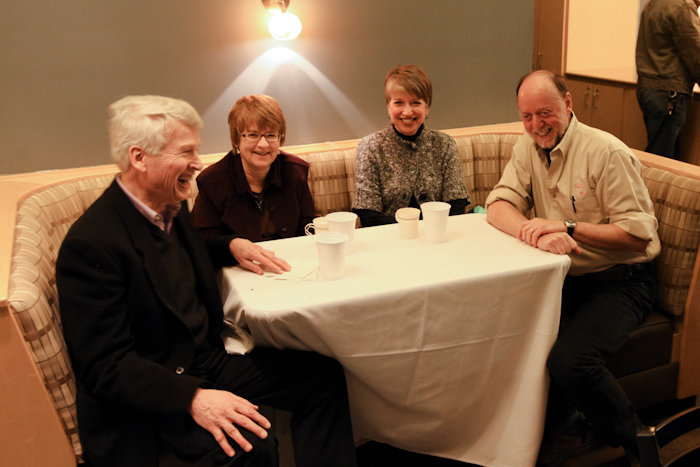
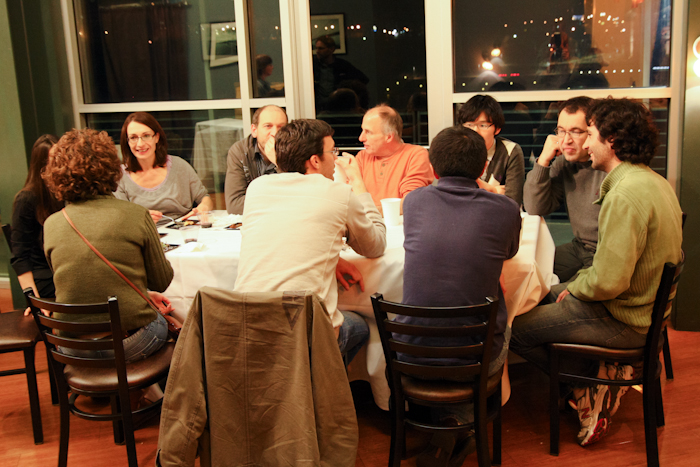
The 2012 ICL Winter Reception was a big hit, and there were plenty of ICLers, and significant others, mingling and enjoying good food and drink. Like last year, the reception was held at the Bridgeview Grill on Neyland Drive. Above, we have a few photos of the event for your viewing pleasure. Here’s to another great year at ICL!
XSEDE / John Towns Lecture
On February 13th, ICL invited guest speaker John Towns, from the National Center for Supercomputing Applications (NCSA), to give a talk about the eXtreme Science and Engineering Discovery Environment (XSEDE) project. John, who is the lead on the project, discussed several aspects of XSEDE, including Campus Bridging, Campus Champions, and networking activities. We had an excellent turn out from students and faculty of both ICL and EECS, and we have posted the slides from John’s talk here.
ICL on the Move
 The “big move” is well underway at ICL. ICL administration is now located in Claxton 203, and many folks have already moved into their new offices or are in the middle of doing so. For everyone else, the move will continue into March as more offices become available for their respective occupants. Keep an eye on your e-mail inbox for updates.
Conference Reports
SIAM PP12
This year’s SIAM Conference on Parallel Processing for Scientific Computing (SIAM PP12), held at the Hyatt Regency Savannah in Savannah, Georgia, had quite a turn out. The conference, which was held on February 15-17, had roughly 300 people in attendance, and ICL was well represented. Nine current ICLers were at the conference along with a whole host of ICL alum–including Bilel Hardi, Hatem Ltaief, Marc Baboullin, Ed Anderson, Greg Henry, Emanuel Augullo, and Alfredo Buttari.
A few conference goers were kind enough to share their thoughts: George’s takeaway was that DAGs are still “hot” and better algorithms will save the world. Piotr insisted that energy was another hot topic, and there were plenty of energy related mini-symposia. Teng Ma enjoyed Kathy Yelick’s enthusiastic talk about new programming models, and good times were had by all.
Keeneland Workshop
On February 20-21, the Keeneland project and the Georgia Tech NVIDIA CUDA Center of Excellence held a two day tutorial on GPU heterogeneous processing for computational science. At the tutorial, attendees were provided with temporary access to the Keeneland Initial Delivery system to port applications and learn how to use a variety of tools. ICL’s Mark Gates gave a lecture on the latest developments of the MAGMA library; you can view the slides from his presentation here.
Recent Releases
PAPI 4.2.1 Released
The PAPI 4.2.1 release is now available for download.
This is a minor release of PAPI-C. It does not break binary or semantic compatibility with previous versions.
- We have reviewed and updated all doxygen generated man pages for documentation, and reworked the output from papi_native_avail and papi_xml_event_info.
- We also added support for AMD Family 11 and 12 processors, and redefined the PAPI_FP_OPS event for Intel SandyBridge, so that it only requires 4 counters, and can run properly with hyperthreading enabled.
- A host of bug fixes and code clean-ups have also been implemented, including significant rewrites of several components for clarity and functionality.
For a summary of changes, read the PAPI 4.2.1 release notes. For installation instructions read the installation notes.
Interview

Micah Beck Interview
Where are you from, originally?
Madison, Wisconsin. I was born at the University of Wisconsin Hospital, lived up in University-operated faculty housing, and both my father and mother were UW faculty members. A true son of Madison, I attended nursery school at the Unitarian Church, attended anti-war protests as a child, and later skipped class in support of the UW teaching assistant’s union. I rode around town on bikes and buses, drank beer and ate bratwurst at the Student Union overlooking a frozen Lake Mendota. That’s right – frozen 2 feet thick – they used to drive fire trucks across it before the global warming hoax.
Can you summarize your educational background?
I earned my BA in Math and Computer Science from the University of Wisconsin, Madison, my Masters in Computer Science from Stanford, had an apprenticeship for 3 years working in Distributed OS at Bell Labs in Murray Hill, and earned my PhD in Computer Science from Cornell.
How did you first meet Jack?
I think that the first time I met him might have been when he visited Cornell to give a talk about the BLAS during the year between when I accepted a position at UTK and when I arrived on campus (I was delayed because I had not yet finished my dissertation). At the time I was shocked to hear that manual optimizations were still being performed on the kernels in assembler. Jack suggested that I work on the problem at UTK, but I never did.
What did you work on during your time at ICL?
I was hired to work on MPI, but I worked more in digital repositories and content distribution (Netlib-related), developing the Internet2 Distributed Storage Infrastructure (I2-DSI).
What are some of your favorite memories from your time at ICL?
The ribbon-cutting reception for I2-DSI is one of my favorite memories. It was quite an affair, with UTK administrators, TV cameras and newspaper reporters. The idea was that since I2-DSI was a wide area communication infrastructure, its inauguration would be something like the opening of a road or a bridge. It was great fun talking about how the use of storage could help the emerging Internet scale to much greater size and scope.
Tell us where you are and what you’re doing now.
I am now an Associate Professor in the EECS department at UTK, and I enjoy it very much. I am on sabbatical this year, and developing a new line of research in Digital Preservation which is an outgrowth of my work in storage and networking. I am also getting involved in the NSF’s Global Environment for Network Innovation (GENI), a programmable wide area platform for developing and deploying new distributed services. I’m still working with some colleagues and a commercial spin-off of our work. Finally, I’ve started looking into projects in the application of information technologies to address the needs of developing countries.
In what ways did working at ICL prepare you for what you do now, if at all?
I learned from Jack about applying for and managing sponsored research, and I was introduced to the Grid community that helped me to develop ideas and approaches that I am still applying in the Networking, Cloud and Distributed Storage areas. I also learned about classical End-to-End design principles from my ICL colleagues Martin Swany and Keith Moore, which have shaped my thinking ever since. And I grew immeasurably in my practice of logic, strategy and communication while working closely with Terry Moore.
EECS recently moved you guys into the new Min Kao building; how do you like your new digs?
Best office I’ve ever had, at least so far (how long were we in Claxton before we realized that the windows leaked?) The design of the building is very pleasant and open.
Tell us something about yourself that might surprise some people.
In the 70s I was a DJ on the community radio station in Madison, where I once interviewed blues legends Sonny Terry and Brownie McGhee—who was born in Knoxville!


