#include <ctype.h>#include <stdlib.h>#include <stdio.h>#include <string.h>#include <time.h>#include <sys/types.h>#include <sys/socket.h>#include <sys/un.h>#include <unistd.h>#include "gs_storage.h"#include "gs_storage_sql_tables.h"#include "utility.h"#include "server.h"#include "problem.h"#include "agent.h"#include "comm_basics.h"#include "comm_encode.h"#include "mysql.h"
Go to the source code of this file.
Functions | |
| static int | gs_insert_task (char *, char *, int, double, double, double, double, int, int, char *, int) |
| int | gs_create_criteria_table (char *name, char *description, char *firstValue) |
| int | gs_mysql_create_clean_db (MYSQL *, const char *, const char *, const char *, const char *, unsigned int, const char *) |
| int | gs_add_single_problem (gs_agent_t *gs_agent, gs_problem_t *gs_problem, char *cid_string) |
| Associated a problem w/ a server, adding the problem if it is unknown. | |
| int | gs_mysql_lock_tables (char *tables[], int n) |
| int | gs_mysql_unlock_tables () |
| int | gs_mysql_init_tables (MYSQL *mysql) |
| int | gs_mysql_init_db (gs_agent_t *gs_agent) |
| int | gs_storage_init (gs_agent_t *gs_agent) |
| Initializes the connection to the database manager. | |
| void | gs_storage_finalize (gs_agent_t *gs_agent) |
| Finalizes the database. | |
| int | gs_add_server (gs_agent_t *gs_agent, gs_server_t *gs_server) |
| Add a server to the database. | |
| int | gs_delete_problem_if_last_mapping (char *problemname) |
| int | gs_delete_server_problems (char *cid_string) |
| int | gs_delete_server (gs_agent_t *gs_agent, gs_server_t *gs_server) |
| Removes a server and all problem associations from the database. | |
| int | gs_insert_submitted_task (char *cid_string, char *taskid, int agent_taskid, double start, double duration, double remaining, double end, int active, int finished) |
| int | gs_insert_submitted_task_guess (char *cid_string, char *taskid, int agent_taskid, double start, double duration, double remaining, double end, int active, int finished) |
| int | gs_insert_completed_task (char *cid_string, char *taskid, int agent_taskid, double start, double duration, double remaining, double end, int active, int finished) |
| int | gs_update_task (char *cid_string, char *old_taskid, char *new_taskid, int agent_taskid, double start, double duration, double remaining, double end, int active, int finished) |
| int | gs_insert_problem (gs_problem_t *gs_problem) |
| int | gs_register_problem_changes (gs_agent_t *gs_agent, gs_problem_t **gs_problem, int num_services, char **models, char **rm_prob, int num_removed, char *cid_string) |
| Associated a problem w/ a server, adding the problem if it is unknown. | |
| int | gs_delete_problem (gs_agent_t *gs_agent, char *probname, char *cid_string) |
| Disassociate a problem w/ a server. | |
| int | gs_update_perf_expr (char *srv_cid, char *probname, char *expr) |
| int | gs_update_ping_list (gs_agent_t *gs_agent, char *cid, char *pings) |
| Update a server ping list. | |
| int | gs_update_workload (gs_agent_t *gs_agent, gs_server_t *gs_server) |
| Update a server workload. | |
| int | gs_server_exists (gs_agent_t *gs_agent, gs_server_t *gs_server) |
| void | gs_server_expiration (void **args) |
| Called periodically by mfork to expire servers. | |
| void | gs_server_expiration_pre (void **args) |
| This is called by mfork one time before it begins looping on gs_server_expiration. | |
| void | gs_server_expiration_post (void **args) |
| This is called by mfork one time when closing out the server expiration process. | |
| int | gs_server_expire (gs_agent_t *gs_agent, int timeout) |
| Expires all servers that have not updated recently. | |
| int | gs_get_server_list (gs_agent_t *gs_agent, gs_problem_t *gs_problem, char *client_criteria, gs_server_t ***servers, int *count) |
| Returns a list of servers tha can solve a given problem. | |
| int | task_start_compare_function (const void *p1, const void *p2) |
| int | gs_get_tasks_for_server (char *cid_string, gs_htm_task ***tasks, int *count, int sync) |
| int | gs_get_server_ping_list (gs_agent_t *gs_agent, gs_server_t ***servers, char *cid, int *count) |
| Returns a list of servers to be pinged. This is currently going to be all servers with componentIDs less than the requesting server and with SmartGridSolve enabled. | |
| int | gs_get_all_smart_servers (gs_agent_t *gs_agent, gs_server_t ***servers, int *count) |
| Returns a list of all known SmartGridSolve servers. | |
| int | gs_get_all_servers (gs_agent_t *gs_agent, gs_server_t ***servers, int *count) |
| Returns a list of all known servers. | |
| int | gs_get_problem_list (gs_agent_t *gs_agent, gs_server_t *gs_server, gs_problem_t ***problems, int *count) |
| Returns a list of all problems the a given server can solve. | |
| int | gs_get_all_problems (gs_agent_t *gs_agent, gs_problem_t ***problems, int *count) |
| Get a complete list of all problems. | |
| int | gs_get_problem_info (gs_agent_t *gs_agent, gs_problem_t ***problems, int *count, char *name) |
| Get a list of problems. | |
| int | gs_get_server (gs_agent_t *gs_agent, char *name, gs_server_t *server) |
| int | gs_get_all_servers_by_hostname (gs_agent_t *gs_agent, char *hostname, gs_server_t ***servers, int *count) |
| int | gs_get_task_by_agent_taskid (int agent_taskid, gs_htm_task *task) |
| int | gs_get_server_by_cid (gs_agent_t *gs_agent, char *cid, gs_server_t *server) |
Variables | |
| MYSQL | mysql_conn |
Function Documentation
| int gs_add_server | ( | gs_agent_t * | gs_agent, | |
| gs_server_t * | gs_server | |||
| ) |
Add a server to the database.
This is the first step of registering a server. The problems must still be registered. If the server is already in the database success is returned.
- Parameters:
-
gs_agent The agent structure. gs_server The structure of the server being added.
- Returns:
- 0 on success, -1 on error.
Definition at line 303 of file gs_storage_mysql.c.
{
  int now, i;
  char *sql, cid_string[2 * CID_LEN + 1],
      server_dottedIP[20], proxy_dottedIP[20], *sa_str,
      *escaped_sa_str, *sp_str;
  gs_info_t *attrs;

  DBGPRINTF("Adding Server.\n");

  proxy_cid_to_str(cid_string, gs_server->componentid);
  proxy_ip_to_str(gs_server->ipaddress, server_dottedIP);
  proxy_ip_to_str(gs_server->proxyip, proxy_dottedIP);
  sa_str = strdup("");
  sp_str = strdup(GS_NO_SERVER_PING_UPDATE);
  gs_encode_infolist(&sa_str, gs_server->sa_list);

  escaped_sa_str = (char *)malloc(2 * strlen(sa_str) + 1);
  if(!escaped_sa_str) {
    ERRPRINTF("malloc failed\n");
    free(sa_str);
    return -1;
  }

  mysql_real_escape_string(&mysql_conn, escaped_sa_str, sa_str, strlen(sa_str));

  now = time(0);
  sql = dstring_sprintf("INSERT INTO servers (hostname,ipaddress,port,proxyip,proxyport,componentid,arch,data_format,kflops,workload,ncpu,status,availcpu,availmem,nproblems,agenthost,agentport,smart,lastupdate,addedat,infolist,server_pings) VALUES ('%s','%s','%d','%s','%d','%s','%s','%d','%d','%d','%d','%d','%lf','%lf','%d','%s','%d','%d','%ld','%ld','%s','%s');",
       gs_server->hostname, server_dottedIP, gs_server->port, proxy_dottedIP,
       gs_server->proxyport, cid_string, gs_server->arch,
       gs_server->data_format, gs_server->kflops, gs_server->workload,
       gs_server->ncpu, gs_server->status, gs_server->availcpu,
       gs_server->availmem, gs_server->nproblems, gs_server->agenthost,
       gs_server->agentport, gs_server->smart, now, now, escaped_sa_str, sp_str);

  /* free sa_str, but don't free escaped_sa_str yet, we'll reuse it below */
  free(sa_str);
  free(sp_str);

  if(mysql_query(&mysql_conn, sql)) {
    ERRPRINTF("SQL ERROR inserting server: %s\n", mysql_error(&mysql_conn));
    ERRPRINTF("The query was: %s\n", sql);
    free(escaped_sa_str);
    free(sql);
    return -1;
  }

  free(sql);

  SENSORPRINTF("SRV_UP %s %s\n", gs_server->hostname, cid_string);
  DBGPRINTF("Added Server, now adding attributes.\n");

  /*
   * Add attributes
   */
  attrs = gs_server->sa_list;
  while(attrs != NULL) {
    i=0;
    while ( !isspace((int)attrs->type[i]) && attrs->type[i] != '\0') i++;
    attrs->type[i] = '\0';
    i=0;
    while ( !isspace((int)attrs->value[i]) && attrs->value[i] != '\0') i++;
    attrs->value[i] = '\0';
    if(gs_create_criteria_table(attrs->type, "", attrs->value) < 0) {
      ERRPRINTF("Error adding criteria table.\n");
      free(escaped_sa_str);
      return -1;
    }

    /* attrs->type shouldn't have any characters that need escaping,
     * but attrs->value might
     */
    mysql_real_escape_string(&mysql_conn, escaped_sa_str, attrs->value,
      strlen(attrs->value));

    sql = dstring_sprintf("INSERT INTO %s (value,componentid) values ('%s','%s');",
         attrs->type, escaped_sa_str, cid_string);
    DBGPRINTF("Submitting Attribute Query.\n");

    if(mysql_query(&mysql_conn, sql)) {
      ERRPRINTF("SQL ERROR inserting attribute: %s\n", mysql_error(&mysql_conn));
      ERRPRINTF("The query was: %s\n", sql);
      free(escaped_sa_str);
      free(sql);
      return -1;
    }

    free(sql);

    DBGPRINTF("Attribute added: %s.\n", attrs->type);
    attrs = attrs->next;
  }

  free(escaped_sa_str);

  return 0;
}


| int gs_add_single_problem | ( | gs_agent_t * | gs_agent, | |
| gs_problem_t * | gs_problem, | |||
| char * | cid_string | |||
| ) |
Associated a problem w/ a server, adding the problem if it is unknown.
Associates problems with servers. If the problem is already in the database, this problem will be checked against the database to confirm that there is no conflict. If the problem is already registered to the server, success is returned.
- Parameters:
-
gs_agent The agent structure. gs_problem The complete problem structure. cid_string The component id of the server.
- Returns:
- 0 on success, -1 on error.
Definition at line 891 of file gs_storage_mysql.c.
{
  char *sql = 0;
  int pid = 0, nrows = 0;
  MYSQL_RES *res;
  MYSQL_ROW row;

  DBGPRINTF("ADDING %s to %s\n", gs_problem->name, cid_string);

  /*
   * Check if problem already exists
   */
  sql = dstring_sprintf("SELECT encoding FROM problems WHERE problemname='%s';",
                       gs_problem->name);
  if(mysql_query(&mysql_conn, sql)) {
    ERRPRINTF("SQL ERROR checking for problem: %s\n", mysql_error(&mysql_conn));
    ERRPRINTF("The query was: %s\n", sql);
    free(sql);
    return -1;
  }
  free(sql);

  res = mysql_store_result(&mysql_conn);
  nrows = mysql_affected_rows(&mysql_conn);

  if(nrows == 1)
    pid = 1;

  /*
   * If problem is not in db, insert it
   */
  if(!pid) {
    mysql_free_result(res);

    if(gs_insert_problem(gs_problem) < 0) {
      ERRPRINTF("Failed to insert new problem.\n");
      return -1;
    }
  }
  else {
    int comparison_result;
    char *new_prot, *db_prot;

    /*
     * Check encoding for differences, looking only at the actual prototype
     */
    gs_problem_t *gs_problem_in_db  = (gs_problem_t *) CALLOC(1, sizeof(gs_problem_t));
    if(!gs_problem_in_db) {
      ERRPRINTF("couldn't malloc space for problem to compare\n");
      mysql_free_result(res);
      return -1;
    }

    row = mysql_fetch_row(res);

    if(gs_decode_problem(row[0], gs_problem_in_db) < 0) {
      mysql_free_result(res);
      ERRPRINTF("decoding problem from database failed\n");
      return -1;
    }

    mysql_free_result(res);

    new_prot = gs_problem_prototype(gs_problem);
    db_prot = gs_problem_prototype(gs_problem_in_db);

    comparison_result = strcmp(new_prot, db_prot);

    gs_free_problem(gs_problem_in_db);
    free(new_prot);
    free(db_prot);

    if(comparison_result != 0) {
      gs_server_t **server_list = NULL;
      int server_match, count, i;

      /* this problem exists, but is different than the problem being
       * registered.  if this is the only server that has the problem
       * then allow the new version to be registered.
       */
      count = gs_get_server_list(gs_agent, gs_problem, NULL, &server_list,
                 &count);

      server_match = 0;

      if(server_list) {
        char srv_cid[CID_LEN];

        proxy_str_to_cid(srv_cid, cid_string);

        for(i = 0; i < count; i++) {
          if(!memcmp(srv_cid, server_list[i]->componentid, CID_LEN))
            server_match = 1;

          gs_server_free(server_list[i]);
        }
        free(server_list);
      }

      /* if only one server has the problem and it matches the
       * current server name, then delete the old problem and
       * allow registration of the new version of the problem.
       */
      if((count == 1) && server_match &&
          (gs_delete_problem(gs_agent, gs_problem->name, cid_string) >= 0) &&
          (gs_insert_problem(gs_problem) >= 0))
      {
        LOGPRINTF("Successfully replaced old version of problem %s\n",
           gs_problem->name);
      }
      else {
        ERRPRINTF("Failed to replace old version of problem '%s'.\n",
          gs_problem->name);
        gs_delete_problem(gs_agent, gs_problem->name, cid_string);
        return -1;
      }
    }
  }

  /*
   * Associate the problem with the server.
   */
  sql = dstring_sprintf("INSERT INTO problem_server (problemname,componentid,perf_model_expr) VALUES ('%s','%s','%s');",
       gs_problem->name, cid_string, "-1");
  if(mysql_query(&mysql_conn, sql)) {
    ERRPRINTF("SQL ERROR inserting problem association: %s\n",
        mysql_error(&mysql_conn));
    ERRPRINTF("The query was: %s\n", sql);
    free(sql);
    return -1;
  }

  free(sql);

  return 0;
}


| int gs_create_criteria_table | ( | char * | name, | |
| char * | description, | |||
| char * | firstValue | |||
| ) |
Creates a table for the specified attribute.
- Parameters:
-
name -- the name of the attribute (also used for the table name) description -- description of the attribute firstValue -- the value of this attribute
- Returns:
- 0 on success, -1 on failure.
Definition at line 1956 of file gs_storage_mysql.c.
{
  char *sql, *tables_to_lock[] = {"criteria", "problems"};
  int nrows;
  MYSQL_RES *res;

  if(gs_mysql_lock_tables(tables_to_lock,
       sizeof(tables_to_lock)/sizeof(*tables_to_lock)) < 0)
    ERRPRINTF("Warning: table lock failed\n");

  /*
   * Check if criteria is already in db
   */
  sql = dstring_sprintf("SELECT 1 FROM criteria WHERE critname = '%s';", name);
  if(mysql_query(&mysql_conn, sql)) {
    gs_mysql_unlock_tables();
    ERRPRINTF("SQL ERROR getting criteria: %s\n", mysql_error(&mysql_conn));
    ERRPRINTF("The query was: %s\n", sql);
    free(sql);
    return -1;
  }
  free(sql);

  res = mysql_store_result(&mysql_conn);
  nrows = mysql_affected_rows(&mysql_conn);

  mysql_free_result(res);

  if(nrows > 0) {
    gs_mysql_unlock_tables();
    return 0;
  }

  sql = dstring_sprintf("CREATE TABLE %s (value VARCHAR(128) NOT NULL, componentid VARCHAR(128) NOT NULL, UNIQUE(componentid));",
       name);
  if(mysql_query(&mysql_conn, sql)) {
    gs_mysql_unlock_tables();
    ERRPRINTF("SQL ERROR creating criteria table: %s\n", mysql_error(&mysql_conn));
    ERRPRINTF("The query was: %s\n", sql);
    free(sql);
    return -1;
  }
  free(sql);

  sql = dstring_sprintf("INSERT INTO criteria (critname,description) VALUES ('%s','%s');",
     name, description);
  if(mysql_query(&mysql_conn, sql)) {
    gs_mysql_unlock_tables();
    ERRPRINTF("SQL ERROR inserting criteria: %s\n", mysql_error(&mysql_conn));
    ERRPRINTF("The query was: %s\n", sql);
    free(sql);
    return -1;
  }

  gs_mysql_unlock_tables();
  free(sql);

  return 0;
}


| int gs_delete_problem | ( | gs_agent_t * | gs_agent, | |
| char * | probname, | |||
| char * | cid_string | |||
| ) |
Disassociate a problem w/ a server.
When a problem is disassociated from its last server, it is automatically removed by the database.
- Parameters:
-
gs_agent The agent structure. gs_problem The problem structure, only problemname is needed. cid_string The server component id to disassociate with.
- Returns:
- 0 on success, -1 on error.
Definition at line 1040 of file gs_storage_mysql.c.
{
  char *sql;

  if(gs_delete_problem_if_last_mapping(probname) < 0)
    ERRPRINTF("Warning: failed to delete last problem mapping (if needed)\n");

  /*
   * delete association
   */
  sql = dstring_sprintf("DELETE FROM problem_server WHERE componentid='%s' AND problemname='%s';",
       cid_string, probname);
  if(mysql_query(&mysql_conn, sql)) {
    ERRPRINTF("SQL ERROR deleting problem association: %s\n",
        mysql_error(&mysql_conn));
    ERRPRINTF("The query was: %s\n", sql);
    free(sql);
    return -1;
  }

  free(sql);

  return 0;
}


| int gs_delete_problem_if_last_mapping | ( | char * | problemname | ) |
This checks whether the last problem-server mapping has been deleted. if so, we go ahead and delete the problem entry from the 'problems' table. This used to be done with a trigger, but it wasn't portable between sqlite and mysql, so it's done manually here.
Definition at line 410 of file gs_storage_mysql.c.
{
  char *sql, *tables_to_lock[] = {"problem_server", "problems"};
  MYSQL_RES *res;

  if(gs_mysql_lock_tables(tables_to_lock,
       sizeof(tables_to_lock)/sizeof(*tables_to_lock)) < 0)
    ERRPRINTF("Warning: table lock failed\n");

  sql = dstring_sprintf("SELECT 1 FROM problem_server WHERE problemname='%s';",
                       problemname);
  if(mysql_query(&mysql_conn, sql)) {
    ERRPRINTF("SQL ERROR selecting problem-server mappings: %s\n",
        mysql_error(&mysql_conn));
    ERRPRINTF("The query was: %s\n", sql);
    gs_mysql_unlock_tables();
    free(sql);
    return -1;
  }
  free(sql);

  res=mysql_store_result(&mysql_conn);

  if(mysql_affected_rows(&mysql_conn) == 1) {
    mysql_free_result(res);
    sql = dstring_sprintf("DELETE FROM problems WHERE problemname='%s';",
                       problemname);
    if(mysql_query(&mysql_conn, sql)) {
      ERRPRINTF("SQL ERROR deleting problem: %s\n",
        mysql_error(&mysql_conn));
      ERRPRINTF("The query was: %s\n", sql);
      gs_mysql_unlock_tables();
      free(sql);
      return -1;
    }
    res=mysql_store_result(&mysql_conn);
    free(sql);
  }

  mysql_free_result(res);
  gs_mysql_unlock_tables();

  return 0;
}


| int gs_delete_server | ( | gs_agent_t * | gs_agent, | |
| gs_server_t * | gs_server | |||
| ) |
Removes a server and all problem associations from the database.
When a server is removed, the database automatically handles unregistering the related problems and removing problems that no longer have servers.
- Parameters:
-
gs_agent The agent structure. gs_server The server to remove. Only componentid needs to be filled in.
- Returns:
- 0 on success, -1 on error.
Definition at line 532 of file gs_storage_mysql.c.
{
  char *sql, cid_string[2 * CID_LEN + 1];
  gs_info_t *attrs, *tmp;
  MYSQL_RES *res;
  MYSQL_ROW row;

  proxy_cid_to_str(cid_string, gs_server->componentid);

  /*
   * remove server attributes from their tables.
   */

  sql = dstring_sprintf("SELECT infolist FROM servers WHERE componentid='%s';",
                       cid_string);
  if(mysql_query(&mysql_conn, sql)) {
    ERRPRINTF("SQL ERROR selecting infolist: %s\n", mysql_error(&mysql_conn));
    ERRPRINTF("The query was: %s\n", sql);
    free(sql);
    return -1;
  }
  free(sql);

  res = mysql_store_result(&mysql_conn);

  row = mysql_fetch_row(res);

  attrs = NULL;

  if(row) {
    if(gs_decode_infolist(row[0], &attrs) < 0) {
      ERRPRINTF("Warning: failed to decode infolist\n");
      attrs = NULL;
    }
  }

  mysql_free_result(res);

  while(attrs != NULL) {
    sql = dstring_sprintf("DELETE FROM %s WHERE componentid='%s';",
                         attrs->type, cid_string);
    if(mysql_query(&mysql_conn, sql)) {
      ERRPRINTF("SQL ERROR deleting attribute: %s\n", mysql_error(&mysql_conn));
      ERRPRINTF("The query was: %s\n", sql);
    }

    free(sql);

    tmp = attrs;
    attrs = attrs->next;

    if(tmp) {
      if(tmp->type) free(tmp->type);
      if(tmp->value) free(tmp->value);
      free(tmp);
    }
  }

  /* DELETE SERVER */
  sql = dstring_sprintf("DELETE FROM servers WHERE componentid='%s';",
                       cid_string);
  if(mysql_query(&mysql_conn, sql)) {
    ERRPRINTF("SQL ERROR removing server: %s\n", mysql_error(&mysql_conn));
    ERRPRINTF("The query was: %s\n", sql);
    free(sql);
    return -1;
  }

  free(sql);

  if(gs_delete_server_problems(cid_string) < 0) {
    ERRPRINTF("Failed to delete server-problem mappings\n");
    return -1;
  }

  SENSORPRINTF("SRV_RM %s unknown\n", cid_string);

  return 0;
}


| int gs_delete_server_problems | ( | char * | cid_string | ) |
Deletes the problem-server mappings when a server is deleted. This used to be done with a trigger, but it wasn't portable between sqlite and mysql, so it's done manually here.
Definition at line 463 of file gs_storage_mysql.c.
{
  MYSQL_RES *res;
  MYSQL_ROW row;
  char *sql;
  int nrows;

  sql = dstring_sprintf("SELECT problemname FROM problem_server WHERE componentid='%s';",
                       cid_string);
  if(mysql_query(&mysql_conn, sql)) {
    ERRPRINTF("SQL ERROR deleting problem-server mappings: %s\n", mysql_error(&mysql_conn));
    ERRPRINTF("The query was: %s\n", sql);
    free(sql);
    return -1;
  }
  free(sql);

  res = mysql_store_result(&mysql_conn);
  nrows = mysql_affected_rows(&mysql_conn);

  if(nrows > 0) {
    char **pnames;
    int i;

    pnames = (char **)malloc(nrows * sizeof(char *));

    for(i=0;i<nrows;i++) {
      row = mysql_fetch_row(res);
      pnames[i] = strdup(row[0]);
    }

    mysql_free_result(res);

    for(i=0;i<nrows;i++) {
      if(gs_delete_problem_if_last_mapping(pnames[i]) < 0)
        ERRPRINTF("Warning: could not delete unreferenced problems (if needed)\n");
      free(pnames[i]);
    }

    free(pnames);
  }
  else
    mysql_free_result(res);

  sql = dstring_sprintf("DELETE FROM problem_server WHERE componentid='%s';",
                       cid_string);
  if(mysql_query(&mysql_conn, sql)) {
    ERRPRINTF("SQL ERROR deleting problem-server mappings: %s\n", mysql_error(&mysql_conn));
    ERRPRINTF("The query was: %s\n", sql);
    free(sql);
    return -1;
  }
  free(sql);

  return 0;
}


| int gs_get_all_problems | ( | gs_agent_t * | gs_agent, | |
| gs_problem_t *** | problems, | |||
| int * | count | |||
| ) |
Get a complete list of all problems.
- Parameters:
-
gs_agent The agent structure. problems The list of problem structures for all known problems. This is allocated by the function. count The number of known problems.
- Returns:
- The number of known problems or -1 on error.
Definition at line 1881 of file gs_storage_mysql.c.
{
  return gs_get_problem_info(gs_agent, problems, count, NULL);
}


| int gs_get_all_servers | ( | gs_agent_t * | gs_agent, | |
| gs_server_t *** | servers, | |||
| int * | count | |||
| ) |
Returns a list of all known servers.
- Parameters:
-
gs_agent The agent structure. servers A list of all server structures, allocated by the function. count The number of servers in servers list.
- Returns:
- number of servers or -1 on error.
Definition at line 1749 of file gs_storage_mysql.c.
{
  int i, nrows;
  char *sql;
  gs_server_t **server_list;
  MYSQL_RES *res;
  MYSQL_ROW row;

  sql = dstring_sprintf("SELECT * FROM servers WHERE 1;");
  if(mysql_query(&mysql_conn, sql)) {
    ERRPRINTF("SQL ERROR getting all known servers: %s\n",
        mysql_error(&mysql_conn));
    ERRPRINTF("The query was: %s\n", sql);
    free(sql);
    return -1;
  }

  free(sql);

  res = mysql_store_result(&mysql_conn);
  nrows = mysql_affected_rows(&mysql_conn);

  *count = nrows;
  server_list = (gs_server_t **) CALLOC(nrows, sizeof(gs_server_t *));

  if(server_list == NULL) {
    ERRPRINTF("malloc error\n");
    mysql_free_result(res);
    return -1;
  }

  for(i=0; i<nrows; i++) {
    row = mysql_fetch_row(res);

    server_list[i] = (gs_server_t *) CALLOC(1, sizeof(gs_server_t));
    if(!server_list[i]) {
      ERRPRINTF("malloc error\n");
      mysql_free_result(res);
      return -1;
    }

    server_list[i]->hostname = strdup(row[0]);
    proxy_str_to_ip(&(server_list[i]->ipaddress), row[1]);
    server_list[i]->port = atoi(row[2]);
    proxy_str_to_ip(&(server_list[i]->proxyip), row[3]);
    server_list[i]->proxyport = atoi(row[4]);
    proxy_str_to_cid(server_list[i]->componentid, row[5]);
    server_list[i]->arch = strdup(row[6]);
    server_list[i]->data_format = atoi(row[7]);
    server_list[i]->kflops = atoi(row[8]);
    server_list[i]->workload = atoi(row[9]);
    server_list[i]->ncpu = atoi(row[10]);
    server_list[i]->status = atoi(row[11]);
    server_list[i]->availcpu = atof(row[12]);
    server_list[i]->availmem = atof(row[13]);
    server_list[i]->nproblems = atoi(row[14]);
    server_list[i]->agenthost = strdup(row[15]);
    server_list[i]->agentport = atoi(row[16]);
    server_list[i]->smart = atoi(row[17]);
    server_list[i]->last_update = atol(row[18]);
  }

  mysql_free_result(res);
  *servers = server_list;
  return *count;
}


| int gs_get_all_servers_by_hostname | ( | gs_agent_t * | gs_agent, | |
| char * | hostname, | |||
| gs_server_t *** | servers, | |||
| int * | count | |||
| ) |
Gets a list of all servers with the specified hostname. There can easily be multiple servers with the same name, e.g.:
gridsolve> ./GS_config localhost AGENT: localhost [2 servers] SERVER: localhost.localdomain (192.168.0.103:9000) [cid=20206a66691be13f] SERVER: localhost.localdomain (192.168.0.103:9002) [cid=40409434e7f9d73f]
So we will have to ask the user to disambiguate by using the cid.
Definition at line 2099 of file gs_storage_mysql.c.
{
  int i, nrows;
  char *sql;
  gs_server_t **server_list;
  MYSQL_RES *res;
  MYSQL_ROW row;

  *count = -1;

  sql = dstring_sprintf("SELECT * FROM servers WHERE hostname='%s';",
    hostname);
  if(mysql_query(&mysql_conn, sql)) {
    ERRPRINTF("SQL ERROR getting all servers by name: %s\n",
      mysql_error(&mysql_conn));
    ERRPRINTF("The query was: %s\n", sql);
    free(sql);
    return -1;
  }
  free(sql);

  res = mysql_store_result(&mysql_conn);
  nrows = mysql_affected_rows(&mysql_conn);

  *count = nrows;
  server_list = (gs_server_t **) CALLOC(nrows, sizeof(gs_server_t *));

  if(server_list == NULL) {
    ERRPRINTF("malloc error\n");
    mysql_free_result(res);
    return -1;
  }

  for(i=0;i<nrows;i++) {
    row = mysql_fetch_row(res);

    server_list[i] = (gs_server_t *) CALLOC(1, sizeof(gs_server_t));
    if(!server_list[i]) {
      ERRPRINTF("malloc error\n");
      mysql_free_result(res);
      return -1;
    }

    server_list[i]->hostname = strdup(row[0]);
    proxy_str_to_ip(&(server_list[i]->ipaddress), row[1]);
    server_list[i]->port = atoi(row[2]);
    proxy_str_to_ip(&(server_list[i]->proxyip), row[3]);
    server_list[i]->proxyport = atoi(row[4]);
    proxy_str_to_cid(server_list[i]->componentid, row[5]);
    server_list[i]->arch = strdup(row[6]);
    server_list[i]->data_format = atoi(row[7]);
    server_list[i]->kflops = atoi(row[8]);
    server_list[i]->workload = atoi(row[9]);
    server_list[i]->ncpu = atoi(row[10]);
    server_list[i]->status = atoi(row[11]);
    server_list[i]->availcpu = atof(row[12]);
    server_list[i]->availmem = atof(row[13]);
    server_list[i]->nproblems = atoi(row[14]);
    server_list[i]->agenthost = strdup(row[15]);
    server_list[i]->agentport = atoi(row[16]);
    server_list[i]->last_update = atol(row[17]);
  }

  mysql_free_result(res);
  *servers = server_list;
  return *count;
}


| int gs_get_all_smart_servers | ( | gs_agent_t * | gs_agent, | |
| gs_server_t *** | servers, | |||
| int * | count | |||
| ) |
Returns a list of all known SmartGridSolve servers.
- Parameters:
-
gs_agent The agent structure. servers A list of all server structures, allocated by the function. count The number of servers in servers list.
- Returns:
- number of servers or -1 on error.
Definition at line 1670 of file gs_storage_mysql.c.
{
  int i, nrows;
  char *sql;
  gs_server_t **server_list;
  MYSQL_RES *res;
  MYSQL_ROW row;

  sql = dstring_sprintf("SELECT * FROM servers WHERE smart='1';");
  if(mysql_query(&mysql_conn, sql)) {
    ERRPRINTF("SQL ERROR getting all smart servers: %s\n",
        mysql_error(&mysql_conn));
    ERRPRINTF("The query was: %s\n", sql);
    free(sql);
    return -1;
  }

  free(sql);

  res = mysql_store_result(&mysql_conn);
  nrows = mysql_affected_rows(&mysql_conn);

  *count = nrows;
  server_list = (gs_server_t **) CALLOC(nrows, sizeof(gs_server_t *));

  if(server_list == NULL) {
    ERRPRINTF("malloc error\n");
    mysql_free_result(res);
    return -1;
  }

  for(i=0; i<nrows; i++) {
    row = mysql_fetch_row(res);

    server_list[i] = (gs_server_t *) CALLOC(1, sizeof(gs_server_t));
    if(!server_list[i]) {
      ERRPRINTF("malloc error\n");
      mysql_free_result(res);
      return -1;
    }

    server_list[i]->hostname = strdup(row[0]);
    proxy_str_to_ip(&(server_list[i]->ipaddress), row[1]);
    server_list[i]->port = atoi(row[2]);
    proxy_str_to_ip(&(server_list[i]->proxyip), row[3]);
    server_list[i]->proxyport = atoi(row[4]);
    proxy_str_to_cid(server_list[i]->componentid, row[5]);
    server_list[i]->arch = strdup(row[6]);
    server_list[i]->data_format = atoi(row[7]);
    server_list[i]->kflops = atoi(row[8]);
    server_list[i]->workload = atoi(row[9]);
    server_list[i]->ncpu = atoi(row[10]);
    server_list[i]->status = atoi(row[11]);
    server_list[i]->availcpu = atof(row[12]);
    server_list[i]->availmem = atof(row[13]);
    server_list[i]->nproblems = atoi(row[14]);
    server_list[i]->agenthost = strdup(row[15]);
    server_list[i]->agentport = atoi(row[16]);
    server_list[i]->smart = atoi(row[17]);
    server_list[i]->last_update = atol(row[18]);
    /* skip 19 - addedat */
    /* skip 20 - infolist */
    server_list[i]->server_pings = strdup(row[21]);
  }

  mysql_free_result(res);
  *servers = server_list;

  return *count;
}

| int gs_get_problem_info | ( | gs_agent_t * | gs_agent, | |
| gs_problem_t *** | problems, | |||
| int * | count, | |||
| char * | name | |||
| ) |
Get a list of problems.
- Parameters:
-
gs_agent The agent structure. problems The list of problem structures for all known problems. This is allocated by the function. count The number of known problems. name Problem name to select.
- Returns:
- The number of known problems or -1 on error.
Definition at line 1897 of file gs_storage_mysql.c.
{
  int i, nrows;
  char *sql;
  gs_problem_t **problem_list;
  MYSQL_RES *res;
  MYSQL_ROW row;

  if(name)
    sql = dstring_sprintf("SELECT encoding FROM problems WHERE problemname='%s';", name);
  else
    sql = dstring_sprintf("SELECT encoding FROM problems WHERE 1;");

  if(mysql_query(&mysql_conn, sql)) {
    ERRPRINTF("SQL ERROR getting list of problems: %s\n",
        mysql_error(&mysql_conn));
    ERRPRINTF("The query was: %s\n", sql);
    free(sql);
    return -1;
  }

  free(sql);

  res = mysql_store_result(&mysql_conn);
  nrows = mysql_affected_rows(&mysql_conn);

  *count = nrows;
  problem_list = (gs_problem_t **) CALLOC(nrows, sizeof(gs_problem_t *));
  if(problem_list == NULL) {
    ERRPRINTF("malloc error in gs_get_problem_list\n");
    mysql_free_result(res);
    return -1;
  }

  for(i=0; i < nrows; i++) {
    row = mysql_fetch_row(res);

    problem_list[i] = (gs_problem_t *) CALLOC(1, sizeof(gs_problem_t));
    gs_decode_problem(row[0], problem_list[i]);
  }

  mysql_free_result(res);
  *problems = problem_list;

  return *count;
}


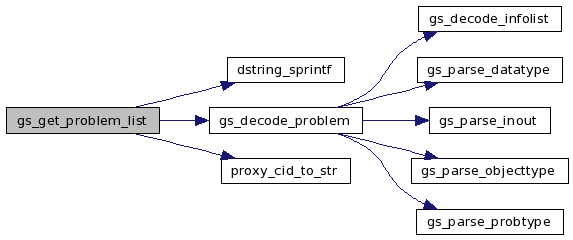
| int gs_get_problem_list | ( | gs_agent_t * | gs_agent, | |
| gs_server_t * | gs_server, | |||
| gs_problem_t *** | problems, | |||
| int * | count | |||
| ) |
Returns a list of all problems the a given server can solve.
- Parameters:
-
gs_agent The agent structure. gs_server The server structure. At least componentid is needed. problems A list of problem structures known by this server. This is allocated by the function. count The number of problems in the list.
- Returns:
- The number on problems or -1 on error.
Definition at line 1826 of file gs_storage_mysql.c.
{
  int i, nrows;
  char *sql, cid_string[2 * CID_LEN + 1];
  gs_problem_t **problem_list;
  MYSQL_RES *res;
  MYSQL_ROW row;

  proxy_cid_to_str(cid_string, gs_server->componentid);
  sql = dstring_sprintf("SELECT problems.encoding FROM problem_server JOIN problems ON problem_server.problemname = problems.problemname WHERE componentid='%s';",
       cid_string);
  if(mysql_query(&mysql_conn, sql)) {
    ERRPRINTF("SQL ERROR getting all problems: %s\n", mysql_error(&mysql_conn));
    ERRPRINTF("The query was: %s\n", sql);
    free(sql);
    return -1;
  }
  free(sql);

  res = mysql_store_result(&mysql_conn);
  nrows = mysql_affected_rows(&mysql_conn);

  *count = nrows;

  problem_list = (gs_problem_t **) CALLOC(nrows, sizeof(gs_problem_t *));
  if(problem_list == NULL) {
    ERRPRINTF("malloc error in gs_get_problem_list\n");
    mysql_free_result(res);
    return -1;
  }

  for(i=0; i < nrows; i++) {
    row = mysql_fetch_row(res);

    problem_list[i] = (gs_problem_t *) CALLOC(1, sizeof(gs_problem_t));
    gs_decode_problem(row[0], problem_list[i]);
  }

  mysql_free_result(res);

  *problems = problem_list;

  return *count;
}

| int gs_get_server | ( | gs_agent_t * | gs_agent, | |
| char * | name, | |||
| gs_server_t * | server | |||
| ) |
Gets all the information about the specified server from the database.
- Parameters:
-
gs_agent -- pointer to agent struct name -- hostname of the server server -- pointer to a server struct which will be filled in here
- Returns:
- 0 on success, -1 on failure.
Definition at line 2027 of file gs_storage_mysql.c.
{
  char *sql;
  int nrows;
  MYSQL_RES *res;
  MYSQL_ROW row;

  sql = dstring_sprintf("SELECT * FROM servers WHERE hostname='%s' LIMIT 1;",
      name);
  if(mysql_query(&mysql_conn, sql)) {
    ERRPRINTF("SQL ERROR getting server info: %s\n", mysql_error(&mysql_conn));
    ERRPRINTF("The query was: %s\n", sql);
    free(sql);
    return -1;
  }
  free(sql);

  res = mysql_store_result(&mysql_conn);
  nrows = mysql_affected_rows(&mysql_conn);

  if(nrows == 0) {
    mysql_free_result(res);
    return -1;
  }

  row = mysql_fetch_row(res);

  /* fill in structure */
  server->hostname = strdup(row[0]);
  proxy_str_to_ip(&(server->ipaddress), row[1]);
  server->port = atoi(row[2]);
  proxy_str_to_ip(&(server->proxyip), row[3]);
  server->proxyport = atoi(row[4]);
  proxy_str_to_cid(server->componentid, row[5]);
  server->arch = strdup(row[6]);
  server->data_format = atoi(row[7]);
  server->kflops = atoi(row[8]);
  server->workload = atoi(row[9]);
  server->ncpu = atoi(row[10]);
  server->status = atoi(row[11]);
  server->availcpu = atof(row[12]);
  server->availmem = atof(row[13]);
  server->nproblems = atoi(row[14]);
  server->agenthost = strdup(row[15]);
  server->agentport = atoi(row[16]);
  server->smart = atol(row[17]);
  server->last_update = atol(row[18]);

  /*
   * fill in server attribuites
   */
  server->sa_list = NULL;
  gs_decode_infolist(row[20], &(server->sa_list));

  mysql_free_result(res);

  return 0;
}

| int gs_get_server_by_cid | ( | gs_agent_t * | gs_agent, | |
| char * | cid, | |||
| gs_server_t * | server | |||
| ) |
Gets information about the server with the specified component id.
- Parameters:
-
gs_agent -- agent struct cid -- the server's component id server -- pointer to a server struct which will be filled in here
- Returns:
- 0 on success, -1 on failure.
Definition at line 2233 of file gs_storage_mysql.c.
{
  char *sql;
  int nrows;
  MYSQL_RES *res;
  MYSQL_ROW row;

  sql = dstring_sprintf("SELECT * FROM servers WHERE componentid='%s' LIMIT 1;",
      cid);
  if(mysql_query(&mysql_conn, sql)) {
    ERRPRINTF("SQL ERROR getting server by component id: %s\n",
       mysql_error(&mysql_conn));
    ERRPRINTF("The query was: %s\n", sql);
    free(sql);
    return -1;
  }
  free(sql);

  res = mysql_store_result(&mysql_conn);
  nrows = mysql_affected_rows(&mysql_conn);

  if(nrows == 0) {
    mysql_free_result(res);
    return -1;
  }

  row = mysql_fetch_row(res);

  /* fill in structure */

  server->hostname = strdup(row[0]);
  proxy_str_to_ip(&(server->ipaddress), row[1]);
  server->port = atoi(row[2]);
  proxy_str_to_ip(&(server->proxyip), row[3]);
  server->proxyport = atoi(row[4]);
  proxy_str_to_cid(server->componentid, row[5]);
  server->arch = strdup(row[6]);
  server->data_format = atoi(row[7]);
  server->kflops = atoi(row[8]);
  server->workload = atoi(row[9]);
  server->ncpu = atoi(row[10]);
  server->status = atoi(row[11]);
  server->availcpu = atof(row[12]);
  server->availmem = atof(row[13]);
  server->nproblems = atoi(row[14]);
  server->agenthost = strdup(row[15]);
  server->agentport = atoi(row[16]);
  server->smart = atol(row[17]);
  server->last_update = atol(row[18]);

  /*
   * fill in server attribuites
   */
  server->sa_list = NULL;
  gs_decode_infolist(row[20], &(server->sa_list));

  mysql_free_result(res);

  return 0;
}


| int gs_get_server_list | ( | gs_agent_t * | gs_agent, | |
| gs_problem_t * | gs_problem, | |||
| char * | client_criteria, | |||
| gs_server_t *** | servers, | |||
| int * | count | |||
| ) |
Returns a list of servers tha can solve a given problem.
- Parameters:
-
gs_agent The agent structure. gs_problem The problem structure. Just problemname is needed, the rest will be filled in. client_criteria Cliet criteria to match. If NULL, it is ignored. servers An array of server structures of servers that can solve the requested problem. This is allocated in the function. count The number of servers in servers list.
- Returns:
- number of servers on success, -1 on error.
Definition at line 1320 of file gs_storage_mysql.c.
{
  int i, nrows;
  char *sql;
  gs_server_t **server_list;
  MYSQL_RES *res;
  MYSQL_ROW row;

  /*
   * fill in remaining problem information.
   */
  sql = dstring_sprintf("SELECT encoding FROM problems WHERE problemname='%s';",
                       gs_problem->name);
  if(mysql_query(&mysql_conn, sql)) {
    ERRPRINTF("SQL ERROR getting problem encodings: %s\n",
        mysql_error(&mysql_conn));
    ERRPRINTF("The query was: %s\n", sql);
    free(sql);
    return -1;
  }

  free(sql);

  res = mysql_store_result(&mysql_conn);
  nrows = mysql_affected_rows(&mysql_conn);

  if(nrows > 0) {
    row = mysql_fetch_row(res);

    free(gs_problem->name);
    gs_problem->name = NULL;

    if(gs_decode_problem(row[0], gs_problem) < 0) {
      ERRPRINTF("decoding problem failed.\n");
      mysql_free_result(res);
      return -1;
    }
  }

  mysql_free_result(res);

  if(client_criteria == NULL) {
    /*
     * get servers associated with this problem.
     */
    sql = dstring_sprintf("SELECT servers.*,problem_server.perf_model_expr FROM problem_server JOIN servers ON problem_server.componentid = servers.componentid WHERE problemname='%s';",
         gs_problem->name);
  }
  else {                        /* we need to consider server attributes */
    char *critq, *gs_parse_client_criteria(char *, int);

    critq = gs_parse_client_criteria(client_criteria, GS_CRIT_PARSE_MYSQL);
    sql = dstring_sprintf(critq, gs_problem->name);
    FREE(critq);
  }
  if(mysql_query(&mysql_conn, sql)) {
    ERRPRINTF("SQL ERROR getting servers associated with problem '%s': %s\n",
        gs_problem->name, mysql_error(&mysql_conn));
    ERRPRINTF("The query was: %s\n", sql);
    free(sql);
    (*servers) = NULL;
    return -1;
  }

  free(sql);

  res = mysql_store_result(&mysql_conn);
  nrows = mysql_affected_rows(&mysql_conn);

  *count = nrows;
  server_list = (gs_server_t **) CALLOC(nrows, sizeof(gs_server_t *));
  if(server_list == NULL) {
    ERRPRINTF("malloc error\n");
    mysql_free_result(res);
    return -1;
  }

  for(i=0;i<nrows;i++) {
    row = mysql_fetch_row(res);

    server_list[i] = (gs_server_t *) CALLOC(1, sizeof(gs_server_t));

    server_list[i]->hostname = strdup(row[0]);
    proxy_str_to_ip(&(server_list[i]->ipaddress), row[1]);
    server_list[i]->port = atoi(row[2]);
    proxy_str_to_ip(&(server_list[i]->proxyip), row[3]);
    server_list[i]->proxyport = atoi(row[4]);
    proxy_str_to_cid(server_list[i]->componentid, row[5]);
    server_list[i]->arch = strdup(row[6]);
    server_list[i]->data_format = atoi(row[7]);
    server_list[i]->kflops = atoi(row[8]);
    server_list[i]->workload = atoi(row[9]);
    server_list[i]->ncpu = atoi(row[10]);
    server_list[i]->status = atoi(row[11]);
    server_list[i]->availcpu = atof(row[12]);
    server_list[i]->availmem = atof(row[13]);
    server_list[i]->nproblems = atoi(row[14]);
    server_list[i]->agenthost = strdup(row[15]);
    server_list[i]->agentport = atoi(row[16]);
    server_list[i]->smart = atoi(row[17]);
    server_list[i]->last_update = atol(row[18]);

    /*
     * fill in server attribuites
     */
    server_list[i]->sa_list = NULL;
    gs_decode_infolist(row[20], &(server_list[i]->sa_list));
    server_list[i]->server_pings = strdup(row[21]);
    server_list[i]->perf_expr = strdup(row[22]);
  }

  mysql_free_result(res);

  *servers = server_list;
  return *count;
}


| int gs_get_server_ping_list | ( | gs_agent_t * | gs_agent, | |
| gs_server_t *** | servers, | |||
| char * | cid, | |||
| int * | count | |||
| ) |
Returns a list of servers to be pinged. This is currently going to be all servers with componentIDs less than the requesting server and with SmartGridSolve enabled.
- Parameters:
-
gs_agent The agent structure. servers A list of all server structures, allocated by the function. cid The component ID of the requesting server count The number of servers in servers list.
- Returns:
- number of servers or -1 on error.
Definition at line 1594 of file gs_storage_mysql.c.
{
  int i, nrows;
  char *sql;
  gs_server_t **server_list;
  MYSQL_RES *res;
  MYSQL_ROW row;

  sql = dstring_sprintf("SELECT * FROM servers WHERE componentid<'%s' AND smart='1';", cid);
  if(mysql_query(&mysql_conn, sql)) {
    ERRPRINTF("SQL ERROR getting servers ping list: %s\n",
        mysql_error(&mysql_conn));
    ERRPRINTF("The query was: %s\n", sql);
    free(sql);
    return -1;
  }

  free(sql);

  res = mysql_store_result(&mysql_conn);
  nrows = mysql_affected_rows(&mysql_conn);

  *count = nrows;
  server_list = (gs_server_t **) CALLOC(nrows, sizeof(gs_server_t *));

  if(server_list == NULL) {
    ERRPRINTF("malloc error\n");
    mysql_free_result(res);
    return -1;
  }

  for(i=0; i<nrows; i++) {
    row = mysql_fetch_row(res);

    server_list[i] = (gs_server_t *) CALLOC(1, sizeof(gs_server_t));
    if(!server_list[i]) {
      ERRPRINTF("malloc error\n");
      mysql_free_result(res);
      return -1;
    }

    server_list[i]->hostname = strdup(row[0]);
    proxy_str_to_ip(&(server_list[i]->ipaddress), row[1]);
    server_list[i]->port = atoi(row[2]);
    proxy_str_to_ip(&(server_list[i]->proxyip), row[3]);
    server_list[i]->proxyport = atoi(row[4]);
    proxy_str_to_cid(server_list[i]->componentid, row[5]);
    server_list[i]->arch = strdup(row[6]);
    server_list[i]->data_format = atoi(row[7]);
    server_list[i]->kflops = atoi(row[8]);
    server_list[i]->workload = atoi(row[9]);
    server_list[i]->ncpu = atoi(row[10]);
    server_list[i]->status = atoi(row[11]);
    server_list[i]->availcpu = atof(row[12]);
    server_list[i]->availmem = atof(row[13]);
    server_list[i]->nproblems = atoi(row[14]);
    server_list[i]->agenthost = strdup(row[15]);
    server_list[i]->agentport = atoi(row[16]);
    server_list[i]->smart = atoi(row[17]);
    server_list[i]->last_update = atol(row[18]);
  }

  mysql_free_result(res);
  *servers = server_list;

  return *count;
}


| int gs_get_task_by_agent_taskid | ( | int | agent_taskid, | |
| gs_htm_task * | task | |||
| ) |
Finds a task with the specified agent-generated task id.
- Parameters:
-
agent_taskid -- the task id of the job to find. task -- pointer to a task structure which will be filled in here
- Returns:
- 0 on success, -1 on failure.
Definition at line 2178 of file gs_storage_mysql.c.
{
  char *sql;
  int nrows;
  MYSQL_RES *res;
  MYSQL_ROW row;

  sql = dstring_sprintf("SELECT * FROM tasks WHERE t_agent_taskid='%d' LIMIT 1;",
    agent_taskid);
  if(mysql_query(&mysql_conn, sql)) {
    ERRPRINTF("SQL ERROR getting task by taskid: %s\n",
      mysql_error(&mysql_conn));
    ERRPRINTF("The query was: %s\n", sql);
    free(sql);
    return -1;
  }
  free(sql);

  res = mysql_store_result(&mysql_conn);
  nrows = mysql_affected_rows(&mysql_conn);

  if(nrows == 0) {
    mysql_free_result(res);
    return -1;
  }

  row = mysql_fetch_row(res);

  /* skip row[0] -- component id */
  strcpy(task->id, row[1]);
  task->agent_taskid = atof(row[2]);
  task->start = atof(row[3]);
  task->duration = atof(row[4]);
  task->remaining = atof(row[5]);
  task->end = atof(row[6]);
  task->active = atoi(row[7]);
  task->finished = atoi(row[8]);
  task->next = NULL;

  mysql_free_result(res);

  return 0;
}


| int gs_get_tasks_for_server | ( | char * | cid_string, | |
| gs_htm_task *** | tasks, | |||
| int * | count, | |||
| int | sync | |||
| ) |
Gets all the tasks (jobs) that are currently running or have recently run on the specified server.
- Parameters:
-
cid_string -- the server's component id tasks -- upon return, this contains an array of pointers to task structures. memory is allocted here. count -- upon return, this is set to the number of entries in the tasks array. sync -- whether to get synchronized task durations (1=synchronized, 0=unsynchronized i.e. prediction only)
- Returns:
- 0 on success, -1 on failure.
Definition at line 1472 of file gs_storage_mysql.c.
{
  int i, nrows;
  char *sql;
  gs_htm_task **task_list;
  MYSQL_RES *res;
  MYSQL_ROW row;

  *count = -1;

  sql = dstring_sprintf("select * from (select * from tasks,completed_tasks where tasks.t_taskid=completed_tasks.c_taskid and tasks.t_componentid=completed_tasks.c_componentid union select * from tasks,completed_tasks where completed_tasks.c_taskid='-1' and tasks.t_taskid not in (select tasks.t_taskid from tasks,completed_tasks where tasks.t_taskid=completed_tasks.c_taskid and tasks.t_componentid=completed_tasks.c_componentid) union select * from tasks,completed_tasks where tasks.t_taskid='-1' and completed_tasks.c_taskid not in (select tasks.t_taskid from tasks,completed_tasks where tasks.t_taskid=completed_tasks.c_taskid and tasks.t_componentid=completed_tasks.c_componentid)) as foo where t_componentid='%s' or c_componentid='%s';", cid_string, cid_string);
  if(mysql_query(&mysql_conn, sql)) {
    ERRPRINTF("SQL ERROR getting tasks: %s\n",
        mysql_error(&mysql_conn));
    ERRPRINTF("The query was: %s\n", sql);
    free(sql);
    return -1;
  }

  free(sql);

  res = mysql_store_result(&mysql_conn);
  nrows = mysql_affected_rows(&mysql_conn);

  *count = nrows;
  task_list = (gs_htm_task **) CALLOC(nrows, sizeof(gs_htm_task *));

  if(task_list == NULL) {
    ERRPRINTF("malloc error\n");
    mysql_free_result(res);
    return -1;
  }

  for(i=0;i<nrows;i++) {
    row = mysql_fetch_row(res);

    task_list[i] = (gs_htm_task *) CALLOC(1, sizeof(gs_htm_task));

    if(!task_list[i]) {
      ERRPRINTF("malloc error\n");
      mysql_free_result(res);
      return -1;
    }

    if(row[1] && row[10] && strcmp(row[1], "-1") && strcmp(row[10], "-1")) {
      /* entry exists in both tasks and completed_tasks */

      strcpy(task_list[i]->id, row[1]);
      /* skip row[2] which is agent_taskid */
      if(sync) {
        task_list[i]->start = MIN(atof(row[3]), atof(row[12]));
        task_list[i]->end = MAX(atof(row[6]), atof(row[15]));
        task_list[i]->duration = task_list[i]->end - task_list[i]->start;
      }
      else {
        task_list[i]->start = atof(row[3]);
        task_list[i]->end = atof(row[6]);
        task_list[i]->duration = atof(row[4]);
      }
      task_list[i]->remaining = atof(row[14]);
      task_list[i]->active = atoi(row[7]);
      task_list[i]->finished = atoi(row[17]);
      task_list[i]->next = NULL;
    }
    else if(row[1] && strcmp(row[1], "-1")) {
      /* entry exists in only in tasks */

      strcpy(task_list[i]->id, row[1]);
      /* skip row[2] which is agent_taskid */
      task_list[i]->start = atof(row[3]);
      task_list[i]->duration = atof(row[4]);
      task_list[i]->remaining = atof(row[5]);
      task_list[i]->end = atof(row[6]);
      task_list[i]->active = atoi(row[7]);
      task_list[i]->finished = atoi(row[8]);
      task_list[i]->next = NULL;
    }
    else if(row[10] && strcmp(row[10], "-1")) {
      /* entry exists in only in completed_tasks */

      strcpy(task_list[i]->id, row[10]);
      /* skip row[11] which is agent_taskid */
      task_list[i]->start = atof(row[12]);
      task_list[i]->duration = atof(row[13]);
      task_list[i]->remaining = atof(row[14]);
      task_list[i]->end = atof(row[15]);
      task_list[i]->active = atoi(row[16]);
      task_list[i]->finished = atoi(row[17]);
      task_list[i]->next = NULL;
    }
    else {
      /* should not hit this case */
      ERRPRINTF("Unexpected result from query.\n");
      mysql_free_result(res);
      return -1;
    }

    /* make sure duration isn't some weird value */
    if(task_list[i]->duration <= 0.0)
      task_list[i]->duration = 0.001;
  }

  qsort(task_list, nrows, sizeof(gs_htm_task *), task_start_compare_function);

  mysql_free_result(res);
  *tasks = task_list;
  return 0;
}


| int gs_insert_completed_task | ( | char * | cid_string, | |
| char * | taskid, | |||
| int | agent_taskid, | |||
| double | start, | |||
| double | duration, | |||
| double | remaining, | |||
| double | end, | |||
| int | active, | |||
| int | finished | |||
| ) |
This inserts a new task completion record into the database.
- Parameters:
-
cid_string -- the component id of the server that the task is running on taskid -- the request id generated by the server. agent_taskid -- the agent-generated task id. start -- the task's start time. duration -- the task's execution time. remaining -- number of seconds remaining in the task's execution. end -- the task's completion time. active -- currently for internal use. pass 0 for this param. finished -- pass TRUE if the task has completed, FALSE otherwise.
- Returns:
- 0 on success, -1 on failure.
Definition at line 686 of file gs_storage_mysql.c.
{
  return gs_insert_task(cid_string, taskid, agent_taskid, start,
    duration, remaining, end, active, finished, "completed_tasks", 1);
}


| int gs_insert_problem | ( | gs_problem_t * | gs_problem | ) |
Inserts a problem encoding into the database.
- Parameters:
-
gs_problem -- pointer to the problem struct to insert
- Returns:
- 0 on success, -1 on failure.
Definition at line 800 of file gs_storage_mysql.c.
{
  char *sql = 0, *penc = 0, *escaped_penc;

  if(gs_encode_problem(&penc, gs_problem) < 0)
    return -1;

  escaped_penc = (char *) malloc(2 * strlen(penc) + 1);

  if(!escaped_penc) {
    ERRPRINTF("malloc failed\n");
    free(penc);
    return -1;
  }

  mysql_real_escape_string(&mysql_conn, escaped_penc, penc, strlen(penc));

  sql = dstring_sprintf("INSERT INTO problems (problemname,encoding) VALUES ('%s','%s');",
         gs_problem->name, escaped_penc);
  if(mysql_query(&mysql_conn, sql)) {
    gs_mysql_unlock_tables();
    ERRPRINTF("SQL ERROR inserting problem encoding: %s\n", mysql_error(&mysql_conn));
    ERRPRINTF("The query was: %s\n", sql);
    free(sql);
    free(penc);
    free(escaped_penc);
    return -1;
  }

  free(sql);
  free(penc);
  free(escaped_penc);

  return 0;
}


| int gs_insert_submitted_task | ( | char * | cid_string, | |
| char * | taskid, | |||
| int | agent_taskid, | |||
| double | start, | |||
| double | duration, | |||
| double | remaining, | |||
| double | end, | |||
| int | active, | |||
| int | finished | |||
| ) |
This inserts a new task submission record into the database.
- Parameters:
-
cid_string -- the component id of the server that the task is running on taskid -- the request id generated by the server. agent_taskid -- the agent-generated task id. start -- the task's start time. duration -- the task's execution time. remaining -- number of seconds remaining in the task's execution. end -- the task's completion time. active -- currently for internal use. pass 0 for this param. finished -- pass TRUE if the task has completed, FALSE otherwise.
- Returns:
- 0 on success, -1 on failure.
Definition at line 630 of file gs_storage_mysql.c.
{
  return gs_insert_task(cid_string, taskid, agent_taskid, start,
    duration, remaining, end, active, finished, "tasks", 1);
}


| int gs_insert_submitted_task_guess | ( | char * | cid_string, | |
| char * | taskid, | |||
| int | agent_taskid, | |||
| double | start, | |||
| double | duration, | |||
| double | remaining, | |||
| double | end, | |||
| int | active, | |||
| int | finished | |||
| ) |
This inserts a new task submission record into the database. This is basically the same as gs_insert_submitted_task() except that we use this one when the taskid string has not been obtained from the server yet. In that case, we don't overwrite any previous DB entries.
- Parameters:
-
cid_string -- the component id of the server that the task is running on taskid -- the request id generated by the server. agent_taskid -- the agent-generated task id. start -- the task's start time. duration -- the task's execution time. remaining -- number of seconds remaining in the task's execution. end -- the task's completion time. active -- currently for internal use. pass 0 for this param. finished -- pass TRUE if the task has completed, FALSE otherwise.
- Returns:
- 0 on success, -1 on failure.
Definition at line 660 of file gs_storage_mysql.c.
{
  return gs_insert_task(cid_string, taskid, agent_taskid, start,
    duration, remaining, end, active, finished, "tasks", 0);
}


| static int gs_insert_task | ( | char * | cid_string, | |
| char * | taskid, | |||
| int | agent_taskid, | |||
| double | start, | |||
| double | duration, | |||
| double | remaining, | |||
| double | end, | |||
| int | active, | |||
| int | finished, | |||
| char * | tname, | |||
| int | clobber | |||
| ) | [static] |
This is common code used by gs_insert_completed_task() and gs_insert_submitted_task() to insert a new task record into the database.
- Parameters:
-
cid_string -- the component id of the server that the task is running on taskid -- the request id generated by the server. agent_taskid -- the agent-generated task id. start -- the task's start time. duration -- the task's execution time. remaining -- number of seconds remaining in the task's execution. end -- the task's completion time. active -- currently for internal use. pass 0 for this param. finished -- pass TRUE if the task has completed, FALSE otherwise. tname -- the name of the table to insert this record into. currently this should be "tasks" or "completed_tasks". clobber -- overwrite previous row? (1=yes, 0=no)
- Returns:
- 0 on success, -1 on failure.
Definition at line 716 of file gs_storage_mysql.c.
{
  char *sql = 0, *conflict_res;

  switch(clobber) {
    case 0:
      conflict_res = "IGNORE";
      break;
    case 1:
      conflict_res = "REPLACE";
      break;
    default:
      ERRPRINTF("Bad arg value for clobber: %d\n", clobber);
      return -1;
      break;
  }

  sql = dstring_sprintf("INSERT OR %s INTO %s VALUES ('%s','%s','%d','%lf','%lf','%lf','%lf','%d','%d');",
           conflict_res, tname, cid_string, taskid, agent_taskid, start, duration, remaining, end, active, finished);

  if(mysql_query(&mysql_conn, sql)) {
    ERRPRINTF("SQL ERROR inserting task: %s\n", mysql_error(&mysql_conn));
    ERRPRINTF("The query was: %s\n", sql);
    free(sql);
    return -1;
  }

  free(sql);

  return 0;
}


| int gs_mysql_create_clean_db | ( | MYSQL * | mysql, | |
| const char * | host, | |||
| const char * | user, | |||
| const char * | passwd, | |||
| const char * | db, | |||
| unsigned int | port, | |||
| const char * | unix_socket | |||
| ) |
Cleans out any old junk before using the database.
- Parameters:
-
gs_agent - pointer to the agent structure host - host name of MySQL database daemon user - database user name (not necessarily unix login name) passwd - database passwd db - database name port - mysqld port (0 if using unix socket) unix_socket - name of mysqld unix domain socket
- Returns:
- 0 on success, -1 on failure.
Definition at line 212 of file gs_storage_mysql.c.
{
  char *sql;

  if(!mysql_real_connect(mysql, host, user, passwd, db, port, unix_socket, 0)) {
    if(!mysql_real_connect(mysql, host, user, passwd, 0, port, unix_socket, 0)) {
      ERRPRINTF("Failed to connect to MySQL: Error: %s\n", mysql_error (mysql));
      return -1;
    }
  }
  else {
    sql = dstring_sprintf("DROP DATABASE %s;", db);

    if(mysql_query(mysql, sql)) {
      ERRPRINTF("Failed to drop db: Error: %s (%d)\n", mysql_error(mysql), mysql_errno(mysql));
      free(sql);
      return -1;
    }
    free(sql);
  }

  sql = dstring_sprintf("CREATE DATABASE %s;", db);

  if(mysql_query(mysql, sql)) {
    ERRPRINTF("Failed to create db: Error: %s (%d)\n", mysql_error(mysql), mysql_errno(mysql));
    free(sql);
    return -1;
  }
  free(sql);

  if(mysql_select_db(mysql, db)) {
    ERRPRINTF("Failed to select db: Error: %s (%d)\n", mysql_error(mysql), mysql_errno(mysql));
    return -1;
  }

  return 0;
}


| int gs_mysql_init_db | ( | gs_agent_t * | gs_agent | ) |
Initializes the MySQL database.
- Parameters:
-
gs_agent - pointer to the agent structure
- Returns:
- 0 on success, -1 on failure.
Definition at line 168 of file gs_storage_mysql.c.
{
  MYSQL mysql;

  if(mysql_init(&mysql) == NULL) {
    ERRPRINTF("\nFailed to initate MySQL connection");
    return -1;
  }

  if(gs_mysql_create_clean_db(&mysql, gs_agent->mysql.host, gs_agent->mysql.user,
       gs_agent->mysql.passwd, gs_agent->mysql.db_name, gs_agent->mysql.port,
       gs_agent->mysql.unix_socket) < 0)
  {
    ERRPRINTF("\nFailed to create db.");
    mysql_close(&mysql);
    return -1;
  }

  if(gs_mysql_init_tables(&mysql) < 0) {
    ERRPRINTF("\nFailed to init tables.");
    mysql_close(&mysql);
    return -1;
  }

  mysql_close(&mysql);

  return 0;
}


| int gs_mysql_init_tables | ( | MYSQL * | mysql | ) |
Initializes the tables in the MySQL database.
- Parameters:
-
mysql - the current mysql instance
- Returns:
- 0 on success, -1 on failure.
Definition at line 131 of file gs_storage_mysql.c.
{
  char *cmds[] = {
    GS_SQL_SERVER_TABLE,
    GS_SQL_PROBLEM_TABLE,
    GS_SQL_PROBLEM_SERVER_MAPPING_TABLE,
    GS_SQL_CRITERIA_TABLE,
    GS_SQL_TASKS_TABLE,
    GS_SQL_INIT_TASKS_TABLE,
    GS_SQL_COMPLETED_TASKS_TABLE,
    GS_SQL_INIT_COMPLETED_TASKS_TABLE,
    GS_SQL_EXTRA_OPTIONS,
    NULL};
  int i;

  for(i=0; cmds[i]; i++) {
    if(!strcmp(cmds[i], ""))
      continue;

    if(mysql_query(mysql, cmds[i])) {
      ERRPRINTF("Query failed: Error: %s (%d)\n", mysql_error(mysql), mysql_errno(mysql));
      return -1;
    }
  }

  return 0;
}

| int gs_mysql_lock_tables | ( | char * | tables[], | |
| int | n | |||
| ) |
Locks the specified tables.
- Parameters:
-
tables -- list of the table names n -- number of tables
- Returns:
- 0 on success, -1 on failure
Definition at line 54 of file gs_storage_mysql.c.
{
  char *sql, *tmp;
  int i;

  sql = dstring_sprintf("LOCK TABLES ");
  if(!sql) {
    ERRPRINTF("failed to create string\n");
    return -1;
  }

  for(i=0;i<n;i++) {
    tmp = dstring_sprintf("%s WRITE%c", tables[i], (i==(n-1)) ? ';' : ',');
    if(!tmp) {
      ERRPRINTF("failed to create tmp string\n");
      free(sql);
      return -1;
    }

    sql = dstring_append(sql, tmp);
    if(!sql) {
      ERRPRINTF("failed to create string\n");
      if(tmp) free(tmp);
      return -1;
    }
    free(tmp);
  }

  if(mysql_query(&mysql_conn, sql)) {
    ERRPRINTF("Failed to lock tables: Error: %s (%d)\n", mysql_error(&mysql_conn),
       mysql_errno(&mysql_conn));
    ERRPRINTF("The query was: %s\n", sql);
    free(sql);
    return -1;
  }
  free(sql);

  return 0;
}


| int gs_mysql_unlock_tables | ( | ) |
Unlocks all tables.
- Returns:
- 0 on success, -1 on failure.
Definition at line 101 of file gs_storage_mysql.c.
{
  char *sql;

  sql = dstring_sprintf("UNLOCK TABLES;");
  if(!sql) {
    ERRPRINTF("failed to create string\n");
    return -1;
  }

  if(mysql_query(&mysql_conn, sql)) {
    ERRPRINTF("Failed to unlock tables: Error: %s (%d)\n", mysql_error(&mysql_conn),
       mysql_errno(&mysql_conn));
    free(sql);
    return -1;
  }
  free(sql);

  return 0;
}


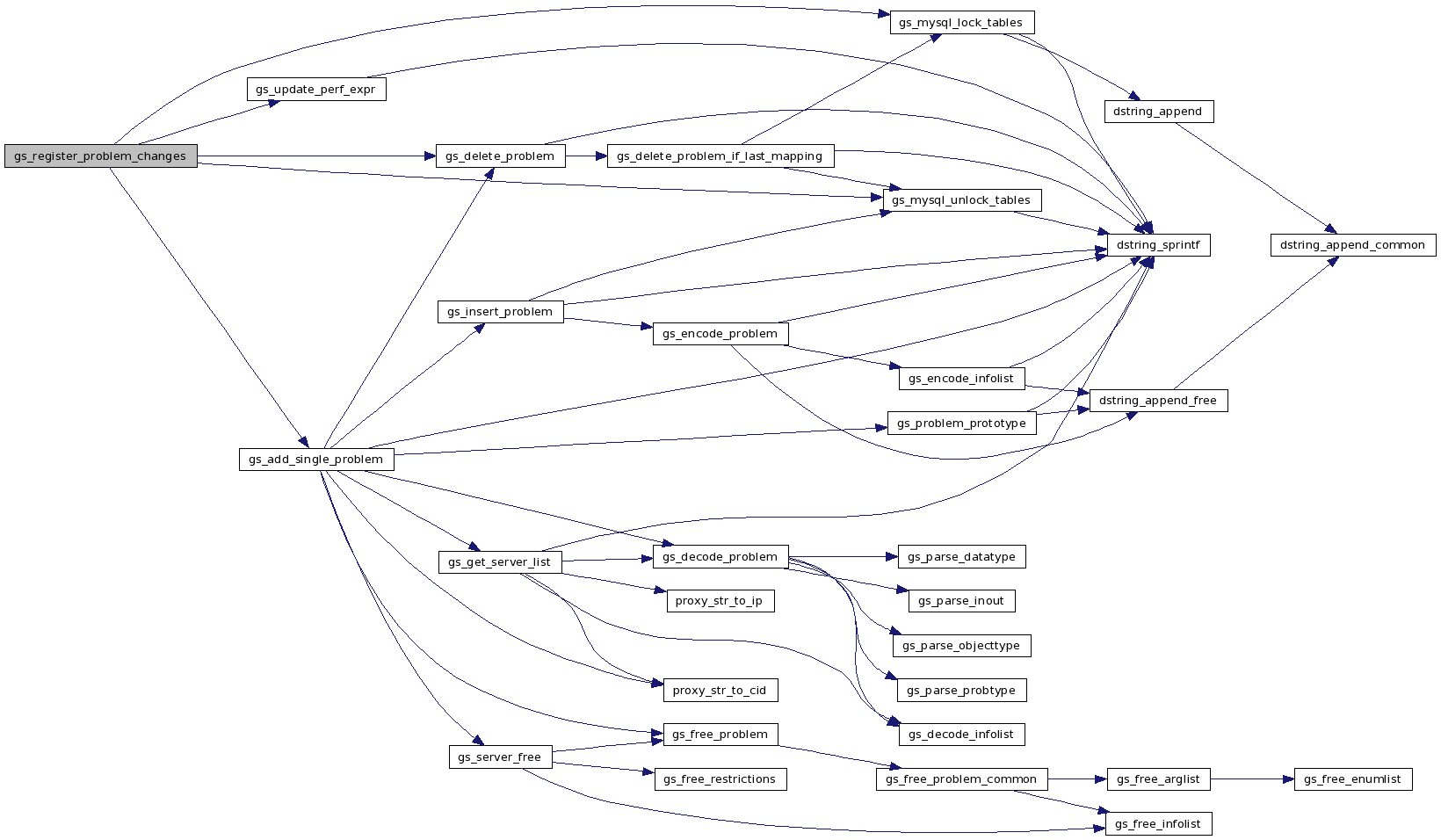
| int gs_register_problem_changes | ( | gs_agent_t * | gs_agent, | |
| gs_problem_t ** | gs_problem, | |||
| int | num_services, | |||
| char ** | models, | |||
| char ** | rm_prob, | |||
| int | num_removed, | |||
| char * | cid_string | |||
| ) |
Associated a problem w/ a server, adding the problem if it is unknown.
Associates problems with servers. If the problem is already in the database, this problem will be checked against the database to confirm that there is no conflict. If the problem is already registered to the server, success is returned.
- Parameters:
-
gs_agent The agent structure. gs_problem array of complete problem structures. num_services number of elements in gs_problem models array of performance models rm_prob array of problem names to be removed num_removed number of elements in rm_prob cid_string The component id of the server.
- Returns:
- 0 on success, -1 on error.
Definition at line 856 of file gs_storage_mysql.c.
{
  char *tables_to_lock[] = {"problems", "problem_server"};
  int i;

  if(gs_mysql_lock_tables(tables_to_lock,
       sizeof(tables_to_lock)/sizeof(*tables_to_lock)) < 0)
    ERRPRINTF("Warning: table lock failed\n");

  for(i=0;i<num_services;i++) {
    if(gs_add_single_problem(gs_agent, gs_problem[i], cid_string) < 0) {
      gs_mysql_unlock_tables();
      ERRPRINTF("Add problem failed.\n");
      return -1;
    }

    if(gs_update_perf_expr(cid_string, gs_problem[i]->name, models[i]) < 0)
      ERRPRINTF("Warning: failed to update perf model expression\n");
  }

  gs_mysql_unlock_tables();

  for(i=0;i<num_removed;i++) {
    if(gs_delete_problem(gs_agent, rm_prob[i], cid_string) < 0)
      ERRPRINTF("Failed to delete problem: %s\n", rm_prob[i]);
    else
      LOGPRINTF("Unregistered problem %s\n", rm_prob[i]);
  }

  return 0;
}

| int gs_server_exists | ( | gs_agent_t * | gs_agent, | |
| gs_server_t * | gs_server | |||
| ) |
Checks whether a server is registered.
- Parameters:
-
gs_agent The agent structure. gs_server The server structure. At least componentid must be filled in.
- Returns:
- 0 if server is not registered, 1 if it is, -1 on error.
Definition at line 1164 of file gs_storage_mysql.c.
{
  char *sql, cid_string[2 * CID_LEN + 1];
  int nrows = 0;
  MYSQL_RES *res;

  proxy_cid_to_str(cid_string, gs_server->componentid);

  sql = dstring_sprintf("SELECT 1 FROM servers WHERE componentid='%s';",
                       cid_string);
  if(mysql_query(&mysql_conn, sql)) {
    ERRPRINTF("SQL ERROR checking server existence: %s\n",
        mysql_error(&mysql_conn));
    ERRPRINTF("The query was: %s\n", sql);
    free(sql);
    return -1;
  }

  res = mysql_store_result(&mysql_conn);
  nrows = mysql_affected_rows(&mysql_conn);

  mysql_free_result(res);

  if(nrows > 0)
    return 1;

  return 0;
}

| void gs_server_expiration | ( | void ** | args | ) |
Called periodically by mfork to expire servers.
This function should be spawned as a thread at agent start-up. It periodically checks the database and removes servers that haven't contacted us recently.
- Parameters:
-
args This is the arg list supplied when mfork was called. args[0] should be a pointer to the gs_agent structure. args[1] should be a pointer to the (integer) timeout value.
Definition at line 1205 of file gs_storage_mysql.c.
{
  gs_agent_t *agent;
  int timeout;

  agent = (gs_agent_t *) args[0];
  timeout = *((int *) args[1]);

  gs_server_expire(agent, timeout);
}


| void gs_server_expiration_post | ( | void ** | args | ) |
This is called by mfork one time when closing out the server expiration process.
- Parameters:
-
args This is the arg list supplied when mfork was called. args[0] should be a pointer to the gs_agent structure. args[1] should be a pointer to the (integer) timeout value.
Definition at line 1245 of file gs_storage_mysql.c.
{
  gs_agent_t *agent;
  agent = (gs_agent_t *) args[0];
  gs_storage_finalize(agent);
}


| void gs_server_expiration_pre | ( | void ** | args | ) |
This is called by mfork one time before it begins looping on gs_server_expiration.
- Parameters:
-
args This is the arg list supplied when mfork was called. args[0] should be a pointer to the gs_agent structure. args[1] should be a pointer to the (integer) timeout value.
Definition at line 1223 of file gs_storage_mysql.c.
{
  gs_agent_t *agent;
  int timeout;

  agent = (gs_agent_t *) args[0];
  timeout = *((int *) args[1]);
  if(gs_storage_init(agent) < 0 ) {
    ERRPRINTF("Error connecting to database manager.\n");
    return;
  }
  gs_server_expire(agent, timeout);
}


| int gs_server_expire | ( | gs_agent_t * | gs_agent, | |
| int | timeout | |||
| ) |
Expires all servers that have not updated recently.
Removes all servers and their associated problems if they haven't sent a workload report in more than timeout seconds.
- Parameters:
-
gs_agent The agent structure. timeout The number of seconds for the timeout value.
- Returns:
- 0 on success, -1 on error.
Definition at line 1262 of file gs_storage_mysql.c.
{
  int now, nrows;
  char *sql;
  MYSQL_RES *res;
  MYSQL_ROW row;

  now = time(0);
  sql = dstring_sprintf("SELECT componentid FROM servers WHERE lastupdate < '%ld';",
                        now - timeout);
  if(mysql_query(&mysql_conn, sql)) {
    ERRPRINTF("SQL ERROR selecting servers to expire: %s\n",
        mysql_error(&mysql_conn));
    ERRPRINTF("The query was: %s\n", sql);
    free(sql);
    return -1;
  }

  free(sql);

  res = mysql_store_result(&mysql_conn);
  nrows = mysql_affected_rows(&mysql_conn);

  if(nrows > 0) {
    gs_server_t tmpsrv;

    /* just in case */
    memset(&tmpsrv, 0, sizeof(tmpsrv));

    while((row = mysql_fetch_row(res))) {
      ERRPRINTF("expiring %s\n", row[0]);

      proxy_str_to_cid(tmpsrv.componentid, row[0]);
      if(gs_delete_server(gs_agent, &tmpsrv) < 0)
        ERRPRINTF("Failed to delete server '%s'\n", row[0]);
    }
  }

  mysql_free_result(res);

  return 0;
}


| void gs_storage_finalize | ( | gs_agent_t * | gs_agent | ) |
Finalizes the database.
Since the database manager was added, this function does nothing, but may do something in the future.
- Parameters:
-
gs_agent The agent structure.
Definition at line 286 of file gs_storage_mysql.c.
{
  mysql_close(&mysql_conn);
  return;
}

| int gs_storage_init | ( | gs_agent_t * | gs_agent | ) |
Initializes the connection to the database manager.
- Parameters:
-
gs_agent The agent structure.
- Returns:
- 0 on success, -1 on error.
Definition at line 256 of file gs_storage_mysql.c.
{
  if(mysql_init(&mysql_conn) == NULL) {
    ERRPRINTF("Failed to initiate MySQL connection\n");
    return -1;
  }

  if(!mysql_real_connect(&mysql_conn, gs_agent->mysql.host, gs_agent->mysql.user, gs_agent->mysql.passwd,
       gs_agent->mysql.db_name, gs_agent->mysql.port, gs_agent->mysql.unix_socket, 0)) {
    ERRPRINTF("Failed to connect to database: %s\n", mysql_error(&mysql_conn));
    return -1;
  }

  if(mysql_select_db(&mysql_conn, gs_agent->mysql.db_name)) {
    printf("Failed to select db: Error: %s (%d)\n", mysql_error(&mysql_conn),
         mysql_errno(&mysql_conn));
    return -1;
  }

  return 0;
}

| int gs_update_perf_expr | ( | char * | srv_cid, | |
| char * | probname, | |||
| char * | expr | |||
| ) |
Updates the performance expression, which is used to compute the estimated execution time of a particular instance of a problem on a specific server.
- Parameters:
-
srv_cid -- the component id of the server probname -- the name of the problem expr -- the new performance expression
- Returns:
- 0 on success, -1 on failure.
Definition at line 1079 of file gs_storage_mysql.c.
{
  char *sql;

  sql = dstring_sprintf("UPDATE problem_server SET perf_model_expr='%s' WHERE componentid='%s' AND problemname='%s';",
       expr, srv_cid, probname);
  if(mysql_query(&mysql_conn, sql)) {
    ERRPRINTF("SQL ERROR updating performance expression: %s\n",
        mysql_error(&mysql_conn));
    ERRPRINTF("The query was: %s\n", sql);
    free(sql);
    return -1;
  }

  free(sql);

  return 0;
}


| int gs_update_ping_list | ( | gs_agent_t * | gs_agent, | |
| char * | cid, | |||
| char * | pings | |||
| ) |
Update a server ping list.
- Parameters:
-
gs_agent The agent structure. cid The server component ID pings The ping list (string)
- Returns:
- 0 on success, -1 on error.
Definition at line 1106 of file gs_storage_mysql.c.
{
  char *sql;

  sql = dstring_sprintf("UPDATE servers SET server_pings='%s' WHERE componentid='%s';",
        pings, cid);
  if(mysql_query(&mysql_conn, sql)) {
    ERRPRINTF("SQL ERROR updating server workload: %s\n",
        mysql_error(&mysql_conn));
    ERRPRINTF("The query was: %s\n", sql);
    free(sql);
    return -1;
  }
  free(sql);

  return 0;
}


| int gs_update_task | ( | char * | cid_string, | |
| char * | old_taskid, | |||
| char * | new_taskid, | |||
| int | agent_taskid, | |||
| double | start, | |||
| double | duration, | |||
| double | remaining, | |||
| double | end, | |||
| int | active, | |||
| int | finished | |||
| ) |
This updates the task corresponding to "old_taskid" with all the specified parameters.
- Parameters:
-
cid_string -- the component id of the server that the task is running on old_taskid -- the temporary request id generated by the agent. new_taskid -- the real request id generated by the server. agent_taskid -- the agent-generated task id. start -- the task's start time. duration -- the task's execution time. remaining -- number of seconds remaining in the task's execution. end -- the task's completion time. active -- currently for internal use. pass 0 for this param. finished -- pass TRUE if the task has completed, FALSE otherwise.
- Returns:
- 0 on success, -1 on failure.
Definition at line 770 of file gs_storage_mysql.c.
{
  char *sql;

  sql = dstring_sprintf("UPDATE tasks SET t_componentid='%s', t_taskid='%s', t_agent_taskid='%d', t_start='%lf', t_duration='%lf', t_remaining='%lf', t_end='%lf', t_active='%d', t_finished='%d' WHERE t_taskid='%s';",
           cid_string, new_taskid, agent_taskid, start, duration, remaining, end, active, finished, old_taskid);

  if(mysql_query(&mysql_conn, sql)) {
    ERRPRINTF("SQL ERROR updating task: %s\n", mysql_error(&mysql_conn));
    ERRPRINTF("The query was: %s\n", sql);
    free(sql);
    return -1;
  }

  free(sql);

  return 0;
}


| int gs_update_workload | ( | gs_agent_t * | gs_agent, | |
| gs_server_t * | gs_server | |||
| ) |
Update a server workload.
- Parameters:
-
gs_agent The agent structure. gs_server The server structure. At least componentid and workload must be filled in.
- Returns:
- 0 on success, -1 on error.
Definition at line 1132 of file gs_storage_mysql.c.
{
  int now;
  char *sql, cid_string[2 * CID_LEN + 1];

  proxy_cid_to_str(cid_string, gs_server->componentid);

  now = time(0);
  sql = dstring_sprintf("UPDATE servers SET workload='%d', nproblems='%d', lastupdate='%ld' WHERE componentid='%s';",
       gs_server->workload, gs_server->nproblems, now, cid_string);
  if(mysql_query(&mysql_conn, sql)) {
    ERRPRINTF("SQL ERROR updating server workload: %s\n",
        mysql_error(&mysql_conn));
    ERRPRINTF("The query was: %s\n", sql);
    free(sql);
    return -1;
  }
  free(sql);

  SENSORPRINTF("WORK %s %d\n", cid_string, gs_server->workload);

  return 0;
}


| int task_start_compare_function | ( | const void * | p1, | |
| const void * | p2 | |||
| ) |
Definition at line 1439 of file gs_storage_mysql.c.
{
  gs_htm_task *s1, *s2;

  if(!p1 || !p2) return 0;

  s1 = *((gs_htm_task **) p1);
  s2 = *((gs_htm_task **) p2);

  if(s1->start > s2->start)
    return 1;
  if(s1->start < s2->start)
    return -1;

  return 0;
}

Variable Documentation
| MYSQL mysql_conn |
Definition at line 42 of file gs_storage_mysql.c.