Loading...
Searching...
No Matches
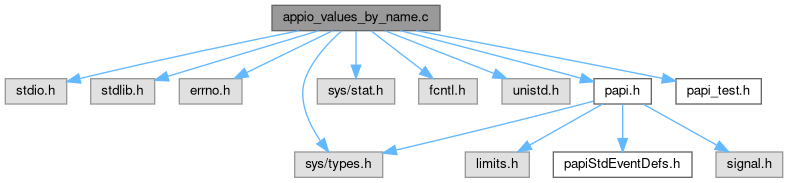
Include dependency graph for appio_values_by_name.c:
Go to the source code of this file.
Macros | |
| #define | NUM_EVENTS 11 |
| Prints the values of several (but not all) appio events specified by names. | |
Functions | |
| int | main (int argc, char **argv) |
Macro Definition Documentation
◆ NUM_EVENTS
| #define NUM_EVENTS 11 |
test case for the appio component (adapted from test in linux-net component)
Definition at line 27 of file appio_values_by_name.c.
Function Documentation
◆ main()
Definition at line 29 of file appio_values_by_name.c.
30{
34 "READ_BYTES",
35 "READ_CALLS",
36 "READ_USEC",
37 "READ_EOF",
38 "READ_SHORT",
39 "READ_ERR",
40 "WRITE_BYTES",
41 "WRITE_CALLS",
42 "WRITE_USEC",
43 "WRITE_ERR",
44 "WRITE_SHORT"
45 };
48 int total_events=0;
49
50 /* Set TESTS_QUIET variable */
51 tests_quiet( argc, argv );
52
53 /* PAPI Initialization */
57 }
58
60 printf("Appio events by name\n");
61 }
62
63 /* Map names to codes */
68 }
69
70 total_events++;
71 }
72
73 int fdin,fdout;
74 const char* infile = "/etc/group";
76 int bytes = 0;
78
79 /* Create and populate the EventSet */
81
85 }
86
90 }
91
95 }
96
97 fdin=open(infile, O_RDONLY);
98 if (fdin < 0) perror("Could not open file for reading: \n");
100 if (fdout < 0) perror("Could not open /dev/null for writing: \n");
101
104 }
105 close(fdin);
106 close(fdout);
107
111 }
112
115 printf("%#x %-24s = %lld\n",
117 }
118 }
119
123 }
124
128 }
129
130 if (total_events==0) {
132 }
133
134 test_pass( __FILE__ );
135
136 return 0;
137}
#define NUM_EVENTS
Prints the values of several (but not all) appio events specified by names.
Definition: appio_values_by_name.c:27
add multiple PAPI presets or native hardware events to an event set
Empty and destroy an EventSet.
Create a new empty PAPI EventSet.
Empty and destroy an EventSet.
Convert a name to a numeric hardware event code.
initialize the PAPI library.
Start counting hardware events in an event set.
Stop counting hardware events in an event set.
void PAPI_NORETURN test_fail(const char *file, int line, const char *call, int retval)
Definition: test_utils.c:491
void PAPI_NORETURN test_skip(const char *file, int line, const char *call, int retval)
Definition: test_utils.c:584
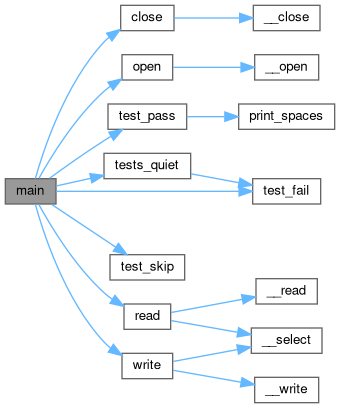
Here is the call graph for this function: