Loading...
Searching...
No Matches
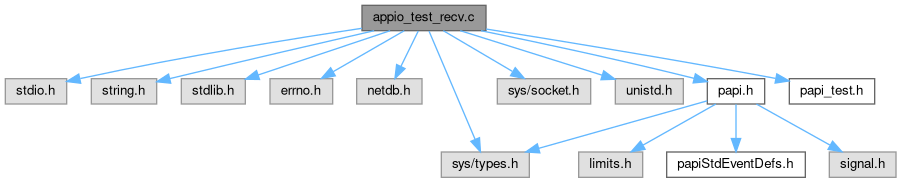
Include dependency graph for appio_test_recv.c:
Go to the source code of this file.
Macros | |
| #define | PORT 3490 |
| #define | NUM_EVENTS 6 |
Functions | |
| main (int argc, char *argv[]) | |
Macro Definition Documentation
◆ NUM_EVENTS
| #define NUM_EVENTS 6 |
Definition at line 14 of file appio_test_recv.c.
◆ PORT
| #define PORT 3490 |
Definition at line 13 of file appio_test_recv.c.
Function Documentation
◆ main()
| main | ( | int | argc, |
| char * | argv[] | ||
| ) |
Definition at line 16 of file appio_test_recv.c.
16 {
18 const char* names[NUM_EVENTS] = {"RECV_CALLS", "RECV_BYTES", "RECV_USEC", "RECV_ERR", "RECV_INTERRUPTED", "RECV_WOULD_BLOCK"};
20
21 /* Set TESTS_QUIET variable */
22 tests_quiet( argc, argv );
23
27 exit(1);
28 }
29
30 /* Create the Event Set */
33 exit(2);
34 }
35
36 if (!TESTS_QUIET) printf("This program will listen on port 3490, and write data received to standard output\n");
38 int e;
39 int event_code;
44 exit(2);
45 }
49 exit(2);
50 }
51 }
52
53 int bytes = 0;
55
56 int sockfd, n_sockfd, sin_size, len;
57 char *host_addr, *recv_msg;
58 struct sockaddr_in my_addr;
59 struct sockaddr_in their_addr;
60 my_addr.sin_family = AF_INET;
61 my_addr.sin_port = htons(PORT);
62 my_addr.sin_addr.s_addr = INADDR_ANY;
63
64 sockfd = socket(AF_INET, SOCK_STREAM, 0);
65 if (sockfd < 0) {
66 perror("socket");
67 exit(1);
68 }
69 if ((bind(sockfd, (struct sockaddr *)&my_addr, sizeof(struct sockaddr))) == -1) {
70 perror("bind");
71 exit(1);
72 }
73 listen(sockfd, 10);
74 if ((n_sockfd = accept(sockfd, (struct sockaddr *)&their_addr, &sin_size)) == -1) {
75 perror("accept");
76 exit(1);
77 }
78 close(sockfd);
79
80 /* Start counting events */
83 exit(1);
84 }
85
88 }
89
90 close(n_sockfd);
91
92 /* Stop counting events */
95 }
96
98 printf("----\n");
101 }
102 test_pass( __FILE__ );
103 return 0;
104}
add PAPI preset or native hardware event to an event set
Create a new empty PAPI EventSet.
Convert a name to a numeric hardware event code.
initialize the PAPI library.
Start counting hardware events in an event set.
Stop counting hardware events in an event set.
FILE * stderr
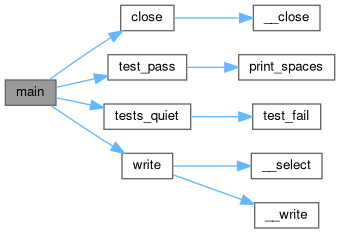
Here is the call graph for this function: