Loading...
Searching...
No Matches
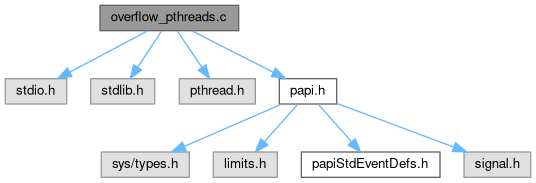
Include dependency graph for examples/overflow_pthreads.c:
Go to the source code of this file.
Macros | |
| #define | THRESHOLD 200000 |
| #define | OVER_FMT "handler(%d ) Overflow at %p! bit=%#llx \n" |
| #define | ERROR_RETURN(retval) { fprintf(stderr, "Error %d %s:line %d: \n", retval,__FILE__,__LINE__); exit(retval); } |
Functions | |
| void | do_flops (int n) |
| void | handler (int EventSet, void *address, long long overflow_vector, void *context) |
| void * | Thread (void *arg) |
| int | main (int argc, char **argv) |
Variables | |
| int | total = 0 |
Macro Definition Documentation
◆ ERROR_RETURN
| #define ERROR_RETURN | ( | retval | ) | { fprintf(stderr, "Error %d %s:line %d: \n", retval,__FILE__,__LINE__); exit(retval); } |
Definition at line 26 of file examples/overflow_pthreads.c.
◆ OVER_FMT
| #define OVER_FMT "handler(%d ) Overflow at %p! bit=%#llx \n" |
Definition at line 25 of file examples/overflow_pthreads.c.
◆ THRESHOLD
| #define THRESHOLD 200000 |
Definition at line 24 of file examples/overflow_pthreads.c.
Function Documentation
◆ do_flops()
| void do_flops | ( | int | n | ) |
Definition at line 31 of file examples/overflow_pthreads.c.
32{
37
40}
Here is the caller graph for this function:

◆ handler()
Definition at line 44 of file examples/overflow_pthreads.c.
Here is the caller graph for this function:

◆ main()
Definition at line 120 of file examples/overflow_pthreads.c.
121{
122 pthread_t thread_one;
123 pthread_t thread_two;
124 int flops1, flops2;
126 pthread_attr_t attr;
128
129
130 /* papi library initialization */
132 {
133 printf("Library initialization error! \n");
134 exit(1);
135 }
136
137 /* thread initialization */
141
142 /* return the number of microseconds since some arbitrary starting point */
144
145 /* return the number of cycles since some arbitrary starting point */
147
148 /* pthread attribution init */
149 pthread_attr_init(&attr);
150 pthread_attr_setscope(&attr, PTHREAD_SCOPE_SYSTEM);
151
152 /* create the first thread */
153 flops1 = 1000000;
157
158 /* create the second thread */
159 flops2 = 4000000;
163
164 /* wait for the threads to finish */
165 pthread_attr_destroy(&attr);
166 pthread_join(thread_one, NULL);
167 pthread_join(thread_two, NULL);
168
169 /* compute the elapsed cycles and microseconds */
171
173
176
177 /* clean up */
178 PAPI_shutdown();
179 exit(0);
180}
get real time counter value in clock cycles Returns the total real time passed since some arbitrary s...
get real time counter value in microseconds
initialize the PAPI library.
Finish using PAPI and free all related resources.
Initialize thread support in the PAPI library.
Definition: papi_fwrappers_.c:1518
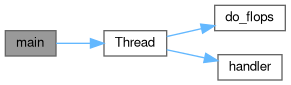
Here is the call graph for this function:
◆ Thread()
| void * Thread | ( | void * | arg | ) |
Definition at line 50 of file examples/overflow_pthreads.c.
51{
56
58
59 /* create the event set */
62
63 /* query whether the event exists */
68
69 /* add events to the event set */
72
75
77
79
83
84 /* start counting */
87
89
92
94
96
97 /* disable overflowing */
101
102 /* remove the event from the eventset */
106
110
112 values[0]);
116
117 pthread_exit(NULL);
118}
add PAPI preset or native hardware event to an event set
Create a new empty PAPI EventSet.
Set up an event set to begin registering overflows.
Query if PAPI event exists.
removes a hardware event from a PAPI event set.
Start counting hardware events in an event set.
Stop counting hardware events in an event set.
Get the thread identifier of the current thread.
void handler(int EventSet, void *address, long long overflow_vector, void *context)
Definition: examples/overflow_pthreads.c:44
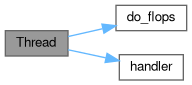
Here is the call graph for this function:
Here is the caller graph for this function:

Variable Documentation
◆ total
| int total = 0 |
Definition at line 29 of file examples/overflow_pthreads.c.