Loading...
Searching...
No Matches
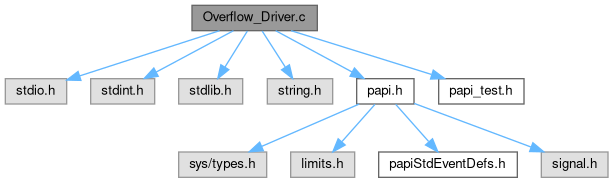
Include dependency graph for Overflow_Driver.c:
Go to the source code of this file.
Macros | |
| #define | EV_THRESHOLD 10 |
Functions | |
| void | cclib_init (void) |
| void | cclib_do_work (void) |
| void | cclib_do_more_work (void) |
| void | setup_PAPI (int *event_set, int threshold) |
| int | main (int argc, char **argv) |
| void | overflow_handler (int event_set, void *address, long long overflow_vector, void *context) |
Variables | |
| int | remaining_handler_invocations = 22 |
| int | be_verbose = 0 |
Macro Definition Documentation
◆ EV_THRESHOLD
| #define EV_THRESHOLD 10 |
Definition at line 8 of file Overflow_Driver.c.
Function Documentation
◆ cclib_do_more_work()
| void cclib_do_more_work | ( | void | ) |
Definition at line 66 of file Lib_With_Created_Counter.c.
66 {
68
70 BRNG();
74 }
75 // Do some usefull work here
77 (void)usleep(1);
78 }
79
80 return;
81}
int papi_sde_inc_counter(papi_handle_t cntr_handle, long long int increment)
Definition: sde_lib.c:637
Here is the caller graph for this function:

◆ cclib_do_work()
| void cclib_do_work | ( | void | ) |
Definition at line 49 of file Lib_With_Created_Counter.c.
Here is the caller graph for this function:

◆ cclib_init()
| void cclib_init | ( | void | ) |
Definition at line 35 of file Lib_With_Created_Counter.c.
35 {
36 papi_handle_t sde_handle;
37
40
41 z1=42;
42 z2=420;
43 z3=42000;
44 z4=424242;
45
46 return;
47}
int papi_sde_create_counter(papi_handle_t handle, const char *event_name, int cntr_mode, void **cntr_handle)
Definition: sde_lib.c:576
Here is the caller graph for this function:

◆ main()
Definition at line 18 of file Overflow_Driver.c.
18 {
20 long long counter_values[1] = {0};
21
22 if( (argc > 1) && !strcmp(argv[1], "-verbose") )
23 be_verbose = 1;
24
25 cclib_init();
26
28
29 // --- Start PAPI
32 }
33
35
36 cclib_do_work();
37
38 // --- Read the event counters _and_ reset them
41 }
43 counter_values[0] = 0;
44
45 cclib_do_more_work();
46
47 // --- Read the event counters _and_ reset them
50 }
52 counter_values[0] = 0;
53
54 }
55
56 // --- Stop PAPI
59 }
60
61 if( remaining_handler_invocations <= 1 ) // Let's allow for up to one missed signal, or race condition.
62 test_pass(__FILE__);
63 else
65
66 // The following "return" is dead code, because both test_pass() and test_fail() call exit(),
67 // however, we need it to prevent compiler warnings.
68 return 0;
69}
Accumulate and reset counters in an EventSet.
Start counting hardware events in an event set.
Stop counting hardware events in an event set.
void PAPI_NORETURN test_fail(const char *file, int line, const char *call, int retval)
Definition: test_utils.c:491
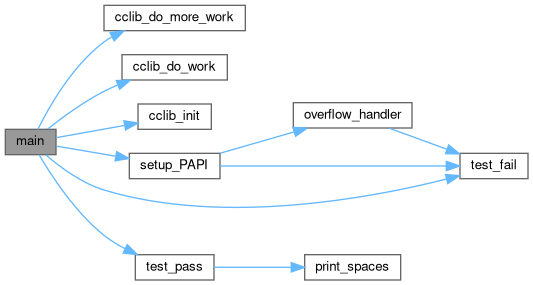
Here is the call graph for this function:
◆ overflow_handler()
Definition at line 72 of file Overflow_Driver.c.
72 {
74 int ret, *event_codes, event_index, number=1;
75
76 (void)address;
77 (void)context;
78
79 if( (ret = PAPI_get_overflow_event_index(event_set, overflow_vector, &event_index, &number)) != PAPI_OK){
81 }
82
83 number = event_index+1;
84 event_codes = (int *)calloc(number, sizeof(int));
85
88 }
89
92 }
93 free(event_codes);
94
97 fflush(stdout);
98 }
99
102
103
104 return;
105}
Convert a numeric hardware event code to a name.
converts an overflow vector into an array of indexes to overflowing events
list the events in an event set
FILE * stdout
Here is the call graph for this function:

Here is the caller graph for this function:

◆ setup_PAPI()
Definition at line 107 of file Overflow_Driver.c.
107 {
108 int ret, event_code;
109
112 }
113
116 }
117
120 }
121
124 }
125
126 if((ret = PAPI_overflow(*event_set, event_code, threshold, PAPI_OVERFLOW_HARDWARE, overflow_handler)) != PAPI_OK){
128 }
129
130 return;
131}
void overflow_handler(int event_set, void *address, long long overflow_vector, void *context)
Definition: Overflow_Driver.c:72
add PAPI preset or native hardware event to an event set
Create a new empty PAPI EventSet.
Convert a name to a numeric hardware event code.
initialize the PAPI library.
Set up an event set to begin registering overflows.
Here is the call graph for this function:

Here is the caller graph for this function:

Variable Documentation
◆ be_verbose
| int be_verbose = 0 |
Definition at line 16 of file Overflow_Driver.c.
◆ remaining_handler_invocations
| int remaining_handler_invocations = 22 |
Definition at line 15 of file Overflow_Driver.c.