Loading...
Searching...
No Matches
papi_hw_int.c File Reference
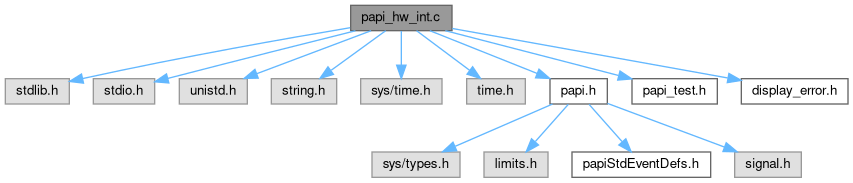
Include dependency graph for papi_hw_int.c:
Go to the source code of this file.
Functions | |
| int | main (int argc, char **argv) |
Function Documentation
◆ main()
Definition at line 25 of file papi_hw_int.c.
25 {
26
28
32
34 unsigned long long seconds;
35 unsigned long long ns;
36
38
39 /* Init the PAPI library */
43 }
44
46 printf("\nTesting PAPI_HW_INT\n");
47 }
48
52 }
53
58 }
59
60 /********************************/
61 /* testing 3 seconds of runtime */
62 /********************************/
63
65 printf("\nRunning for 3 seconds\n");
66 }
67
68 clock_gettime(CLOCK_REALTIME,&before);
69
70 PAPI_reset(eventset);
71 PAPI_start(eventset);
72
73 while(1) {
74 clock_gettime(CLOCK_REALTIME,&after);
75
76 seconds=after.tv_sec - before.tv_sec;
77 ns = after.tv_nsec - before.tv_nsec;
78 ns = (seconds*1000000000ULL)+ns;
79
80 /* be done if 3 billion nanoseconds has passed */
81 if (ns>3000000000ULL) break;
82 }
83
85
88 }
89
92 /* FIXME: find actua Hz on system */
93 /* Or even, read /proc/interrupts */
94 printf("\tAssuming HZ=250, expect roughly 750\n");
95 }
96
98
102 }
103
104 test_pass( __FILE__ );
105
106 return 0;
107}
add PAPI preset or native hardware event by name to an EventSet
Create a new empty PAPI EventSet.
initialize the PAPI library.
Reset the hardware event counts in an event set.
Start counting hardware events in an event set.
Stop counting hardware events in an event set.
void PAPI_NORETURN test_fail(const char *file, int line, const char *call, int retval)
Definition: test_utils.c:491
void PAPI_NORETURN test_skip(const char *file, int line, const char *call, int retval)
Definition: test_utils.c:584
Definition: papi_fwrappers_.c:1292
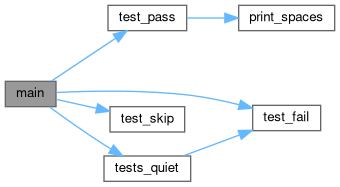
Here is the call graph for this function: