Loading...
Searching...
No Matches
Simple_CountingSet_Driver.c File Reference
Include dependency graph for Simple_CountingSet_Driver.c:

Go to the source code of this file.
Functions | |
| void | libCSet_do_simple_work (void) |
| void | libCSet_dump_set (cset_list_object_t *list_head) |
| int | libCSet_count_set_elements (cset_list_object_t *list_head) |
| int | libCSet_finalize (void) |
| void | setup_PAPI (int *event_set) |
| int | main (int argc, char **argv) |
Function Documentation
◆ libCSet_count_set_elements()
| int libCSet_count_set_elements | ( | cset_list_object_t * | list_head | ) |
Definition at line 114 of file CountingSet_Lib.c.
114 {
115 cset_list_object_t *list_runner;
116 int element_count = 0;
117
118 for(list_runner = list_head; NULL != list_runner; list_runner=list_runner->next){
119 ++element_count;
120 }
121
122 return element_count;
123}
Here is the caller graph for this function:

◆ libCSet_do_simple_work()
| void libCSet_do_simple_work | ( | void | ) |
Definition at line 21 of file CountingSet_Lib.c.
21 {
23 void *test_set;
24 test_type_t element;
25
28
31 element.id = j;
35 }
36
37 return;
38}
int papi_sde_counting_set_insert(void *cset_handle, size_t element_size, size_t hashable_size, const void *element, uint32_t type_id)
Definition: sde_lib.c:766
int papi_sde_create_counting_set(papi_handle_t handle, const char *cset_name, void **cset_handle)
Definition: sde_lib.c:682
Definition: CountingSet_Lib.c:9
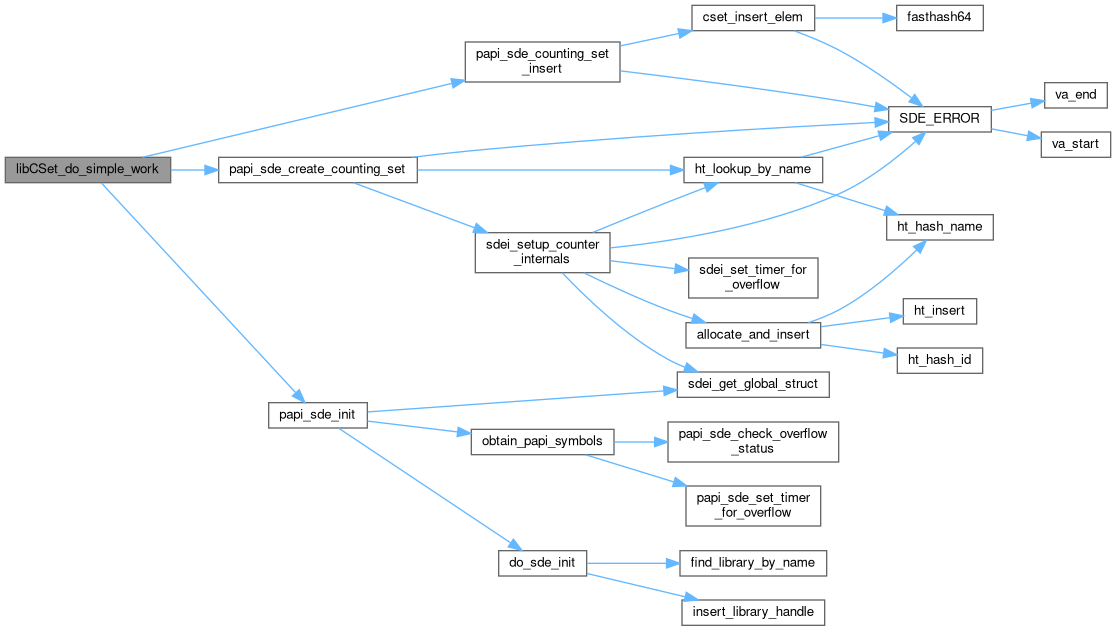
Here is the call graph for this function:
Here is the caller graph for this function:

◆ libCSet_dump_set()
| void libCSet_dump_set | ( | cset_list_object_t * | list_head | ) |
Definition at line 90 of file CountingSet_Lib.c.
90 {
91 cset_list_object_t *list_runner;
92
93 for(list_runner = list_head; NULL != list_runner; list_runner=list_runner->next){
94
95 switch(list_runner->type_id){
96 case 0:
97 {
99 printf("count= %d typesize= %lu {id= %d, x= %f, y= %lf}\n", list_runner->count, list_runner->type_size, ptr->id, ptr->x, ptr->y);
100 break;
101 }
102 case 1:
103 {
105 printf("count= %d typesize= %lu { ptr= %p, line= %d, size= %lu }\n", list_runner->count, list_runner->type_size, ptr->ptr, ptr->line_of_code, ptr->size);
106 break;
107 }
108 }
109 }
110
111 return;
112}
Definition: CountingSet_Lib.c:15
Here is the caller graph for this function:

◆ libCSet_finalize()
| int libCSet_finalize | ( | void | ) |

◆ main()
Definition at line 15 of file Simple_CountingSet_Driver.c.
15 {
17 long long counter_values[1];
18
19 (void)argc;
20 (void)argv;
21
22 setup_PAPI(&event_set);
23
24 // --- Start PAPI
27 }
28
29 libCSet_do_simple_work();
30
31 // --- Stop PAPI
34 }
35
36 if( (argc > 1) && !strcmp(argv[1], "-verbose") ){
37 libCSet_dump_set( (cset_list_object_t *)counter_values[0] );
38 }
39
40 cnt = libCSet_count_set_elements( (cset_list_object_t *)counter_values[0] );
41 if( 5222 == cnt )
42 test_pass(__FILE__);
43 else
45
46 return 0;
47}
int libCSet_count_set_elements(cset_list_object_t *list_head)
Definition: CountingSet_Lib.c:114
void libCSet_dump_set(cset_list_object_t *list_head)
Definition: CountingSet_Lib.c:90
Start counting hardware events in an event set.
Stop counting hardware events in an event set.
void PAPI_NORETURN test_fail(const char *file, int line, const char *call, int retval)
Definition: test_utils.c:491
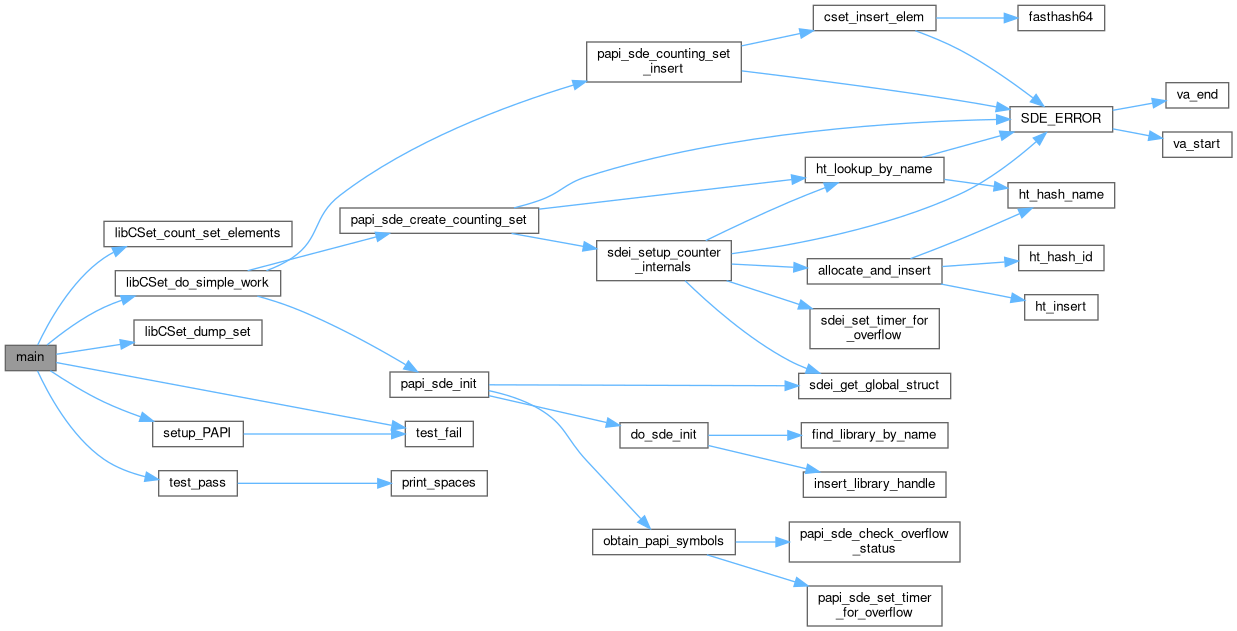
Here is the call graph for this function:
◆ setup_PAPI()
| void setup_PAPI | ( | int * | event_set | ) |
Definition at line 50 of file Simple_CountingSet_Driver.c.
50 {
51 int ret;
52
55 }
56
59 }
60
63 }
64
65 return;
66}
add PAPI preset or native hardware event by name to an EventSet
Create a new empty PAPI EventSet.
initialize the PAPI library.
Here is the call graph for this function:

Here is the caller graph for this function: