Loading...
Searching...
No Matches
Papi_add_env_event.c File Reference
Include dependency graph for Papi_add_env_event.c:
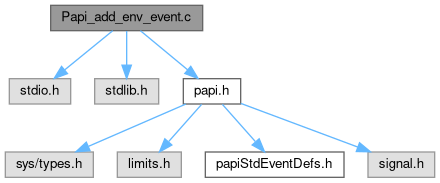
Go to the source code of this file.
Functions | |
| int | PAPI_add_env_event (int *EventSet, int *Event, char *env_variable) |
| int | main () |
Function Documentation
◆ main()
| int main | ( | ) |
Definition at line 41 of file Papi_add_env_event.c.
41 {
49
50
51 /* This initializes the library and checks the version number of the
52 * header file, to the version of the library, if these don't match
53 * then it is likely that PAPI won't work correctly.
54 */
56 /* This call loads up what the error means into errstring
57 * if retval == PAPI_ESYS then it might be beneficial
58 * to call perror as well to see what system call failed
59 */
61 exit(-1);
62 }
63 /* Create space for the EventSet */
66 exit(-1);
67 }
68
69 /* After this call if the environment variable PAPI_EVENT is set,
70 * event_code may contain something different than total instructions.
71 */
74 exit(-1);
75 }
76 /* Now lets start counting */
79 exit(-1);
80 }
81
82 /* Some work to take up some time, the PAPI_start/PAPI_stop (and/or
83 * PAPI_read) should surround what you want to monitor.
84 */
88 }
89
92 exit(-1);
93 }
94
97 exit(-1);
98 }
99
101 /* Remove PAPI instrumentation, this is necessary on platforms
102 * that need to release shared memory segments and is always
103 * good practice.
104 */
105 PAPI_shutdown();
106 exit(0);
107}
int PAPI_add_env_event(int *EventSet, int *Event, char *env_variable)
Definition: Papi_add_env_event.c:111
Create a new empty PAPI EventSet.
Convert a numeric hardware event code to a name.
initialize the PAPI library.
Produces a string on standard error, describing the last library error.
Finish using PAPI and free all related resources.
Start counting hardware events in an event set.
Stop counting hardware events in an event set.
Here is the call graph for this function:

◆ PAPI_add_env_event()
Definition at line 111 of file Papi_add_env_event.c.
111 {
112 int real_event=*EventCode;
115
116 if ( env_variable != NULL ){
121 }
122 else{
125 else
126 real_event = atoi(eventname);
127 }
128 }
129 }
131 if ( real_event != *EventCode ) {
133){
134 real_event = *EventCode;
135 }
136 }
137 }
138 *EventCode = real_event;
140}
add PAPI preset or native hardware event to an event set
Convert a name to a numeric hardware event code.
Here is the caller graph for this function: