Loading...
Searching...
No Matches
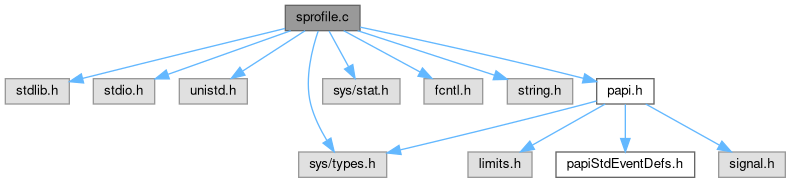
Include dependency graph for examples/sprofile.c:
Go to the source code of this file.
Macros | |
| #define | NUM_FLOPS 20000000 |
| #define | NUM_ITERS 100000 |
| #define | THRESHOLD 100000 |
| #define | ERROR_RETURN(retval) { fprintf(stderr, "Error %d %s:line %d: \n", retval,__FILE__,__LINE__); exit(retval); } |
| #define | DO_FLOPS1 (vptr_t)(do_flops1) |
| #define | DO_FLOPS2 (vptr_t)(do_flops2) |
Functions | |
| void | do_flops2 (int) |
| void | do_flops1 (int n) |
| void | do_both (int n) |
| int | main (int argc, char **argv) |
Variables | |
| volatile double | t1 = 0.8 |
| volatile double | t2 = 0.9 |
| volatile double | a = 0.5 |
| volatile double | b = 2.2 |
Macro Definition Documentation
◆ DO_FLOPS1
Definition at line 22 of file examples/sprofile.c.
◆ DO_FLOPS2
Definition at line 23 of file examples/sprofile.c.
◆ ERROR_RETURN
| #define ERROR_RETURN | ( | retval | ) | { fprintf(stderr, "Error %d %s:line %d: \n", retval,__FILE__,__LINE__); exit(retval); } |
Definition at line 16 of file examples/sprofile.c.
◆ NUM_FLOPS
| #define NUM_FLOPS 20000000 |
Definition at line 13 of file examples/sprofile.c.
◆ NUM_ITERS
| #define NUM_ITERS 100000 |
Definition at line 14 of file examples/sprofile.c.
◆ THRESHOLD
| #define THRESHOLD 100000 |
Definition at line 15 of file examples/sprofile.c.
Function Documentation
◆ do_both()
| void do_both | ( | int | n | ) |
Definition at line 37 of file examples/sprofile.c.
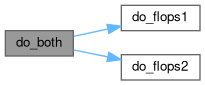
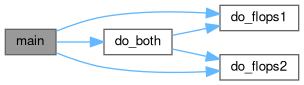
Here is the call graph for this function:
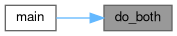
Here is the caller graph for this function:
◆ do_flops1()
| void do_flops1 | ( | int | n | ) |
Definition at line 28 of file examples/sprofile.c.
29{
32
35}
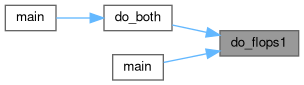
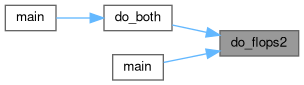
Here is the caller graph for this function:
◆ do_flops2()
| void do_flops2 | ( | int | n | ) |
Definition at line 174 of file examples/sprofile.c.
175{
178
181}
Here is the caller graph for this function:
◆ main()
Definition at line 50 of file examples/sprofile.c.
51{
55 unsigned short *profbuf2;
56 unsigned short *profbuf3;
61 PAPI_sprofil_t sprof[3];
63
64 /* initializaion */
66 {
67 printf("Library initialization error! \n");
68 exit(1);
69 }
70
72 ERROR_RETURN(1);
73
78
82
84
86 if (profbuf2 == NULL)
88
89 memset(profbuf2, 0x00, length );
90
91 profbuf3 = (unsigned short *) malloc(1 * sizeof(unsigned short));
92 if (profbuf3 == NULL)
94
95 memset(profbuf3, 0x00, 1 * sizeof(unsigned short));
96
97 /* First half */
102
104 /* Second half */
105 sprof[1].pr_base = profbuf2;
110
111 /* Overflow bin */
112 sprof[2].pr_base = profbuf3;
113 sprof[2].pr_size = 1;
114 sprof[2].pr_off = 0;
116
117 /* Creating the eventset */
120
122 /* Add Total Instructions Executed to our EventSet */
125
126 /* Add Total Instructions Executed to our EventSet */
129
130 /* set profile flag */
134
137
139
142
143 /* to clear the profile flag before removing the events */
147
148 /* free the resources hold by PAPI */
149 PAPI_shutdown();
150
151 printf("Test case: PAPI_sprofil()\n");
152 printf("---------Buffer 1--------\n");
154 {
157 }
158 printf("---------Buffer 2--------\n");
160 {
163 }
164 printf("-------------------------\n");
165 printf("%u samples fell outside the regions.\n", *profbuf3);
166
167 exit(0);
168}
add PAPI preset or native hardware event to an event set
Create a new empty PAPI EventSet.
Get the executable's address space info.
initialize the PAPI library.
Finish using PAPI and free all related resources.
Generate PC histogram data from multiple code regions where hardware counter overflow occurs.
Start counting hardware events in an event set.
Stop counting hardware events in an event set.
FILE * stderr
Definition: papi.h:579
Here is the call graph for this function:
Variable Documentation
◆ a
| volatile double a = 0.5 |
Definition at line 173 of file examples/sprofile.c.
◆ b
| volatile double b = 2.2 |
Definition at line 173 of file examples/sprofile.c.
◆ t1
| volatile double t1 = 0.8 |
Definition at line 27 of file examples/sprofile.c.
◆ t2
| volatile double t2 = 0.9 |
Definition at line 27 of file examples/sprofile.c.