Loading...
Searching...
No Matches
johnmay2.c File Reference
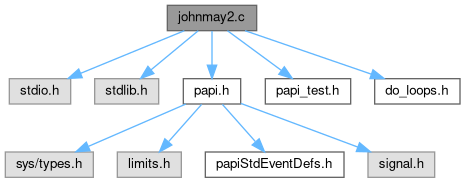
Include dependency graph for johnmay2.c:
Go to the source code of this file.
Functions | |
| int | main (int argc, char **argv) |
Function Documentation
◆ main()
Definition at line 10 of file johnmay2.c.
11{
17
18 /* Set TESTS_QUIET variable */
20
21 /* init PAPI */
25 }
26
27 /* Use PAPI_FP_INS if available, otherwise use PAPI_TOT_INS */
30 else
32
37 }
38
39 /* Create the eventset */
42
43 /* Add event to the eventset */
46
47 /* Start counting */
50
51 /* Try to cleanup while running */
52 /* Fail test if this isn't refused */
55
56 /* Try to destroy eventset while running */
57 /* Fail test if this isn't refused */
60
61 /* do some work */
62 do_flops( 1000000 );
63
64 /* stop counting */
67
68 /* Try to destroy eventset without cleaning first */
69 /* Fail test if this isn't refused */
72
73 /* Try to cleanup eventset. */
74 /* This should pass. */
77
78 /* Try to destroy eventset. */
79 /* This should pass. */
82
83 /* Make sure eventset was set to PAPI_NULL */
86
91
92 printf( "Test case John May 2: cleanup / destroy eventset.\n" );
93 printf( "-------------------------------------------------\n" );
94 printf( "Test run : \t1\n" );
97 printf( "\n" );
98 printf( "-------------------------------------------------\n" );
99 printf( "The following messages will appear if PAPI is compiled with debug enabled:\n" );
100 printf
101 ( "\tPAPI Error Code -10: PAPI_EISRUN: EventSet is currently counting\n" );
102 printf
103 ( "\tPAPI Error Code -10: PAPI_EISRUN: EventSet is currently counting\n" );
104 printf( "\tPAPI Error Code -1: PAPI_EINVAL: Invalid argument\n" );
105 }
106 test_pass( __FILE__ );
107
108 return 0;
109}
add PAPI preset or native hardware event to an event set
Empty and destroy an EventSet.
Create a new empty PAPI EventSet.
Empty and destroy an EventSet.
Convert a numeric hardware event code to a name.
initialize the PAPI library.
Query if PAPI event exists.
Start counting hardware events in an event set.
Stop counting hardware events in an event set.
void PAPI_NORETURN test_fail(const char *file, int line, const char *call, int retval)
Definition: test_utils.c:491
void PAPI_NORETURN test_skip(const char *file, int line, const char *call, int retval)
Definition: test_utils.c:584
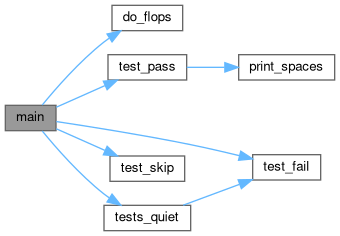
Here is the call graph for this function: