Loading...
Searching...
No Matches
Include dependency graph for papi_tot_cyc.c:

Go to the source code of this file.
Macros | |
| #define | SLEEP_RUNS 3 |
| #define | REPITITIONS 2 |
Functions | |
| static long long | convert_to_ns (struct timespec *before, struct timespec *after) |
| int | main (int argc, char **argv) |
Macro Definition Documentation
◆ REPITITIONS
| #define REPITITIONS 2 |
◆ SLEEP_RUNS
| #define SLEEP_RUNS 3 |
Definition at line 22 of file papi_tot_cyc.c.
Function Documentation
◆ convert_to_ns()
Definition at line 25 of file papi_tot_cyc.c.
26 {
27
28 long long seconds;
29 long long ns;
30
33
34 ns = (seconds*1000000000ULL)+ns;
35
36 return ns;
37}
Here is the caller graph for this function:

◆ main()
Definition at line 40 of file papi_tot_cyc.c.
40 {
41
43 double mmm_ghz;
44
45 double error;
46
49 long long nsecs;
50 long long mmm_count;
54
56
58
59 /* Init the PAPI library */
63 }
64
66 printf("\nTesting PAPI_TOT_CYC\n\n");
67 }
68
71 }
72
76 }
77
82 }
83
84
86
87 PAPI_reset(eventset);
88 PAPI_start(eventset);
89
90 sleep(1);
91
95 }
96
100 }
101
103
105 printf("\tAverage should be low, as no user cycles when sleeping\n");
106 printf("\tMeasured average: %lld\n",average);
107 }
108
109 if (average>100000) {
112 }
113
114 /*****************************/
115 /* testing Matrix Matrix GHz */
116 /*****************************/
117
119 printf("\nEstimating GHz with matrix matrix multiply\n");
120 }
121
122 // We have a problem with subsequent runs requiring fewer cycles than
123 // the first run. This may be system dependent; so we do a throw-away
124 // run here, so we end up comparing the SECOND run to the 3rd, 4th, etc.
125
127
128 clock_gettime(CLOCK_REALTIME,&before);
129
130 PAPI_reset(eventset);
131 PAPI_start(eventset);
132
134
136
139 }
140
141 clock_gettime(CLOCK_REALTIME,&after);
142
143 nsecs=convert_to_ns(&before,&after);
144
146
149 printf("\tEstimated actual GHz = %.2lfGHz\n",mmm_ghz);
150 }
151
152 mmm_count=count;
153
154 /************************************/
155 /* Check for Linear Speedup */
156 /************************************/
157
159
160#define REPITITIONS 2
161
162 clock_gettime(CLOCK_REALTIME,&before);
163
164 PAPI_reset(eventset);
165 PAPI_start(eventset);
166
169 }
170
172
175 }
176
177 clock_gettime(CLOCK_REALTIME,&after);
178
179 nsecs=convert_to_ns(&before,&after);
180
182
184
187 printf("\tError=%.2f%%\n",error);
188 }
189
190 if ((error>10.0) || (error<-10.0)) {
191
194 }
195
197
198 test_pass( __FILE__ );
199
200 return 0;
201}
add PAPI preset or native hardware event by name to an EventSet
Create a new empty PAPI EventSet.
initialize the PAPI library.
Reset the hardware event counts in an event set.
Start counting hardware events in an event set.
Stop counting hardware events in an event set.
void PAPI_NORETURN test_fail(const char *file, int line, const char *call, int retval)
Definition: test_utils.c:491
void PAPI_NORETURN test_skip(const char *file, int line, const char *call, int retval)
Definition: test_utils.c:584
static long long convert_to_ns(struct timespec *before, struct timespec *after)
Definition: papi_tot_cyc.c:25
#define REPITITIONS
Definition: papi_fwrappers_.c:1292
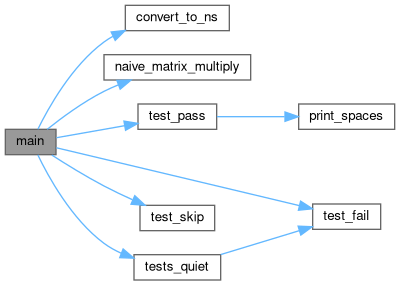
Here is the call graph for this function: