Loading...
Searching...
No Matches
overflow_index.c File Reference
Include dependency graph for overflow_index.c:

Go to the source code of this file.
Data Structures | |
| struct | ocount_t |
Macros | |
| #define | OVER_FMT "handler(%d) Overflow at %p! vector=%#llx\n" |
| #define | OUT_FMT "%-12s : %16lld%16lld\n" |
| #define | INDEX_FMT "Overflows vector %#llx: \n" |
Functions | |
| static void | handler (int EventSet, void *address, long long overflow_vector, void *context) |
| int | main (int argc, char **argv) |
Variables | |
| static ocount_t | overflow_counts [3] = { {0, 0}, {0, 0}, {0, 0} } |
| static int | total_unknown = 0 |
Macro Definition Documentation
◆ INDEX_FMT
| #define INDEX_FMT "Overflows vector %#llx: \n" |
Definition at line 19 of file overflow_index.c.
◆ OUT_FMT
| #define OUT_FMT "%-12s : %16lld%16lld\n" |
Definition at line 18 of file overflow_index.c.
◆ OVER_FMT
| #define OVER_FMT "handler(%d) Overflow at %p! vector=%#llx\n" |
Definition at line 17 of file overflow_index.c.
Function Documentation
◆ handler()
|
static |
Definition at line 33 of file overflow_index.c.
34{
36
37 ( void ) context;
38
41 }
42
43 /* Look for the overflow_vector entry */
44
48 return;
49 }
50 }
51
52 /* Didn't find it so add it. */
53
58 return;
59 }
60 }
61
62 /* Unknown entry!?! */
63
64 total_unknown++;
65}
FILE * stderr
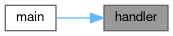
Here is the caller graph for this function:
◆ main()
Definition at line 68 of file overflow_index.c.
69{
75 int index_array[2], number;
78
79 /* Set TESTS_QUIET variable */
81
85 }
86
87 /* add PAPI_TOT_CYC and one of the events in PAPI_FP_INS, PAPI_FP_OPS or
88 PAPI_TOT_INS, depends on the availability of the event on the
89 platform */
91
95 }
96
100
102
106
113
117
119
123
127 }
128
130 printf( "Test case: Overflow dispatch of 2nd event in set with 2 events.\n" );
131 printf( "---------------------------------------------------------------\n" );
134 printf( "-----------------------------------------------\n" );
135
136 printf( "Test type : %16d%16d\n", 1, 2 );
139 }
140
142 test_fail( __FILE__, __LINE__,
143 "one counter had no overflows", 1 );
144 }
145
146 for ( k = 0; k < 3; k++ ) {
148 number = 2;
150 overflow_counts[k].mask,
151 index_array, &number );
153 test_fail( __FILE__, __LINE__,
155 }
161 printf( "\n" );
162 }
163 }
164 }
165
168 printf( "-----------------------------------------------\n" );
169 }
170
173 }
174
178 }
179
180 test_pass( __FILE__ );
181
182 return 0;
183}
Empty and destroy an EventSet.
Convert a numeric hardware event code to a name.
converts an overflow vector into an array of indexes to overflowing events
initialize the PAPI library.
Set up an event set to begin registering overflows.
Start counting hardware events in an event set.
Stop counting hardware events in an event set.
static void handler(int EventSet, void *address, long long overflow_vector, void *context)
Definition: overflow_index.c:33
int add_two_nonderived_events(int *num_events, int *papi_event, int *mask)
Definition: test_utils.c:671
void PAPI_NORETURN test_fail(const char *file, int line, const char *call, int retval)
Definition: test_utils.c:491
void PAPI_NORETURN test_skip(const char *file, int line, const char *call, int retval)
Definition: test_utils.c:584
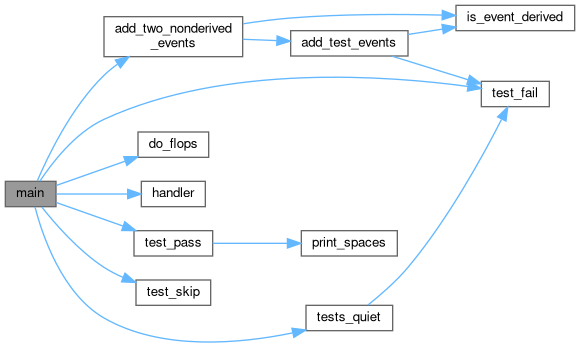
Here is the call graph for this function:
Variable Documentation
◆ overflow_counts
|
static |
Definition at line 29 of file overflow_index.c.
◆ total_unknown
|
static |
Definition at line 30 of file overflow_index.c.