Loading...
Searching...
No Matches
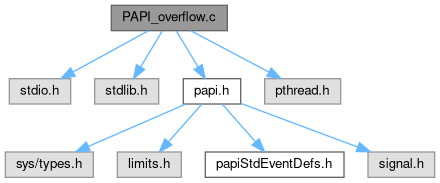
Include dependency graph for PAPI_overflow.c:
Go to the source code of this file.
Macros | |
| #define | OVER_FMT "handler(%d ) Overflow at %p! bit=%#llx \n" |
| #define | THRESHOLD 100000 |
| #define | ERROR_RETURN(retval) { fprintf(stderr, "Error %d %s:line %d: \n", retval,__FILE__,__LINE__); exit(retval); } |
Functions | |
| void | handler (int EventSet, void *address, long long overflow_vector, void *context) |
| int | main () |
Variables | |
| int | total = 0 |
Macro Definition Documentation
◆ ERROR_RETURN
| #define ERROR_RETURN | ( | retval | ) | { fprintf(stderr, "Error %d %s:line %d: \n", retval,__FILE__,__LINE__); exit(retval); } |
Definition at line 13 of file PAPI_overflow.c.
◆ OVER_FMT
| #define OVER_FMT "handler(%d ) Overflow at %p! bit=%#llx \n" |
Definition at line 11 of file PAPI_overflow.c.
◆ THRESHOLD
| #define THRESHOLD 100000 |
Definition at line 12 of file PAPI_overflow.c.
Function Documentation
◆ handler()
Definition at line 19 of file PAPI_overflow.c.
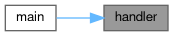
Here is the caller graph for this function:
◆ main()
| int main | ( | ) |
Definition at line 26 of file PAPI_overflow.c.
27{
29 /* must be set to null before calling PAPI_create_eventset */
30
37
38
39 /****************************************************************************
40 * This part initializes the library and compares the version number of the *
41 * header file, to the version of the library, if these don't match then it *
42 * is likely that PAPI won't work correctly.If there is an error, retval *
43 * keeps track of the version number. *
44 ****************************************************************************/
45
47 {
48 printf("Library initialization error! \n");
49 exit(1);
50 }
51
52 /* Here we create the eventset */
55
57
58 /* Here we are querying for the existence of the PAPI presets */
60 {
62
65
66 printf ("PAPI_TOT_INS not available on this platform.");
67 printf (" so subst PAPI_event with PAPI_TOT_CYC !\n\n");
68
69 }
70
71
72 /* PAPI_event_code_to_name is used to convert a PAPI preset from
73 its integer value to its string name. */
76
77 /* add event to the event set */
80
81 /* register overflow and set up threshold */
82 /* The threshold "THRESHOLD" was set to 100000 */
86
87 printf ("Here are the addresses at which overflows occurred and overflow vectors \n");
88 printf ("--------------------------------------------------------------\n");
89
90
91 /* Start counting */
92
95
97 {
99 tmp++;
100 }
101
102 /* Stops the counters and reads the counter values into the values array */
105
106
108
109 /* clear the overflow status */
113
114 /************************************************************************
115 * PAPI_cleanup_eventset can only be used after the counter has been *
116 * stopped then it remove all events in the eventset *
117 ************************************************************************/
120
121 /* Free all memory and data structures, EventSet must be empty. */
124
125 /* free the resources used by PAPI */
126 PAPI_shutdown();
127
128 exit(0);
129}
void handler(int EventSet, void *address, long long overflow_vector, void *context)
Definition: PAPI_overflow.c:19
add PAPI preset or native hardware event to an event set
Empty and destroy an EventSet.
Create a new empty PAPI EventSet.
Empty and destroy an EventSet.
Convert a numeric hardware event code to a name.
initialize the PAPI library.
Set up an event set to begin registering overflows.
Query if PAPI event exists.
Finish using PAPI and free all related resources.
Start counting hardware events in an event set.
Stop counting hardware events in an event set.
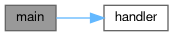
Here is the call graph for this function:
Variable Documentation
◆ total
| int total = 0 |
Definition at line 15 of file PAPI_overflow.c.