PLASMA  2.4.5
PLASMA - Parallel Linear Algebra for Scalable Multi-core Architectures
 All Data Structures Namespaces Files Functions Variables Typedefs Enumerations Enumerator Macros Groups
pdpack.c File Reference
#include <stdlib.h>
#include <sys/types.h>
#include "common.h"
Include dependency graph for pdpack.c:

Go to the source code of this file.

Functions

void plasma_pdpack (plasma_context_t *plasma)
void plasma_pdunpack (plasma_context_t *plasma)

Detailed Description

PLASMA InPlaceTransformation module PLASMA is a software package provided by Univ. of Tennessee, Univ. of California Berkeley and Univ. of Colorado Denver

This work is the implementation of an inplace transformation based on the GKK algorithm by Gustavson, Karlsson, Kagstrom and its fortran implementation.

Version:
2.4.5
Author:
Mathieu Faverge
Date:
2010-11-15

d Tue Nov 22 14:35:42 2011

Definition in file pdpack.c.


Function Documentation

void plasma_pdpack ( plasma_context_t plasma)

plasma_pdpack pack all extra elements at the end of the matrix

 +&mdash;&mdash;&mdash;&mdash;&mdash;+
 |               |
 |               |
 |     A11       |
 |               |
 |               |
 +&mdash;&mdash;&mdash;&mdash;&mdash;+
 |     A21       |
 +&mdash;&mdash;&mdash;&mdash;&mdash;+

This matrix is initially stored as (example of Column Major, it's the same for row major. We just consider the transpose matrix) : A11(:,0), A21(:,0), A11(:,1), A21(:,1), ...

On exit, it's stored as follow. A11(:,:), A12(:,:)

Parameters:
[in]plasmaPlasma context
[in]mNumber of rows in matrix A
[in]nNumber of columns in matrix A
[in,out]AMatrix A to pack. (see above for entry and exit format)
[in]m0Number of rows of A21

Definition at line 65 of file pdpack.c.

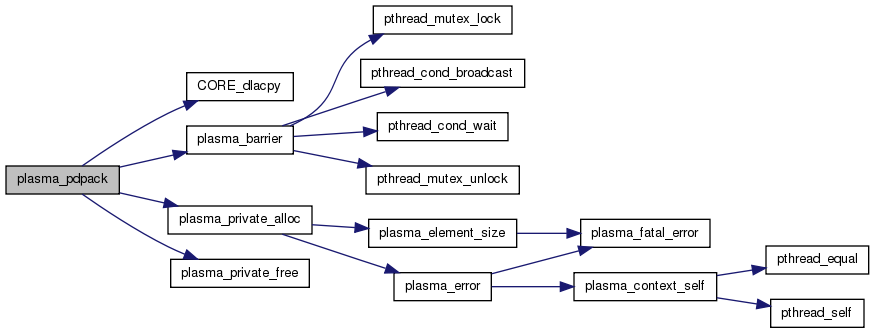
References A, CORE_dlacpy(), min, plasma_barrier(), plasma_private_alloc(), plasma_private_free(), PLASMA_RANK, PLASMA_SIZE, PLASMA_SUCCESS, plasma_unpack_args_6, PlasmaRealDouble, PlasmaUpperLower, plasma_sequence_t::status, and W.

{
double *A, *W, *Wl;
PLASMA_sequence *sequence;
PLASMA_request *request;
int m, n, m0;
int i, m1, size, rank, start, end, bs, mod;
plasma_unpack_args_6(m, n, A, m0, sequence, request);
if (sequence->status != PLASMA_SUCCESS)
return;
/* Quick return */
if ( n <= 1 )
return;
m1 = m - m0;
size = PLASMA_SIZE;
rank = PLASMA_RANK;
mod = (n-1) % size;
bs = (n-1) / size;
start = rank * bs;
if ( rank < mod ) {
bs++;
}
start += min( mod, rank );
W = (double*)plasma_private_alloc(plasma, (m0*bs), PlasmaRealDouble);
Wl = (double*)plasma_private_alloc(plasma, m1, PlasmaRealDouble);
/* Save leftover pieces that are otherwise going to be overwritten */
CORE_dlacpy( PlasmaUpperLower, m0, bs, &(A[(int64_t)start*m+m1]), m, W, m0 );
/* Pack A */
end = ((n-1) / size) * size + 1;
for(i=rank+1; i<end; i+=size) {
memcpy( Wl, &(A[i*m]), m1*sizeof(double));
plasma_barrier(plasma);
memcpy( &(A[i*m1]), Wl, m1*sizeof(double));
}
if ( rank < (n - end)) {
i = end + rank;
memcpy( Wl, &(A[i*m]), m1*sizeof(double));
plasma_barrier(plasma);
memcpy( &(A[i*m1]), Wl, m1*sizeof(double));
}
else
plasma_barrier(plasma);
/* Restore leftover pieces */
CORE_dlacpy( PlasmaUpperLower, m0, bs, W, m0, &(A[(int64_t)m1*n+start*m0]), m0 );
plasma_private_free(plasma, W);
plasma_private_free(plasma, Wl);
}

Here is the call graph for this function:

Here is the caller graph for this function:

void plasma_pdunpack ( plasma_context_t plasma)

plasma_pdunpack unpack all extra elements from the end of the matrix

 +&mdash;&mdash;&mdash;&mdash;&mdash;+
 |               |
 |               |
 |     A11       |
 |               |
 |               |
 +&mdash;&mdash;&mdash;&mdash;&mdash;+
 |     A21       |
 +&mdash;&mdash;&mdash;&mdash;&mdash;+

This matrix is initially stored as (example of Column Major, it's the same for row major. We just consider the transpose matrix) : A11(:,:), A12(:,:)

On exit, it's stored as follow. A11(:,0), A21(:,0), A11(:,1), A21(:,1), ...

Parameters:
[in]plasmaPlasma context
[in]mNumber of rows in matrix A
[in]nNumber of columns in matrix A
[in,out]AMatrix A to pack. (see above for entry and exit format)
[in]m0Number of rows of A21

Definition at line 166 of file pdpack.c.

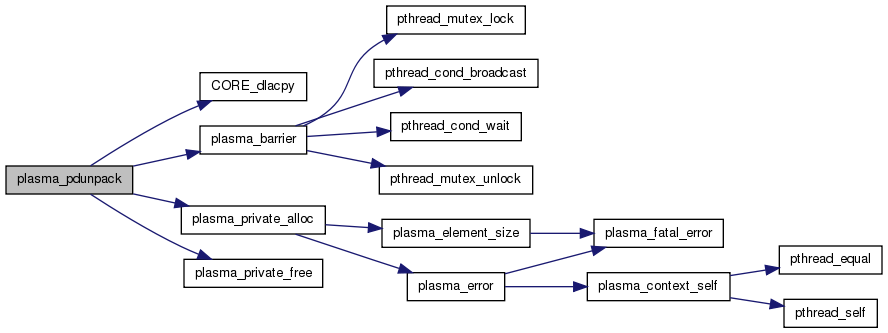
References A, CORE_dlacpy(), min, plasma_barrier(), plasma_private_alloc(), plasma_private_free(), PLASMA_RANK, PLASMA_SIZE, PLASMA_SUCCESS, plasma_unpack_args_6, PlasmaRealDouble, PlasmaUpperLower, plasma_sequence_t::status, and W.

{
double *A, *W, *Wl;
PLASMA_sequence *sequence;
PLASMA_request *request;
int m, n, m0;
int i, m1, size, rank, start, end, bs, mod;
plasma_unpack_args_6(m, n, A, m0, sequence, request);
if (sequence->status != PLASMA_SUCCESS)
return;
/* Quick return */
if ( n <= 1 )
return;
m1 = m - m0;
size = PLASMA_SIZE;
rank = PLASMA_RANK;
mod = (n-1) % size;
bs = (n-1) / size;
start = rank * bs;
if ( rank < mod ) {
bs++;
}
start += min( mod, rank );
W = (double*)plasma_private_alloc(plasma, (m0*bs), PlasmaRealDouble);
Wl = (double*)plasma_private_alloc(plasma, m1, PlasmaRealDouble);
/* Save leftover pieces that are otherwise going to be overwritten */
CORE_dlacpy( PlasmaUpperLower, m0, bs, &(A[(int64_t)m1*n+start*m0]), m0, W, m0 );
/* Unpack A */
end = ((n-1) % size) ;
for(i=n-1-rank; i>end; i-=size) {
memcpy( Wl, &(A[i*m1]), m1*sizeof(double));
plasma_barrier(plasma);
memcpy( &(A[i*m]), Wl, m1*sizeof(double));
}
if ( rank < end ) {
i = rank+1;
memcpy( Wl, &(A[i*m1]), m1*sizeof(double));
plasma_barrier(plasma);
memcpy( &(A[i*m]), Wl, m1*sizeof(double));
}
else
plasma_barrier(plasma);
/* Restore leftover pieces */
CORE_dlacpy( PlasmaUpperLower, m0, bs, W, m0, &(A[(int64_t)start*m+m1]), m );
plasma_private_free(plasma, W);
plasma_private_free(plasma, Wl);
}

Here is the call graph for this function:

Here is the caller graph for this function: