Jack Dongarra Lends Expertise to National Conversation on International High-Performance Computing Dynamics
ASAC Subcommittee on American Competitiveness and Innovation Report
 Jack Dongarra recently served as chair of the Advanced Scientific Computing Advisory Committee (ASAC) Subcommittee on American Competitiveness and Innovation, which issued a report titled “Can the United States Maintain Its Leadership in High-Performance Computing?”.
The opening of the report’s Executive Summary sets the discussion up as follows:
The United States (U.S.) is no longer the unambiguous leader in the vitally important field of high-performance computing (HPC). Japan, the European Union (EU), and China have fielded systems that are on par with our fastest supercomputers. The supply chain for everything from semiconductors to scientific software is globally distributed. Yet our economic future and security depend critically on our ability to innovate faster than our competitors, and the speed of innovation depends increasingly on large-scale computational science and engineering and thus HPC. How should the United States respond to this challenge? This report seeks to initiate a new and potentially transformative national discussion on this vital question.
NYTimes Magazine Article
Also along the same topic of international HPC dynamics, Jack Dongarra was recently quoted in an article in NYTimes Magazine titled “‘An Act of War’: Inside America’s Silicon Blockade Against China.” The article was also turned into an episode of the NYTimes podcast The Daily.
“The person with the best supercomputer can do the best science,” Jack Dongarra, founding director of the Innovative Computing Laboratory at the University of Tennessee, told me. Dongarra runs a program called the TOP500, which offers a biannual ranking of the fastest supercomputers in the world. As of June, China claims 134 spots, compared with 150 for the U.S. But the picture is incomplete: Around 2020, China’s submissions plummeted in a way that suggested to Dongarra a desire to avoid attracting unwanted attention. Rumors of new supercomputers leak out in scientific papers and research announcements, leaving observers to guess at the true state of the competition — and the size of China’s presumed lead. “It’s striking because in 2001 China had no computers on the list,” Dongarra says. “Now they’ve grown to the point that they dominate it.”
Intel Tech Innovation Tools Blog Features Ginkgo
ICL’s Ginkgo high-performance linear algebra library was recently spotlighted in a blog post on Intel’s Tech Innovation Tools blog.
The Innovative Computing Lab at the University of Tennessee at Knoxville under the leadership of Hartwig Anzt has been working on Ginkgo*, making it available with full support for the SYCL cross-platform abstraction layer and oneAPI.
Ginkgo is a modern C++ math library for scientific high performance computing. It is modular by design with the intent of actively being able to take advantage of GPUs and other accelerators. For GPU offload of its math algebra functions and solvers it relies on the implementation of executors. One such executor is the DPC++ Executor, a module specifically dedicated to enabling the use of Ginkgo Linear Operators with SYCL and thus allowing offload compute acceleration on GPUs and compute devices from a variety of vendors including Intel.
The key functionality Ginkgo provides consists of
- Sparse Linear Solvers and Preconditioners
- Sparse Matrix Vector Multiplication Functions
In short, Ginkgo is a high-performance linear algebra library for many core systems, with a focus on solution of sparse linear systems. It is implemented using C++ with GPU kernels supporting CUDA*, HIP*, and of course SYCL/oneAPI.
In this blog we will talk about the great work being done at the University of Tennessee at Knoxville as part of the oneAPI Academic Centers of Excellence.
We will also briefly talk about how Ginkgo fits into the oneAPI ecosystem and how it and its SYCL support augments the Intel® oneAPI Math Kernel Library (oneMKL).
ICL Hosts Kick-off for AI for Environmental Remediation Project


ICL hosted the formal Kick-off meeting July July 17-18, 2023 for the AI for Environmental Remediation project. Joining ICL’s George Bosilca, Deborah Penchoff, and Stan Tomov were Niki Labbe from University of Tennessee Institute of Agriculture, Charles Sims from UTK’s Howard H. Baker Jr. School of Public Policy and Public Affairs, Vasileios Anagnostopoulos from University of Central Florida, and Charles Peterson from University of California, Los Angeles. The project aims to spearhead the design of novel AI-driven solutions to reduce environmental contamination involving REEs and actinides through HPC-exascale enabling capabilities.
Austrian Alps Expedition
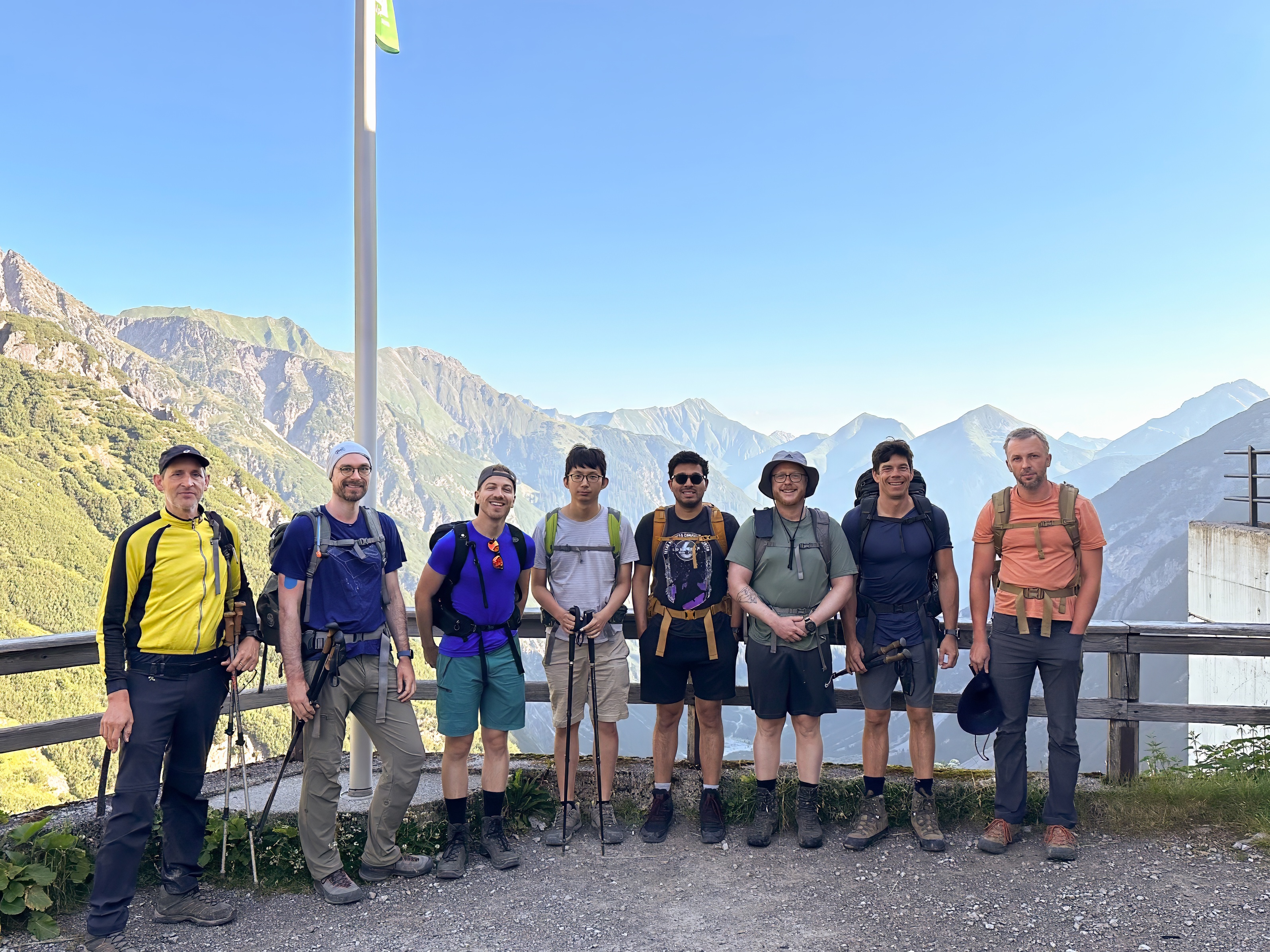
A group from ICL/KIT recently embarked on a three-day hiking trip through the Austrian Alps, starting in Imst, Austria, and ending in the small town of Boden. Two nights were spent along the way in Müttekopfhütte and Hanauer Hütte. On the journey from ICL/KIT were (from right to left in the group photo) Geri Ragghianti, Hartwig Anzt, Fritz Göbel, Pratik Nayak, Yu-Hsiang Mike Tsai, Thomas Gruetzmacher, and Marcel Koch. They were joined by Prof. Quintana-Ortí (far left), who was visiting from Spain’s Polytechnic University of Valencia.



Of course, Hartwig attempted to attend a Zoom meeting from the mountain locale.
Conference Reports
Berlin Summit for EVE
ICL Director Hartwig Anzt had the opportunity to attend the July 3-7 Berlin Summit for EVE, which brought together invited participants from across the world to draft a blueprint for the EVE (Earth Virtualization Engines) project. This ambitious project aims to create a “digital twin” of the Earth to better understand and adapt to climate change. NVIDIA CEO Jensen Huang gave a keynote:
“EVE’s vision to understand future climate impacts at kilometer scale is a grand challenge that demands simultaneous breakthroughs in modelling, computing, and AI. Nvidia is working with the EVE community to provide a path to simulate and visualize the global atmosphere at unprecedented speed and scale, using cutting-edge AI for physics simulation, accelerated scientific computing and advanced data infrastructure.” – Jensen Huang, CEO of Nvidia
ISPDC 2023
ICL director Hartwig Anzt was one of the featured keynote speakers at the 22nd IEEE International Symposium on Parallel and Distributed Computing (ISPDC 2023) held July 10-12. Hartwig talked in his keynote about the role of software in HPC and the lessons learned in the U.S. Exascale Computing Project. The conference was held in Romania’s capital city of Bucharest and included a conference dinner in the historical Cary’cu Bere Restaurant and a visit to Cotroceni Palace. The conference was organized around the topic of “The Compute Continuum” which allowed for talks and panel discussions ranging from IoT, 6G networks, and edge computing to security and user analysis.
Many lessons learned from this project: Humans are key, listen to applications, plan early, adopt project management tools! Excellent talk! pic.twitter.com/mCcHfifZHs
— Florina Ciorba (@cflorina) July 10, 2023
CEED 7th Annual Meeting


Stan Tomov, Natalie Beams, and Ahmad Abdelfattah represented ICL at the 7th Annual CEED Meeting August 1-3. Stan traveled to Lawrence Livermore National Lab for the meeting, while Natalie and Ahmad participated remotely. Stan and Natalie presented the latest developments in MAGMA and the MAGMA backend for libCEED, as well as efforts to optimize the MAGMA backend for Frontier/Aurora, with improvements in the batch matrix-vector multiplication kernel and utilizing Tensor Cores/Matrix Cores for enhanced GEMM performance. The team also covered porting the MAGMA backend to Intel GPUs, mixed-precision optimizations in CEED, mini-application development, integration of MFEM-Ginkgo for distributed solvers, autotuning the MAGMA backend, exploring SYCL backends in libCEED, and ongoing work in porting the entire MAGMA library to SYCL/oneAPI.
Interview
Treece Burgess

Where are you from originally?
I was born in Dallas, Texas, but only lived there for roughly a year after I was born and never got to experience actually living there. I have spent essentially all 27 years of my life in Knoxville, TN and even though I am originally from Texas, I would say my home and where I grew up is Knoxville.
Can you summarize your educational and professional background prior to joining ICL?
I obtained my Bachelors of Science in Mathematics at the University of Tennessee, Knoxville (UTK) in 2021. Upon finishing this degree, I immediately took a graduate research assistant position with Dr. Taufer at GCLab while I began working on a Masters degree in Mathematics at UTK. As a graduate research assistant for the past two years I have helped the PAVE team at LLNL develop Thicket which is a python-based toolkit for analyzing ensemble performance data. With two years of study/research now passing, I will officially graduate with the Masters of Mathematics degree the first week of August.
How did you first hear about the lab, and what made you want to work here?
I first heard about ICL due to my being a part of GCLab and having the opportunity to attend the ICL retreat/weekly seminars. Over the course of the last few years I have begun to grow more interested in performance engineering and linear algebra due to my research/studies. Being able to attend the weekly seminars and the retreat allowed me to see the research being performed at ICL and I felt as though my research interests aligned well with various projects within the lab.
What is your focus here at ICL? What are you working on?
My focus will be on the SLATE project, where I will primarily be working on benchmarking, tracing, and updating documentation.
What are your interests/hobbies outside of work?
My main interest/hobby right now is running. I am currently training to run a sub 3-hour marathon to qualify for the Boston marathon and due to this I spend most of my hours outside of work training.
Tell us something about yourself that might surprise people.
I am a really big Real Madrid fan. Most people would probably not know I am a fan since I never actually wear anything with the club logo on it around town. However, I grew up playing soccer and eventually began to follow the club closely due to players such as Zidane, Ronaldo, and Modric.
If you weren’t working at ICL, where would you like to be working and why?
If I weren’t working at ICL, I would really like to work at NVIDIA. The reason for this is due to the type of research/work they perform.