News and Announcements
Supercomputing ’12

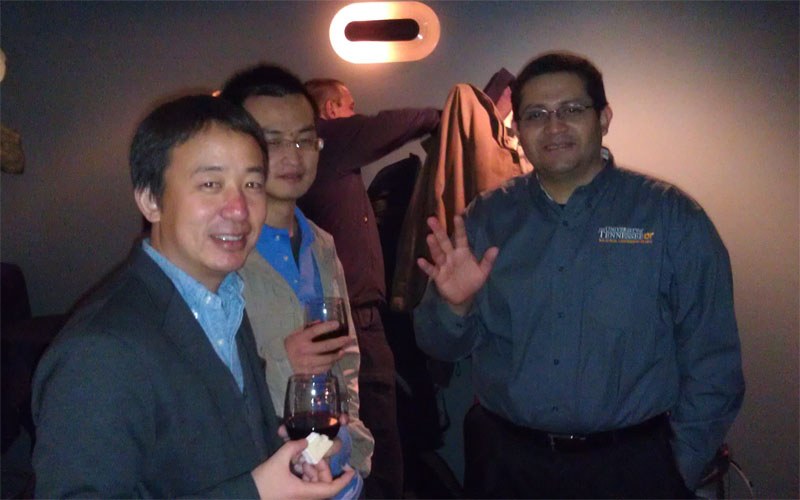


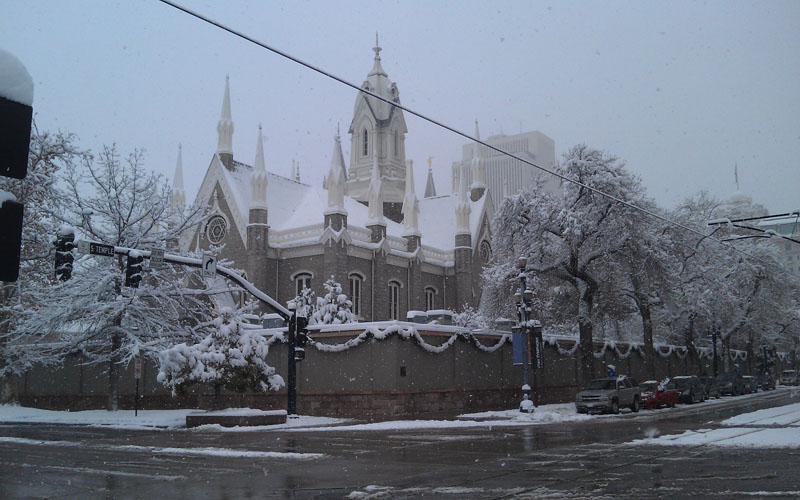


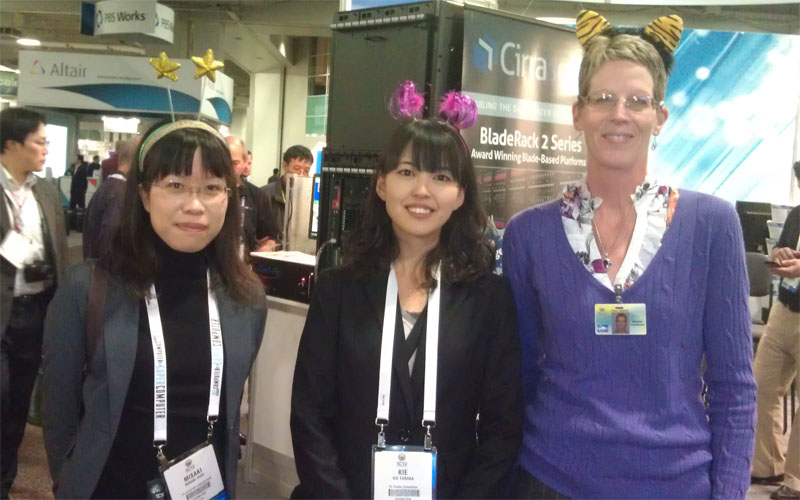


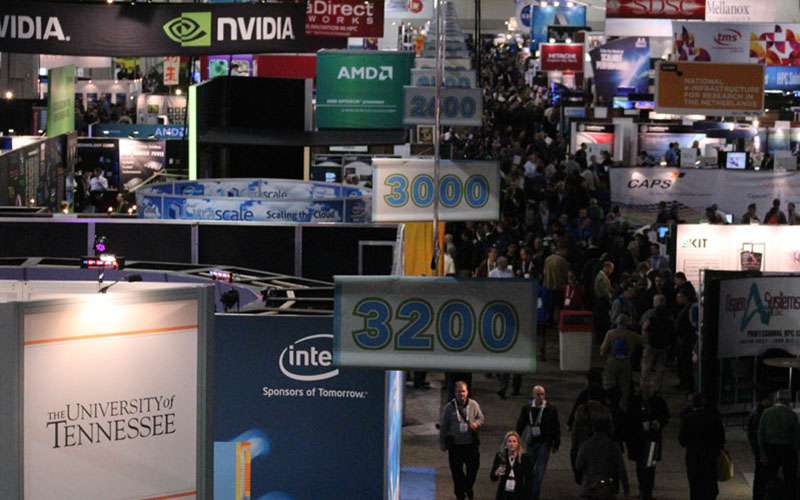

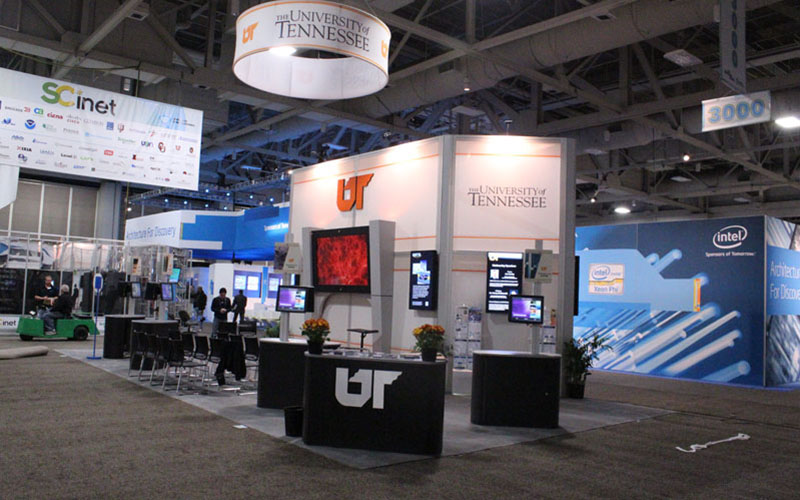


This year’s Supercomputing Conference was held in Salt Lake City, Utah on November 10th – 16th. A staple of ICL’s November itinerary, the lab routinely has a significant presence at SC, with faculty, research staff, and students giving talks, presenting papers, and leading BoF sessions; SC12 was no exception.
ICL had a new venue this year in the form of the University of Tennessee’s first ever SC booth. The booth, which was organized and led by the National Institute for Computational Sciences (NICS), was visually designed with the help of ICL/CITR staff, manned with support from ICL researchers attending SC, and featured the lab’s research projects in the booth’s kiosks. Jack Dongarra drew a large crowd to the booth during the exhibition’s Gala Opening when he gave his annual talk presenting the November 2012 TOP500 list.
As is tradition, the ICLers both past and present who attended SC12 were invited to the Alumni Dinner. This year, the dinner was held at Faustina, and there were plenty of conversations shared between old friends and colleagues, as the ideas and drinks flowed freely. In the end, everyone had a good time as they capped off the last major conference of the year.
TOP500 – ORNL’s Titan is Number One
 With the 40th edition of the TOP500 list, it was revealed that Titan, ORNL’s new Cray XK7 system, took the #1 spot at 17.59 petaflops on the HPL benchmark, making the Oak Ridge National Laboratory once again home to the fastest supercomputer on the planet.
Titan utilizes a hybrid architecture, with 16-core AMD Opteron 6274 CPUs working alongside NVIDIA Tesla K20 GPUs, to achieve it’s incredible performance. ORNL’s massive 18,688 node machine is also one of the world’s most energy efficient supercomputers, ranking #3 on the November 2012 Green500 list.
| Rank | Site | System |
|---|---|---|
| 1 | DOE/SC/Oak Ridge National Laboratory United States |
Titan – Cray XK7 , Opteron 6274 16C 2.200GHz, Cray Gemini interconnect, NVIDIA K20x Cray Inc. |
| 2 | DOE/NNSA/LLNL United States |
Sequoia – BlueGene/Q, Power BQC 16C 1.60 GHz, Custom IBM |
| 3 | RIKEN Advanced Institute for Computational Science (AICS) Japan |
K Computer – K computer, SPARC64 VIIIfx 2.0GHz, Tofu interconnect Fujitsu |
| 4 | DOE/SC/Argonne National Laboratory United States |
Mira – BlueGene/Q, Power BQC 16C 1.60GHz, Custom IBM |
| 5 | Forschungszentrum Juelich (FZJ) Germany |
JUQUEEN – BlueGene/Q, Power BQC 16C 1.600GHz, Custom Interconnect IBM |
| See the full list at Top500.org. | ||
Green500 – UT’s Beacon is Number One
The University of Tennessee’s Beacon supercomputer, an Appro Xtreme-X, debuted at the top of the November 2012 Green500 List. Managed by the National Institute for Computational Sciences (NICS), the Beacon system has set the new energy efficiency bar at 2.49 gigaflops per watt. Utilizing Intel Sandy Bridge CPUs and four Intel Xeon Phi accelerators per node, Beacon achieved a peak 112,200 gigaflops of performance running the LINPACK benchmark, while consuming only 44.89 kW of power.
2012 HPC Challenge Awards
Each year, the HPCC Awards competition features contestants who submit performance numbers from the world’s largest supercomputer installations, as well as alternative implementations that use a vast array of parallel programming environments.
This year’s HPCC winners were unveiled by Piotr Luszczek and Jack Dongarra during a BoF session at SC12. For the Class 1 awards, the Japanese K Computer, currently #3 on the TOP500, took 1st place in the Global HPL, Global FFT, and EP-STREAM-Triad (system) benchmarks, while IBM’s IBM Power 775 took 1st place in the Global RandomAccess benchmark. Visit the HPCC website to see the full list of the winners.
MAGMA at SC12
Also at SC12, Jack Dongarra gave an in-depth talk on the latest developments in the Matrix Algebra on GPU and Multicore Architectures (MAGMA) project. Click on the video above to see the entire presentation.
Recent Releases
SC12 Handouts
New project handouts from SC12 are available for download in PDF format.


MAGMA 1.3 and MAGMA MIC 0.3 Released
Matrix Algebra on GPU and Multicore Architectures (MAGMA) is a collection of next generation linear algebra (LA) libraries for hybrid architectures. The MAGMA package supports interfaces for current LA libraries and standards, e.g., LAPACK and BLAS, to allow computational scientists to easily port any LA-reliant software components to heterogeneous systems.
- MAGMA 1.3 provides performance improvements and support for the new NVIDIA Kepler GPUs.
- MAGMA MIC 0.3 provides implementations for MAGMA’s one-sided dense matrix factorizations (LU, QR, and Cholesky) for Intel Xeon Phi Coprocessors.
Visit the MAGMA software page to download the tarball(s).
PaRSEC 1.0.0 Released
PaRSEC is a generic framework for architecture aware scheduling and management of micro-tasks on distributed many-core heterogeneous architectures. Applications we consider can be expressed as a Direct Acyclic Graph of tasks with labeled edges designating data dependencies. DAGs are represented in a compact problem-size independent format that can be queried on demand to discover data dependencies in a totally distributed fashion.
PaRSEC 1.0.0 includes the PaRSEC software as well as the DPLASMA dense linear algebra layer. It is strongly recommended that all users of previous versions upgrade to 1.0.0 as soon as possible.
The provided DPLASMA layer supports all basic datatypes (s,d,z,c) for the following kernels:
- Linear Systems of Equations: Cholesky, LU (inc. pivoting and partial pivoting), LDL (prototype).
- Least Squares: QR & LQ; — Parameterized QR (all possible trees) (factorization / generation of Q).
- Symmetric Eigenvalue Problems: Reduction to Band (prototype).
- Level 3 Tile BLAS: GEMM, TRSM, TRMM, HEMM/SYMM, HERK/SYRK, HER2K/SYR2K.
Visit the PaRSEC software page for download and installation instructions.
PLASMA 2.5.0 Beta 1 Released
The Parallel Linear Algebra Software for Multicore Architectures (PLASMA) package, ICL’s flagship project for multicore and many-core computing, is designed to deliver high performance from homogeneous multi-socket multicore systems by combining state-of-the-art solutions in algorithms, scheduling, and software engineering.
The PLASMA 2.5.0b1 release contains new algorithms to compute condition estimators for general and positive definite cases, along with the following updates:
- Introduced condition estimators for General and Positive Definite cases (xGECON, xPOCON).
- Fixed recurring with LAPACK release number in plasma-installer.
- Fixed out-of-order computation in QR/LQ factorization that was causing numerical issues with dynamic scheduling.
- Fixed many comments in the Doxygen documentation.
- Corrected some performance issues with in-place layout translation.
Visit the PLASMA software page to download the tarball.
Interview
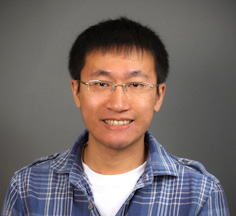
Peng Du
Where are you from, originally?
I was born in Dalian, China and I spent 7 years in Beijing before coming to the U.S. and joining ICL.
Can you summarize your educational background?
I earned my Bachelor’s and Master’s degrees in Engineering at the Beijing University of Aeronautics and Astronautics. My Master’s degree research focused on hyperspectral image processing for ground object classification. I obtained my PhD from UTK in 2012. My PhD dissertation is about fault tolerance in dense linear algebra algorithms.
How did you first meet Jack?
I first heard about Jack and ICL in 2004, during a seminar about numerical linear algebra and HPC in China. I was fascinated by the topic, so I started to follow the work of ICL. Later, on a conference trip to the U.S. in early 2005, I made my first visit to Knoxville and met Jack in person as sort of an interview. We had a 30-minute talk and later Jack invited me to attend one of the staff meetings and introduced me to a few staff members and students at ICL.
What did you work on during your time at ICL?
I was involved in projects like LAPACK, ScaLAPACK, and MAGMA. For my dissertation I was working with the MPI team and developing fault tolerance algorithms.
What are some of your favorite memories from your time at ICL?
Off the top of my head, there were the lunch talks and retreats. But my favorite memories are the people I met at ICL. Coming from a very remote background, so many people have kindly helped, encouraged, and inspired me throughout work and life over the years. I’ve made many good friends here.
Tell us where you are and what you’re doing now.
I live in Seattle, WA now working for Amazon as a software engineer. I am in the tools team in the Amazon Web Service (AWS) division, but for the first few months I worked for the Operation Engineering team where I wrote software tools and web services to help maintain and improve fleet health.
In what ways did working at ICL prepare you for what you do now, if at all?
There are so many things I learned at ICL that are now benefiting my current work, such as the programming and debugging skills, problem analysis, or even the heavy use of Vim. But what I benefit from the most, especially as a PhD student, is the ability to take initiative in solving complex problems by researching and collaborating with great people. This seemed very challenging at the beginning, but turned out to be the most rewarding benefit.
How do you like Seattle? Did you enjoy driving across the U.S.?
I really enjoy living in Seattle. The city is very energetic and full of opportunities. It is beautiful, even if the rain almost never stops in winter. Driving across the U.S. is definitely a once-in-a-lifetime experience. I traveled 2,556 miles in 7 days taking the northern routes. I wish I had more time for the trip because there are still so many places that could be explored on the way. Being out there alone driving on I-90 through Montana’s mountainous terrain and watching the gorgeous sunset after a storm—it doesn’t get any better!
Tell us something about yourself that might surprise some people.
May not be anything surprising at all, but just a few personal quirks. During 2007-2008, I managed to go swimming every day for 5 months without missing a day. I learned freestyle and butterfly all by myself with the help of YouTube during the time. I went mountain biking at Tsali in North Carolina 10+ times and never had a single flat tire. Back at ICL, I almost never worked in my office. I can fly the most realistic Boeing 747 simulator (PMDG) on computer and perform techniques such as CAT III ILS autoland and forward slip as seen in the incident of Flight 143 in 1983. I’m planning a trip to UK to fly the simulator that’s used to train real-life airline pilots next year. We used to have those in the U.S., but not anymore.