
News and Announcements
Dr. Jack Dongarra receives 2011 IEEE IPDPS Charles Babbage Award

At this year’s IEEE International Parallel and Distributed Processing Symposium in Anchorage, Alaska, Dr. Jack Dongarra received the 2011 IEEE IPDPS Charles Babbage Award in recognition of his diligent work with numerical algorithms and linear algebra libraries for parallel computing.
This honor is awarded at the IPDPS conference, and previous winners include: Wen-Mei Hwu, Mike Flynn, Bill Dally, Yale N. Patt, Christos Papadimitriou, Michel Cosnard, Steve Wallach, Thomson Leighton, Michael O. Rabin (Harvard University), K. Mani Chandy (California Institute of Technology), Jim Gray (Microsoft Research), Frances Allen, David Kuck, Arvind, Harold Stone, H.T. Kung, and Irving S. Reed.
In addition to receiving the Charles Babbage Award at this year’s IPDPS, Dr. Dongarra was also a keynote speaker.
IESP Gets a Nod from G8
 As reported by HPC Wire, the International Exascale Software Project (IESP) is receiving recognition from the G8 for exascale’s potential as a high performance climate modeling platform. In addition, several other exascale research projects are also considered valuable to climate modeling and climate change research as newer high resolution climate models are developed.
One such project, Enabling Climate Simulation (ECS) at Extreme Scale, is being funded by the G8 Research Councils Initiative on Multilateral Research. The ECS team is led by the UIUC’s Marc Snir (project director), and INRIA’s Franck Cappello (associate director). It gathers researchers from five of the G8 nations: the US (University of Illinois at Urbana-Champaign, University of Tennessee [George Bosilca], and the National Center for Atmospheric Research), France (INRIA), Germany (German Research School for Simulation Sciences), Japan (Tokyo Tech and University of Tsukuba), Canada (University of Victoria), and Spain (Barcelona Supercomputing Center).
NSF backs PULSAR
 The new Parallel Unified Linear Algebra with Systolic Arrays (PULSAR) project recently received funding from the National Science Foundation. This three year grant, from NSF’s Computing and Communications Foundation, will enable the PULSAR team to develop efficient Linear Algebra libraries that can run on future, highly parallel, high performance computing systems.
PULSAR introduces the idea of “virtual systolic arrays” in order to adapt the old concept of “systolic arrays” for use on the extreme scale systems of the future. The systolic array execution model minimizes communication costs while maximizing scalability, making it ideally suited to the expected properties of future HPC platforms. The PULSAR team consists of Jack Dongarra, Jakub Kurzak, and Piotr Luszczek.
CUG 2011 Best Paper Finalists
Congratulations to Shirley Moore and ICL alumnus Hiahang You for being Cray User Group (CUG) Best Paper Finalists. Their paper, “The Design of an Auto-Tuning I/O Framework on Cray XT5 System,” was selected at the recent CUG 2011 conference in Fairbanks, Alaska.
iPad 2 Supercomputer?
The New York Times recently posted an article discussing the relative power of Apple’s iPad 2. In the article, Jack Dongarra offers a comparison between the iPad 2 and Cray 2, the world’s fastest supercomputer from 1985 to 1989. He claims that a benchmark test showed the iPad 2 was comparable to a four processor version of Cray 2, which had eight processors in total. In an interesting twist, the benchmark tested only one of iPad 2’s processing cores. Dongarra estimates that a benchmark of both iPad 2 processing cores could render between 1.5 and 1.65 gigaflops, with minimal power consumption.
Recent Releases
PAPI 4.1.3 Now Available
The Performance Application Programming Interface (PAPI) 4.1.3 release is now available for download. This is a minor release of PAPI-C that addresses a number of bugs and other issues that have surfaced since PAPI 4.1.2. See the software page to download the tarball.
Dates to Remember
ICL Retreat 2011

As a reminder, mark your calendars for August 11-12 for the 2011 ICL Retreat! This year’s venue is the Buckberry Lodge in Gatlinburg.
Interview
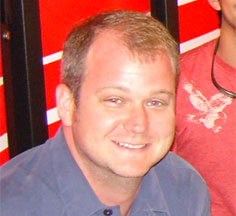
Martin Swany
You’re one of the earliest ICLers. Tell us about your educational background and how you got started with the group.
I worked in the networking group on campus, while working toward a Master’s degree in CS. While taking Jack’s course in Parallel Computing, I realized how much networking was involved in parallel and distributed computing. That was the mid-nineties, when the Internet boom was in full swing. ICL employed some well-known people in networking at the time, like Keith Moore, who was an IETF area director for a while.
What all did you work on back in those days?
The PVM effort always attracted interesting network hardware. As it seemed that we were always testing some network technology, and tweaking it for performance, I talked to Jack about buying some dedicated PCs just for that purpose. Before clustering was really common, we started doing that, and that pile of machines eventually evolved into the Tennessee Oak Ridge Cluster (TORC).
What are some of your favorite memories from your time at ICL?
Friday lunch was always a great thing. It still is, and I think I’m overdue for a visit.
Tell us where you are and what you’re doing now.
Well that’s recently gotten a little complicated. Up until May of this year, I was an associate professor in CIS at the University of Delaware. Starting in the fall, I’m going to be an associate professor in the School of Informatics and Computing at Indiana University in Bloomington. I’ll also have a partial appointment as Principal Scientist in the Office of the VP of IT, which will allow me to collaborate with the Pervasive Technologies Institute (PTI) as well as with the networking division at IU (InCENTRE, GlobalNOC, TransPAC/ACE). This is really a perfect position for me as I tend to work in the space between parallel distributed computing and networking. IU has so much excellent leadership in cyberinfrastructure, and my interests play into many of their ongoing efforts.
In what ways did working at ICL prepare you for what you do now, if at all?
Working at ICL was my initial exposure to the HP(D)C community, and I learned a lot about it. I made many contacts through ICL’s widespread projects and collaborations. It really taught me how large-scale, system-oriented, research is done. I think the position at Indiana is going to give me a chance to put that knowledge to work on a bigger stage.
You’ve done collaborative research with ICL from your current position at the University of Delaware. Do you expect to continue that at IU?
It was great to be able to collaborate on a project with Jack and George Bosilca while I was at the University of Delaware. With Andy Lumsdaine’s OpenMPI efforts at IU, I think that work can continue and grow. Also, since Jack has on-going collaborations with Geoffrey Fox and FutureGrid, which is based at IU, the groundwork seems to have already been laid to do more when I get to IU. So yes, I do look forward to more collaboration with ICL when I get to IU.
Tell us something about yourself that might surprise some people.
The TORC was one of the earlier cluster efforts going on, and in 1999 I got a note from Sergey Brin of Google noting that I was running a Linux cluster at Tennessee and saying they were looking for people. I said thanks but no thanks – I’m going to finish my degree. I figured they’d never beat Alta Vista! Oh well, maybe it’s not surprising, but it’s definitely funny!


