16th Scheduling for Large Scale Systems Workshop

ICL hosted the 16th Scheduling for Large Scale Systems Workshop from May 22 through May 24. The workshop featured thematic half-day sessions focused on topics related to scheduling and algorithms for large-scale systems. The organizers structured the workshop to include dedicated sessions for informal discussions and exchanges, in addition to the scheduled presentations. Past editions of this series took place in Aussois (2004, 2008, 2010, 2011), San Diego (2005), Knoxville (2009, 2017), Pittsburgh (2012), Dagstuhl (2013, 2015), Lyon (2014), Nashville (2016), Berkeley (2018), Bordeaux (2019), and Frejus (2022). George Bosilca and Yves Robert organized the event, which attracted 25 researchers from around the globe, including ICL alumni Mathieu Faverge and Amina Guermouche.
New Proposals Funded
NSF Office of Advanced Cyberinfrastructure (OAC):
Collaborative Research: Frameworks: Performance Engineering Scientific Applications with MVAPICH and TAU using Emerging Communication Primitives
This is a collaborative multi-institutional project to develop the next generation of HPC innovations in existing infrastructure to deliver the best performance for science domains. The emergence of the new MPI 4.0 standard has brought forward new opportunities for rewriting applications. These include partitioned point-to-point and collective operations, and neighborhood collectives to map the execution of MPI tasks to the bare-metal hardware. Recent developments in GPU-based compression techniques provide an attractive option to optimize communication. With these advances, there is a critical need to update the commonly used tools and libraries that form the basis for the NSF’s HPC cyberinfrastructure. As part of this proposal, we undertake this challenge and pursue new performance engineering avenues in the MVAPICH2 and TAU libraries with scientific applications. The project focuses on two popular HPC applications spanning multiple domains – Anelastic Wave Propagation (AWP-ODC) and Highly efficient FFTs for Exascale (heFFTe). The lead PI for the project is DK Panda from the Ohio State University along with Sameer Shende from the University of Oregon, Stan Tomov from the University of Tennessee, and Yifeng Cui from the San Diego Supercomputer Center.
AI Tennessee Initiative Seed Fund:
A Fast Portable Deep Learning Library for Commodity Edge Devices (MagmaEdge)
MagmaEdge will be developed as a fast deep learning (DL) framework for running AI applications on commodity edge devices. Edge devices such as the Raspberry Pi, Nvidia Jetson Nano, or embedded processors from Intel and AMD are widely used in many common applications or appliances. These devices, when equipped with various sensors, provide efficient and economical Internet of Things (IoT) solutions for many common commercial needs and operations, most obviously on the food delivery bot seen around the UTK campus. Unlike traditional IoT devices that exchange data and instructions with a cloud server, the latest generation of edge devices is capable of performing data analytics and providing real-time AI solutions for a spectrum of designated tasks. Stan Tomov is lead PI and Kwai Wong is Co-PI.
AI Tennessee Initiative Seed Fund in Collaboration with the UT Institute of Agriculture:
Accelerating Optimization of Radiochemical Separations for Environmental Remediation with Artificial Intelligence
This effort will spearhead the design of AI-driven solutions to reduce environmental contamination through HPC-exascale enabling capabilities. The focus will be on developing AI-driven predictive capabilities to extract actinides from the environment that were introduced by anthropogenic sources such as atmospheric nuclear weapons testing, accidental releases from nuclear plants, spent fuel processing, and improper waste disposal methods from storage facilities. The team includes Deborah Penchoff, Stan Tomov, and George Bosilca from ICL in collaboration with the UT Institute of Agriculture (UTIA), the UT Energy and Environment Program, the University of Central Florida, and the University of California, Los Angeles. Deborah Penchoff is lead PI, and Niki Labbe from UTIA is co-PI.
Jack Dongarra Interviewed by 9-year-old YouTuber
Jack has conducted many interviews in the last year since his Turing Award was announced, but perhaps none as memorable as this conversation with 9-year-old Ehsan Adouane, who recently interviewed Jack for his STEM education YouTube channel. Enjoy:
Conference Reports
ISC High Performance 2023

The weather was sunny all week in Hamburg, Germany for the ISC High Performance 2023 conference held there May 21st through 25th. Among the 3,100+ attendees were ICL’s Hartwig Anzt, Jack Dongarra, and Piotr Luszczeck, as well as many others from ICL’s extended family including Tobias Ribizel, Vasilis Georgiou, Thomas Grützmacher, and Pratik Nayak from KIT and Michela Taufer from GCLab, who served as the ISC 2023 Program Deputy Chair.
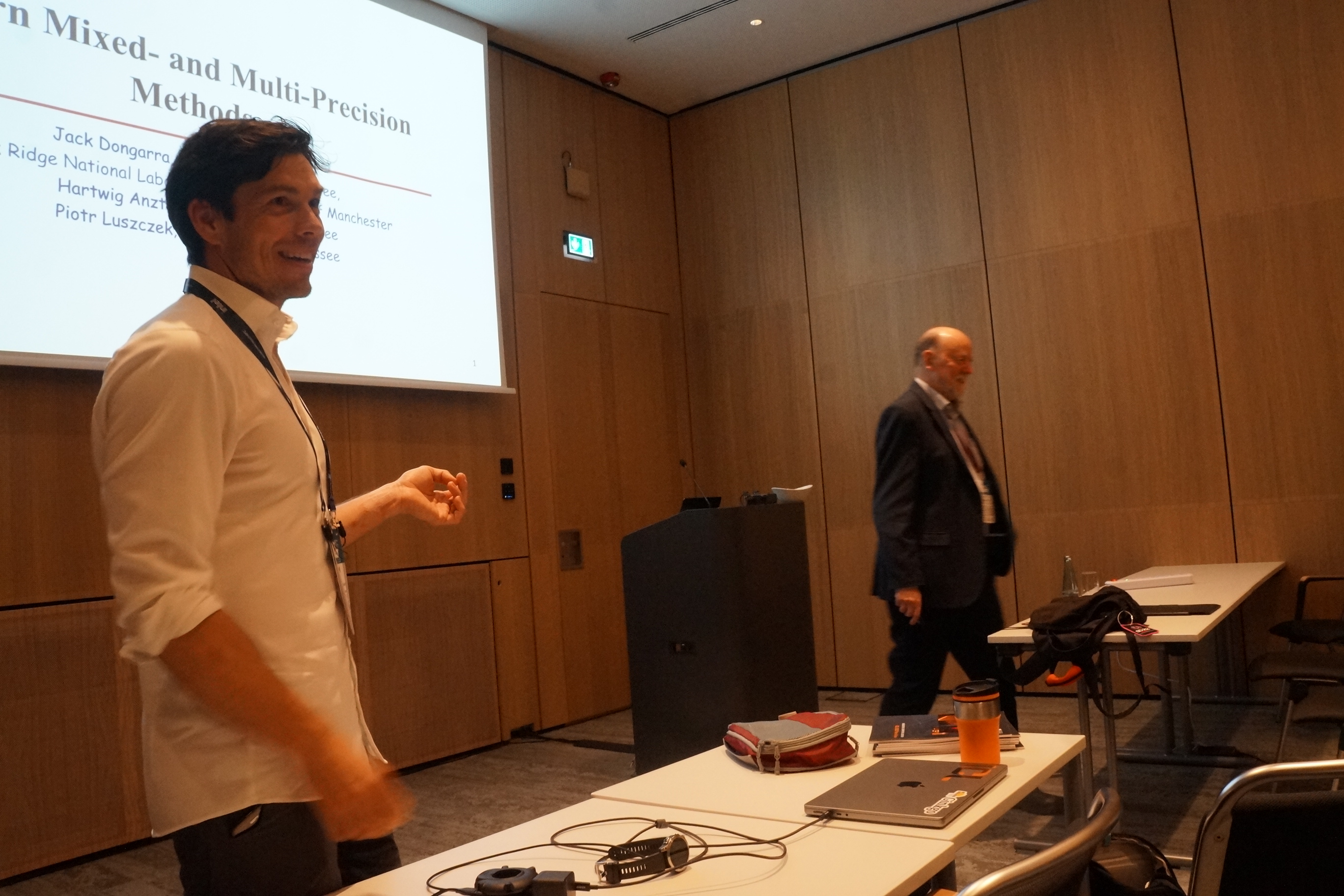
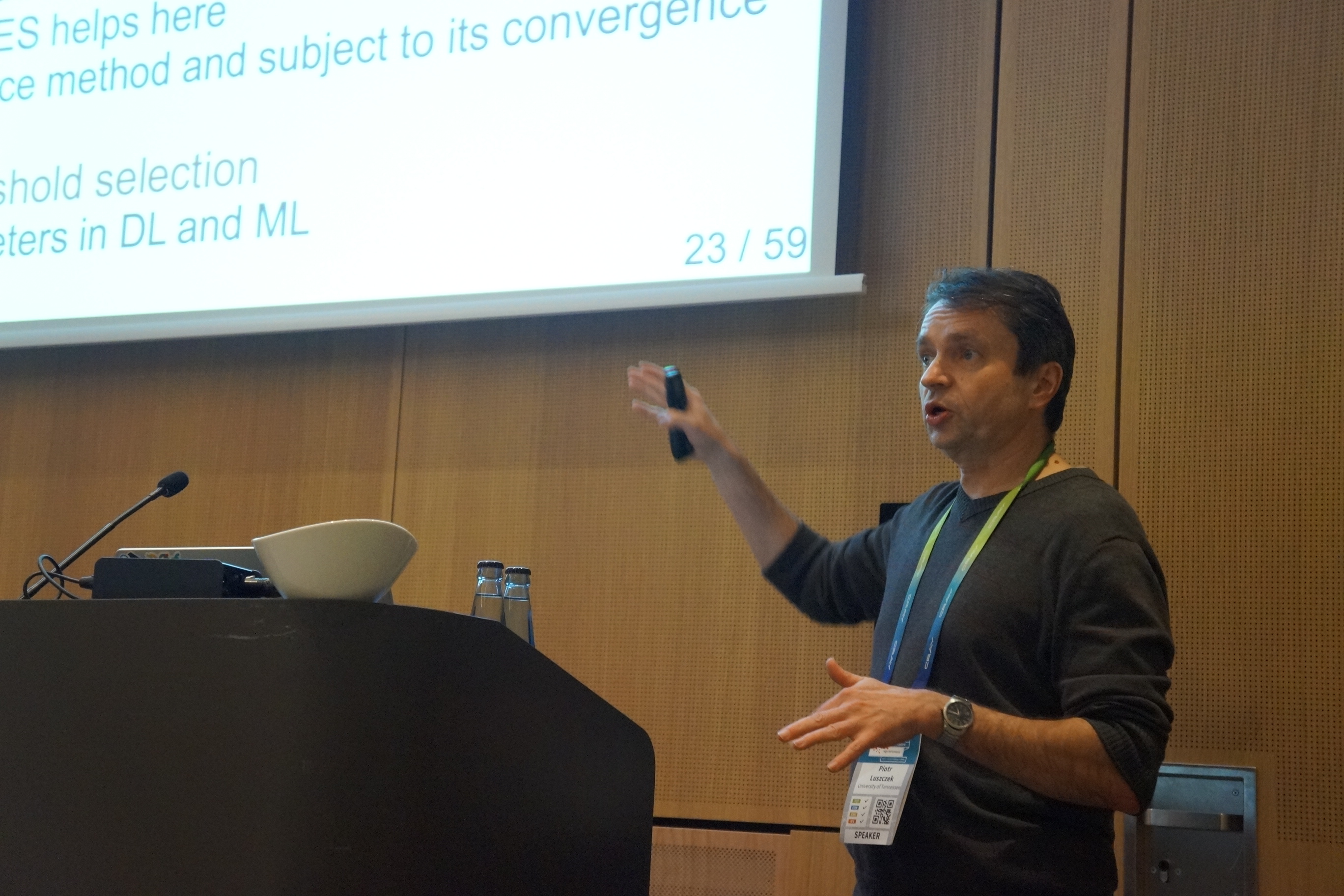
On Sunday, May 21, Piotr, Hartwig, and Jack presented a tutorial titled “Modern Mixed-Precision Methods: Hardware Perspectives, Algorithms, Kernels, and Solvers”.
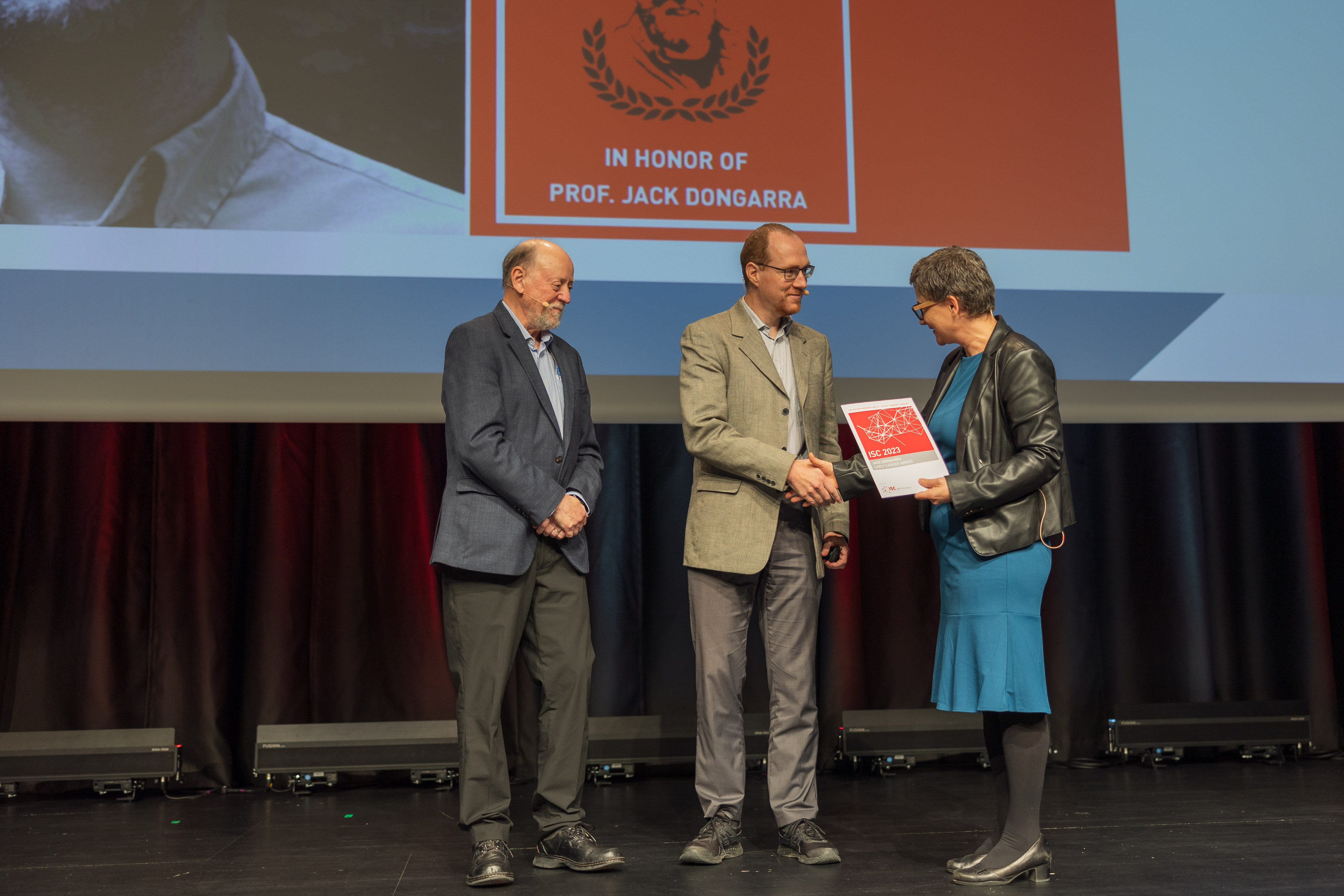
On Monday, May 22nd Michela was on hand to formally present Torsten Hoefler with the first edition of the ISC Jack Dongarra Early Career Award.
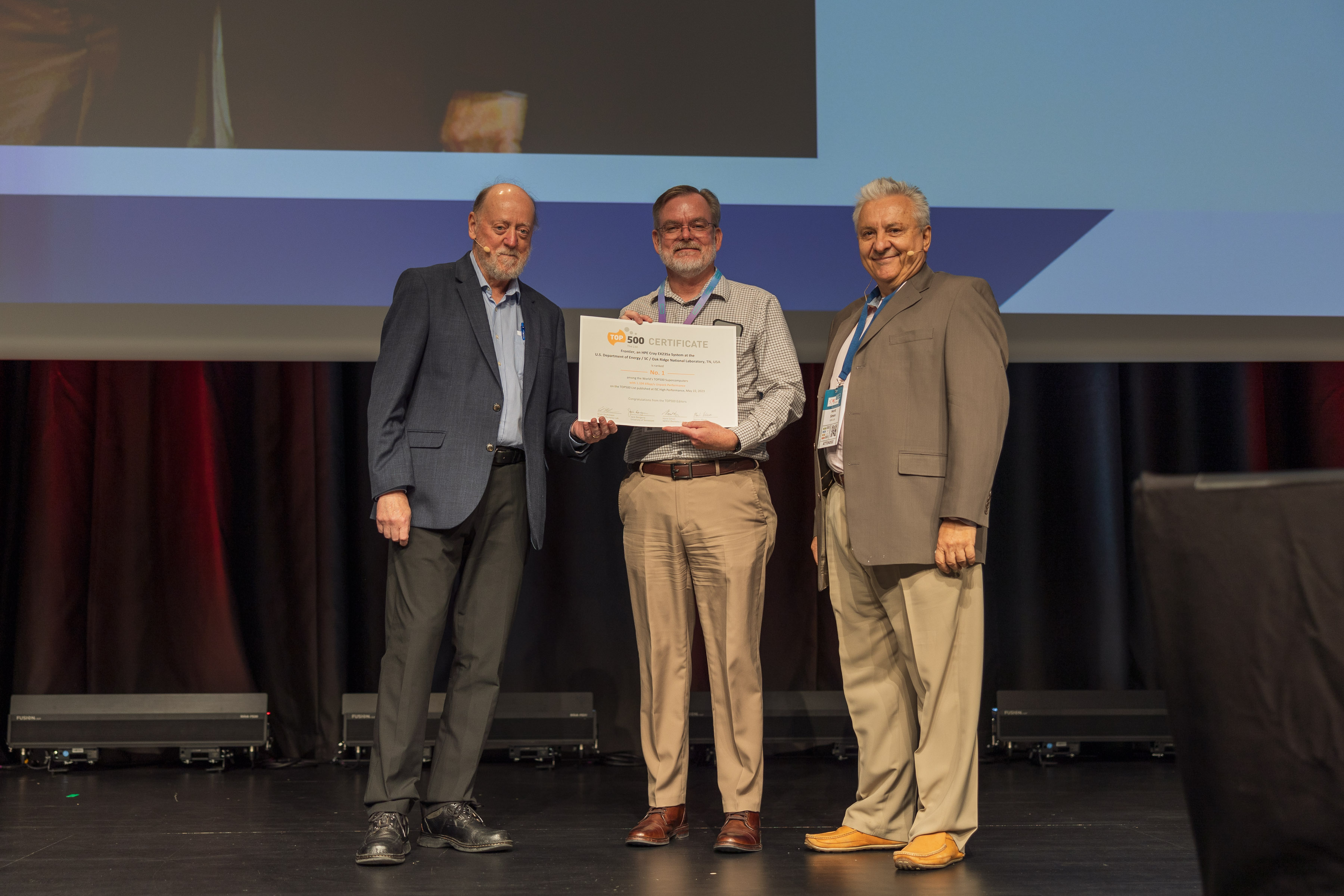
Also on Monday, the latest results from the TOP500, Green500, HPCG, and HPL-MxP benchmark lists were presented. These were no major shakeups in these lists from their previous editions, with the Frontier system at the Oak Ridge National Laboratory, Tennessee, USA remaining the No. 1 system on the TOP500 and the only system reported with an HPL performance exceeding one Exaflop/s. Full highlights from the June 2023 TOP500 list are available at: https://www.top500.org/lists/top500/2023/06/highs/
Monday evening, Hartwig made a guest appearance during a special session on “AI-accelerated HPC” presented by Intel. Intel’s Jeff McVeigh invited Hartwig on stage to discuss ICL’s experience with oneAPI. In the video of the session, Hartwig’s appearance begins around the 36:25 mark:
Hartwig was also part of a panel on Tuesday, May 23 on Plasma physics codes titled “Plasma-PEPSC – Pushing Flagship Plasma Simulation Codes to Tackle Exascale-Enabled Grand Challenges via Performance Optimisation and Codesign“.
Piotr organized a session on Wednesday, May 24 focused on Mixed Precision Algorithms with ICL alumnus Hatem Ltaief of KAUST and Roman Iakymczuk from Umea University.

In a break from the conference schedule, there was an informal dinner with folks from ICL and KIT at Brooklyn Burger Bar on Wednesday.
Piotr, Hartwig, and ICL alumni Hatem Ltaief and Bilel Hadri of KAUST organized the HPC on Heterogeneous Hardware (H3) Workshop which took place on the final day of the conference.
Of special note, during the closing ceremony of ISC 2023 it was announced that Michela Taufer will serve as the ISC 2024 Program Chair.
Interview
Fritz Goebel
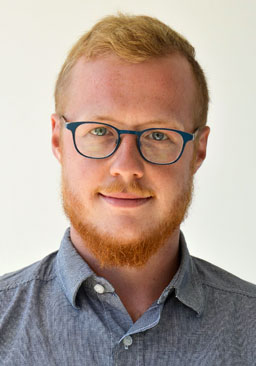
Where are you from originally?
I am originally from Germersheim, that’s a small town in Rhineland-Palantine in Germany. I spent most of my childhood in Malsch though, a village roughly 15 miles south of Karlsruhe, so very close to KIT where I came here from.
Can you summarize your educational and professional background prior to joining ICL?
After finishing high school very close to Karlsruhe, I went to KIT to pursue a Bachelor’s degree in Mathematics. I received that in 2015 and was not sure if I actually wanted to pursue Mathematics any further, so I took a break of a year and a half in which I traveled through Canada, the US west coast and Mexico, worked in hotels, youth hostels, on farms and at a bar. When I came back I had decided that while this was a great time, going back to school to get a Master’s degree would be worth it, so I went back to KIT. I had a student assistant job at a tele-communications company during that time and there, I first got in touch with CUDA programming which was kind of fun, so when I stumbled across Hartwig’s lecture I signed up and stuck around, first as a student assistant and after receiving my Master’s degree in 2020 I joined the group at KIT as a PhD student.
How did you first hear about the lab, and what made you want to work here?
I first heard about ICL when I joined the FiNE group in Karlsruhe and Hartwig sent me to Mathworks for an internship. There I got to fix a few bugs in Magmasparse and joined a few meetings with Stan and Hartwig. I wanted to come over here for a longer visit ever since we had a great time visiting for the retreat last year with a few people from KIT. Since May 31st is my last day at ICL for now, I want to take the opportunity to thank everyone for having me, I had a very nice time here the past few months.
What is your focus here at ICL? What are you working on?
I’m working on implementing a domain decomposition preconditioner in Ginkgo that will later be used in cardiac simulations. These simulations will use a new cell-by-cell model of the human heart and we hope to gain insights into how damaged muscle cells (e.g. from heart attacks or just effects of aging) can affect the heart’s electrophysiology.
What are your interests/hobbies outside of work?
Outside of work, I like to do stuff outdoors. Be it climbing, mountain biking, hiking, canoeing or skiing, I’m in. If the weather is bad, I like to read, play chess (poorly), go to a climbing gym or the pool. I also really enjoy cooking. During my time here, I got to go on a lot of hikes in the Smokies with other ICLers, almost always with Geri, and was happy to have climbing buddies in Anthony and Joseph from the very start. Highlights included the climbing and hiking trip we took to Black Mountain in March and the two-day hike with Geri and Thomas where we stayed at the Laurel Gap shelter in the Smokies.
Tell us something about yourself that might surprise people.
As I love to cook and eat and I refuse to let calorie count dictate my portion size, I need to do a lot of workouts such as not to expand uncontrollably. That’s why, during the past few months here at UTK, I went to swim at the aquatic centre roughly three times a week and to the UT wall to climb around two times a week.
If you weren’t working at ICL, where would you like to be working and why?
I fantasize about being a ski instructor wherever it’s currently winter. Realistically speaking though, if I weren’t working at ICL, I would be working at KIT. Longer term, I can imagine working at any research institution that has something interesting in HPC for me to work on and I have not ruled out switching to industry at some point.