News and Announcements

Dr. Jack Dongarra to retire next summer

Director and Founder of ICL Dr. Jack Dongarra will retire on July 31, 2022. Since its inception in 1989, Jack has served as the head and heart of ICL, where he has cultivated a culture of discovery and excellence, leading over 425 researchers, staff, and students over a course of over 30 years. Part of the glue that holds the lab together, he stands as a Knoxville-based beacon for the international field of HPC. 

Jack assured the team that he will still be active and engaged until July 31, 2022 and then the plan is to become an Emeritus Professor. As an emeritus professor he will still have an office, be able to direct students, and apply for grants. 

2021 Retreat Returns as Hybrid In-Person/Virtual

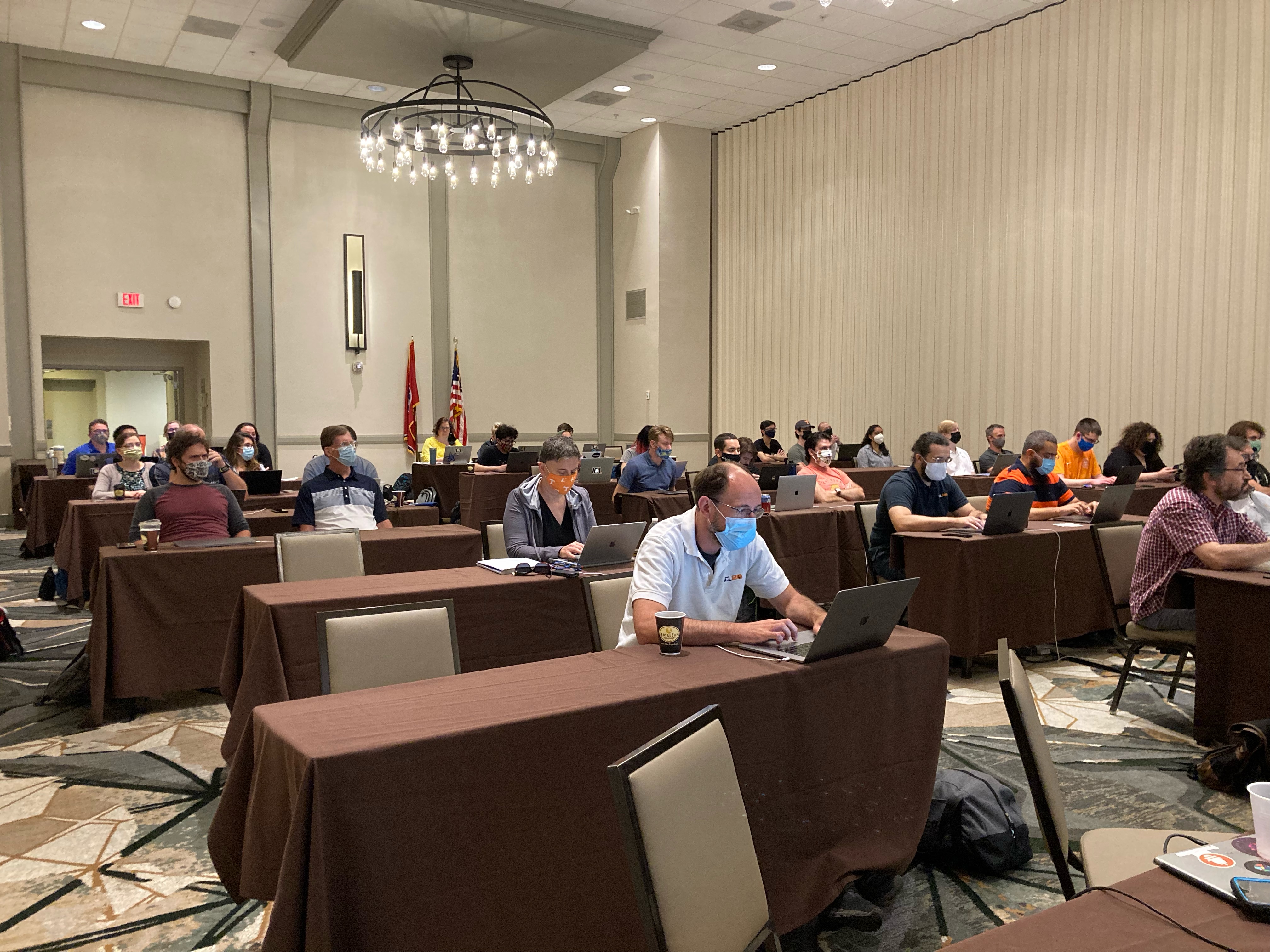
The annual retreat marks a time for everyone at ICL to come together, celebrate each others accomplishments and get excited for future work. This year’s retreat was especially noteworthy; not only was it the return to meeting in-person, but Jack’s retirement  announcement at the end made it especially poignant. Meeting at the Park Vista in Gatlinburg, everyone at ICL got the opportunity to hear from one another, and for several people who joined the team during the COVID-19 pandemic, the retreat marked the first time meeting in-person.

Here are some reflections from the retreat:

“This being my first retreat, it is so interesting to finally understand what my ICL neighbors do! My experience at the retreat will foster some interesting collaborations in the future.”  – Wissam Sid Lakhdar

“Being new here, it was hard to keep track of who does what because ICL/GCL does so much! And the view was definitely one of the better views I’ve seen in my life. I look forward to what else I’ll learn while I’m here.” – Danny Mishler 

Slides from the 2021 retreat can be viewed at: http://bit.ly/icl-retreat-slides-2021

An international birthday party

Due to COVID-19, Jack’s 70th birthday celebration was a highly anticipated event. Postponed from last summer, the Numerical Linear Algebra Group hosted “New Directions in Numerical Linear Algebra and High Performance Computing: Celebrating the 70th Birthday of Jack Dongarra,” a workshop sponsored by The Royal Society and The MathWorks.

This international workshop, July 7-8, focused on numerical linear algebra and high performance computing and brought together researchers from the UC-Davis and Berkley, North Carolina State, King Abdullah University of Science and Technology and of course Manchester and Tennessee.

Session topics included the Top500, Computing in the Old Days and, of course, Jack. Check them out here.


Want to go to SC? Apply for the SIGHPC Travel Grant

Applications for the ACM SIGHPC (Association for Computing Machinery’s Special Interest Group on High Performance Computing) travel grant for SC are open to undergraduates and recent graduate students until September 3. 

  • Who’s eligible: Students at the undergraduate or early graduate level, enrolled in an accredited university in any country, and who are members of SIGHPC. Applicants do not have to be making a presentation at SC, but they need to describe why they will benefit from attending the conference.

  • What’s included: Expenses are reimbursed for up to

    • $600 for recipients from North American universities

    • $1200 for travel from another continent

In addition to funding travel expenses, awardees will receive complimentary conference registration and will be assigned a mentor.

Applications are due September 3rd of each year, with notification provided by September 22nd. To apply, you must complete the following:

  • simple budget (including conference registration fee)

  • statement of why you wish to attend SC and what you hope to gain by doing so

  • letter of support from your advisor referencing any institutional support or recognition that will be provided

  • complete the application

In order to be considered for a grant, the application must be complete and the letter of support submitted on or before September 3rd.

If you have any questions that are not addressed through this page, contact students@sighpc.org.

Conference Reports

ISC 2021 Digital: an HPC blockbuster featuring ICL researchers

Jack Dongarra, Piotr Luszczek and Hartwig Anzt presented at ISC 2021 Digital, which took place between June 24 and July 2. The international conference was widely attended, bringing together over 2000 attendees and 80 presenters.  The program of this years conference highlighted current developments in exascale computing, machine learning/AI, and cloud-based HPC, while also featuring discussions on emerging technologies such as quantum computing, neuromorphic computing, and next-generation HPC components.

On the second day of the conference, the three delivered a Modern Mixed- and Multi-Precision Methods Tutorial, later in the week presented an HPCG Benchmark Update.

Read more about the talks here

The conference report can be found here.

Dr. Deborah Penchoff and Dr. Piotr Lusczek highlight interdisciplinary work at ACS Conference

Associate Director Dr. Deborah Penchoff delivered a talk and chaired two sessions at the American Chemical Society Resilience through Science conference, which took place at the Georgia World Conference Center from August 22-26. Deborah serves on the executive committee for the nuclear division of the ACS, where she’s positioned to support the nuclear community and the larger body of ACS for radio- and nuclear-chemistry needs.

At the conference, this role brought her to helping attendees understand the roles of high-performance computing and data science applications in the field of nuclear chemistry. In addition to chairing two sessions–Data Science and Artificial Intelligence Applications in Nuclear and Radiochemistry and Computational Science for Lanthanides and Actinides–she also gave a talk titled “High Performance Computing: Advances and Challenges in Modeling Rare Earth Elements and Actinides”.

Dr. Piotr Luszczek also gave a talk at the conference titled, “Numerical methods and benchmarking across scales, precisions, and hardware platforms”. For more information or to view the talks, visit the ACS website.

Interview

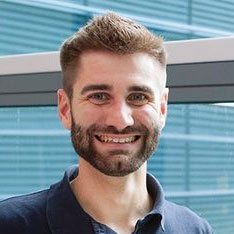
Paul Bagwell Then

Paul Bagwell

Where are you from, originally?
I was born in Kingfisher, Oklahoma, which is most notably recognized as the birthplace of Sam Walton.

Can you summarize your educational background?
I graduated from Pensacola Junior College in Pensacola, Florida with an Associates of Engineering degree.  I graduated from the University of Texas at Arlington with a Bachelor’s of Science in Electrical Engineering.

Where did you work before joining ICL?
I worked for ProNova Solutions in Maryville, TN as a software engineer for the Imaging and Positioning team.

How did you first hear about the lab, and what made you want to work here?
I heard about ICL from the internet.  I have found in medical imaging and also in surveillance systems that high performance GPU computing is necessary to meet requirements.  I wanted to learn more about how ICL develops HPC libraries and applications.

What is your focus here at ICL? What are you working on?
I am working on the SLATE test software.

What are your interests/hobbies outside of work?
I love the outdoors and like to camp and hike in the Great Smoky Mountains National Park.  I like to do yard work and gardening.

Tell us something about yourself that might surprise people.
I’m a grandfather of 6 grandchildren and one more on the way.

If you weren’t working at ICL, where would you like to be working and why?
Once I get proficient in HPC development, I would like to apply my new skills in the Medical Devices industry.


Recent Papers

  1. Sharp, D., M. Stoyanov, S. Tomov, and J. Dongarra, A More Portable HeFFTe: Implementing a Fallback Algorithm for Scalable Fourier Transforms,” ICL Technical Report, no. ICL-UT-21-04: University of Tennessee, August 2021.  (493.17 KB)
  2. Tsai, Y. M., P. Luszczek, and J. Dongarra, Mixed-Precision Algorithm for Finding Selected Eigenvalues and Eigenvectors of Symmetric and Hermitian Matrices,” ICL Technical Report, no. ICL-UT-21-05, August 2021.  (3.93 MB)

Recent Conferences

  1. AUG
    -
    SC21 Planning Meeting St. Louis, Missouri
    Joan Snoderly
    Joan
    Joan Snoderly
  2. AUG
    Deborah Penchoff
    Deborah
    Piotr Luszczek
    Piotr
    Deborah Penchoff, Piotr Luszczek
  3. SEP
    -
    MPI Forum Virtual
    Aurelien Bouteiller
    Aurelien
    Aurelien Bouteiller

Upcoming Conferences

  1. OCT
    -
    EPEXA Meeting and CnC workshop New York City, New York
    George Bosilca
    George
    Thomas Herault
    Thomas
    George Bosilca, Thomas Herault
  2. NOV
    -
    Alan Ayala
    Alan
    Anthony Danalis
    Anthony
    Aurelien Bouteiller
    Aurelien
    Daniel Mishler
    Daniel
    George Bosilca
    George
    Gerald Ragghianti
    Gerald
    Hartwig Anzt
    Hartwig
    Joan Snoderly
    Joan
    Joseph Schuchart
    Joseph
    Neil Lindquist
    Neil
    Piotr Luszczek
    Piotr
    Qinglei Cao
    Qinglei
    Thomas Herault
    Thomas
    Yu Pei
    Yu
    Alan Ayala, Anthony Danalis, Aurelien Bouteiller, Daniel Mishler, George Bosilca, Gerald Ragghianti, Hartwig Anzt, Joan Snoderly, Joseph Schuchart, Neil Lindquist, Piotr Luszczek, Qinglei Cao, Thomas Herault, Yu Pei

Recent Lunch Talks

  1. AUG
    6
    Michele Benzi
    Michele Benzi
    Scuola Normale Superiore in Pisa
    Walk-based measures of centrality, communicability, and robustness in networks
  2. AUG
    20
    Thomas Herault
    Thomas Herault
    Templated Task Graph a new task programing interface in C++
  3. AUG
    27
    Scott Klasky
    Scott Klasky
    Oak Ridge National Laboratory
    Data Reduction via the MultiGrid Adaptive Reduction of Data (MGARD) PDF
  4. SEP
    3
    Tu Mai Anh Do
    Tu Mai Anh Do
    USC Information Sciences Institute
    Assessing Resource Provisioning and Allocation of Ensembles of In Situ Workflows PDF
  5. SEP
    10
    Stephen Herbein
    Stephen Herbein
    Lawrence Livermore National Laboratory
    HPC + Cloud Convergence at LLNL PDF
  6. SEP
    17
    Anouar Benali
    Anouar Benali
    Argonne National Laboratory
    Towards predictive simulations of molecules and solids using quantum Monte Carlo methods
  7. SEP
    24
    Ed Valeev
    Ed Valeev
    Virginia Tech
    Tensor-Centric View of Electrons in Molecules and Materials

Upcoming Lunch Talks

  1. OCT
    1
    Daniel Bielich
    Daniel Bielich
    Delayed Classical Gram-Schmidt with Reorthogonalization (DCGS2), in the context of QR and Arnoldi
  2. OCT
    8
    Aurelien Bouteiller
    Aurelien Bouteiller
  3. OCT
    15
    Hartwig Anzt
    Hartwig Anzt
    Batched Iterative Solvers for Sparse Linear Problems
  4. OCT
    22
    Tony Castaldo
    Tony Castaldo
    Parallel Spectrum Slicing for Selected Eigenpairs with Tall-Skinny QR Orthogonalization of Eigenvectors
  5. OCT
    29
    Rabab Al-omairy
    Rabab Al-omairy
    Communication Avoiding LU with Tournament Pivoting in SLATE
  6. NOV
    5
    Grzegorz Kwasniewski
    Grzegorz Kwasniewski
    ETH Zurich
    From graph pebbling to I/O optimal and high-performance code PDF
  7. NOV
    12
    Mohsen Mahmoudi-Aznaveh
    Mohsen Mahmoudi-Aznaveh
    Texas A&M
    Paru: Parallel Unsymmetric Multifrontal sparse LU factorization PDF

Open Positions at ICL

Grow with ICL – Employment Opportunities

ICL is always looking to recruit the best and the brightest. Think that’s you? Read more about the qualifications for these jobs and how to apply at icl.utk.edu/jobs.

Post Doctoral Research Associate

The University of Tennessee, Knoxville’s Innovative Computing Laboratory (ICL) is seeking full-time Post Doctoral researchers in several areas of high-performance computing (HPC), including: (1) Distributed Computing; (2) Performance Measurement and Modeling; and (3) Numerical Linear Algebra.

Prospective researchers will work in a team-based, deadline-driven environment with the opportunity to: (1) participate in the design, development, and maintenance of software libraries and programming environments for large, distributed-memory hybrid machines; (2) extend and harden the performance monitoring capabilities of ICL’s software for new and advanced hardware and software technologies; or (3) develop and maintain numerical software libraries for solving linear algebra problems on hybrid machines with multi-core processors and hardware accelerators.

The prospective researcher will co-author papers to document research findings, present the team’s work at conferences and workshops, and help lead students and other team members in the lab’s multiple research and development efforts, which are supported by the U.S. Department of Energy’s Exascale Computing Project and the National Science Foundation.

Research Scientist I

The University of Tennessee, Knoxville’s Innovative Computing Laboratory (ICL) is seeking full-time Research Scientist I candidates in one of several areas of high-performance computing (HPC), including: (1) Distributed Computing; (2) Performance Measurement and Modeling; and (3) Numerical Linear Algebra.

Prospective researchers will work in a team-based, deadline-driven environment to design and implement research protocols: (1) in the design, development, and maintenance of software libraries and programming environments for large, distributed-memory hybrid machines; (2) to extend and harden the performance monitoring capabilities of ICL’s software for new and advanced hardware and software technologies; or (3) to develop and maintain numerical software libraries for solving linear algebra problems on hybrid machines with multi-core processors and hardware accelerators.

Prospective researchers will analyze, interpret results for sponsors, coauthor papers to document research findings, present the team’s work at conferences and workshops, and help lead students and other team members in the lab’s multiple research and development efforts, which are supported by the U.S. Department of Energy’s Exascale Computing Project and the National Science Foundation.

Software Engineer

The Innovative Computing Laboratory (ICL) is seeking a self-motivated and highly productive Software Engineer to participate in the development of next-generation computational tools for the US Department of Energy’s Exascale Computing Project (ECP). This position requires a candidate who designs, develops, tests, and documents complex software solutions that perform independently or as part of a larger computational system. We expect a strong commitment to the development of high-quality software, a passion for learning new technical skills, and a keen interest in working with top-of-the-line hardware and bleeding-edge software technologies, some of which are still in active development.