
News and Announcements
TOP500 – June 2016

The 47th TOP500 rankings were presented at ISC-HPC. For the first time in 3 years, there is a new system in the #1 spot. China’s Sunway TaihuLight ascended to the top position with 93 petaflop/s on the LINPACK benchmark.
Developed by the National Research Center of Parallel Computer Engineering & Technology (NRCPC) and installed at the National Supercomputing Center in Wuxi, the Sunway TaihuLight has 10,649,600 computing cores comprising 40,960 nodes, and is twice as fast and three times as efficient as Tianhe-2, which now holds the #2 spot. The peak power consumption under load (running the HPL benchmark) comes in at 15.37 MW, or 6 Gflops/Watt.
The truly interesting feature of the Sunway TaihuLight, aside from being the world’s fastest supercomputer according to HPL, is that it is comprised of Chinese processors and components. Until now, China’s fastest computers have all used US designed processors from companies like Intel. This is a watershed moment for China’s computing industry and research infrastructure on the whole. Click here to read Jack Dongarra’s full report on the Sunway TaihuLight.
Moreover, the latest TOP500 list shows a decisive move from the Chinese as the TaihuLight is now one of 167 Chinese systems on the TOP500, surpassing the US (with 165 systems) for the first time since the inception of the TOP500.
More details on the the 47th edition of the TOP500 are available in the official press release.
| Rank | Site | System | Rmax (TFlop/s) |
|---|---|---|---|
|
1 |
TaihuLight – Sunway MPP, Sunway SW26010 260C 1.45GHz, Sunway |
93,014.6 |
|
|
2 |
33,862.7 |
||
|
3 |
DOE/SC/Oak Ridge National Laboratory |
Titan – Cray XK7 |
17,590.0 |
|
4 |
DOE/NNSA/LLNL |
17,173.2 |
|
|
5 |
RIKEN Advanced Institute for Computational Science (AICS) |
K computer, SPARC64 VIIIfx |
10,510.0 |
ATLAS Earns IEEE Test of Time Award
Clint Whaley and Jack Dongarra’s “Automatically Tuned Linear Algebra Software,” a paper written and published nearly 20 years ago for SC ’98, will receive an IEEE Test of Time Award at SC ’16 in Salt Lake City, Utah. This paper was a major development in what would become the ATLAS software project.
“Automatically Tuned Linear Algebra Software“, 1998 ACM/IEEE conference on Supercomputing (SC ’98), Orlando, FL, IEEE Computer Society, November 1998.
HPCG Results – June 2016
The June 2016 results for the HPC Preconditioned Conjugate Gradient (HPCG) benchmark were released on June 21st at ISC-HPC in Frankfurt, Germany. Intended to be a new HPC metric, HPCG is designed to measure performance that is representative of modern HPC capability by simulating patterns commonly found in real science and engineering applications.
To keep pace with the changing hardware and software infrastructures, HPCG results will be used to augment the TOP500 rankings to show how real world applications might fare on a given machine. In the table below, you can see how the HPCG benchmark would have ranked its top 5 machines, and where those machines ranked on the LINPACK-based TOP500 list. The full list of rankings is available here.
| HPCG Rank | Site | Computer | HPL (Pflop/s) | TOP500 Rank | HPCG (Pflop/s) | %Peak |
| 1 | NSCC / Guangzhou | Tianhe-2 NUDT, Xeon 12C 2.2GHz + Intel Xeon Phi 57C + Custom | 33.863 | 2 | 0.5800 | 1.1% |
| 2 | RIKEN Advanced Institute for Computational Science | K computer, SPARC64 VIIIfx 2.0GHz, Tofu interconnect | 10.510 | 5 | 0.5544 | 4.9% |
| 3 | NSCC / Wuxi | Sunway TaihuLight, Sunway MPP, SW26010 260C 1.45GHz, Sunway NRCPC |
93.015 | 1 | 0.3712 | 0.3% |
| 4 | DOE/NNSA/LLNL USA | Sequoia, IBM BlueGene/Q, PowerPC A2 1.6 GHz 16-core, 5D Torus IBM | 17.173 | 4 | 0.3304 | 1.6% |
| 5 | DOE/SC/Oak Ridge Nat Lab | Titan, Cray XK7 , Opteron 6274 16C 2.200GHz, Cray Gemini interconnect, NVIDIA K20x | 17.590 | 3 | 0.3223 | 1.2% |
Conference Reports
ISC High Performance


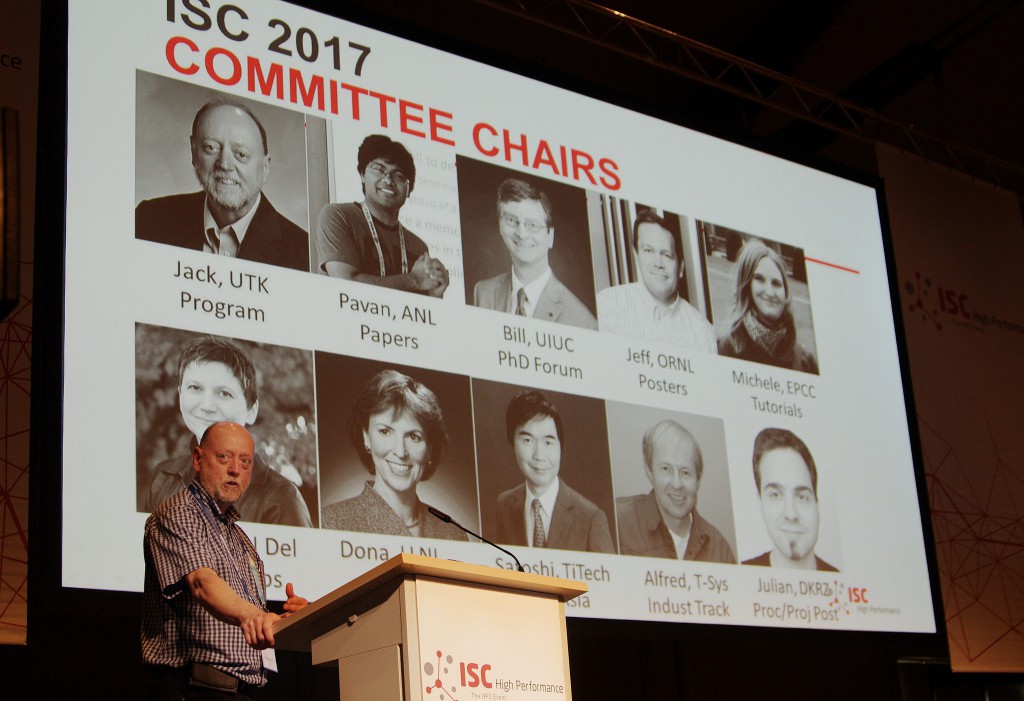
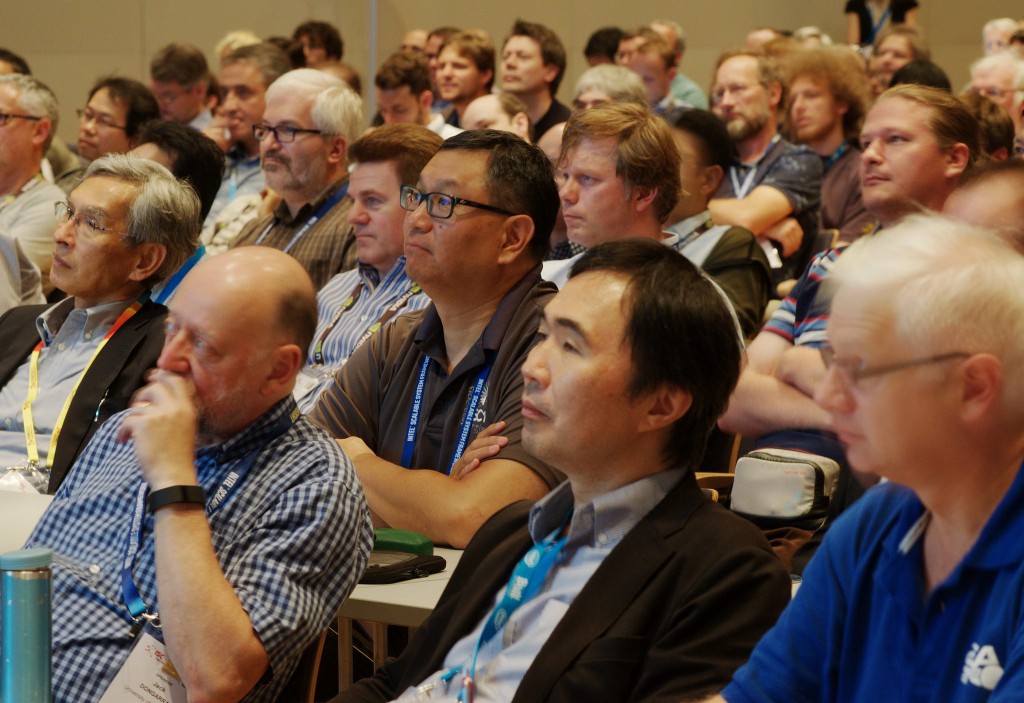


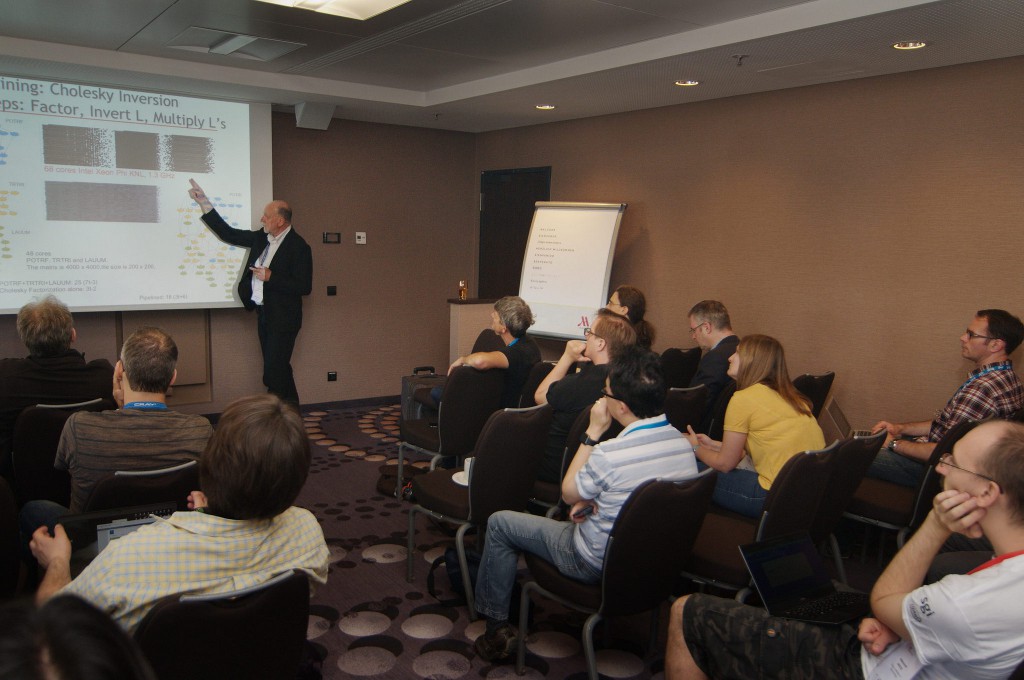

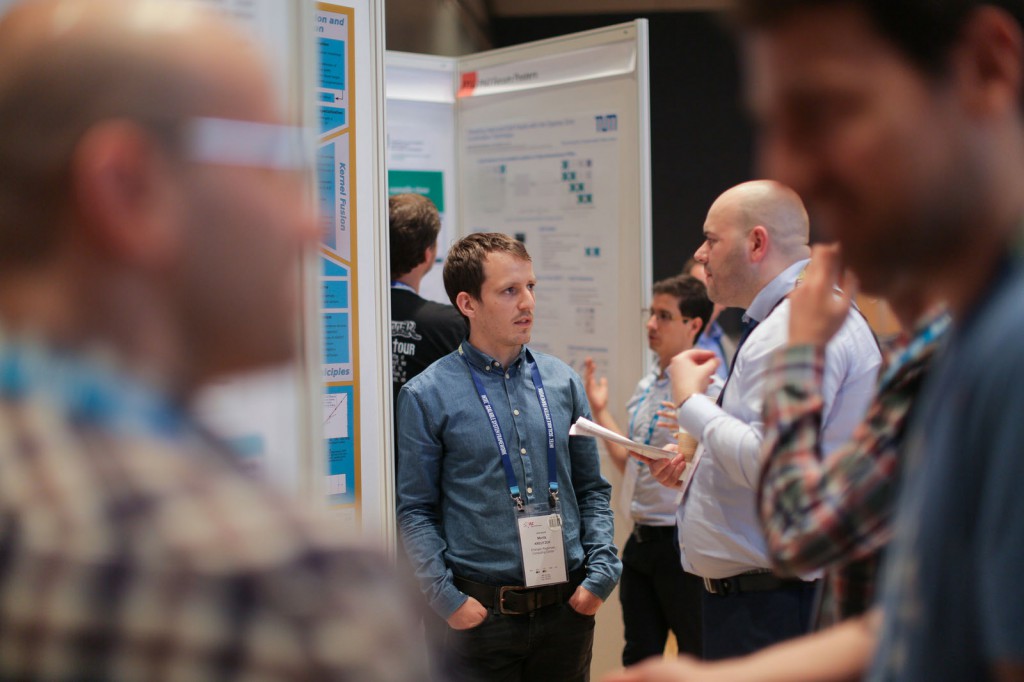


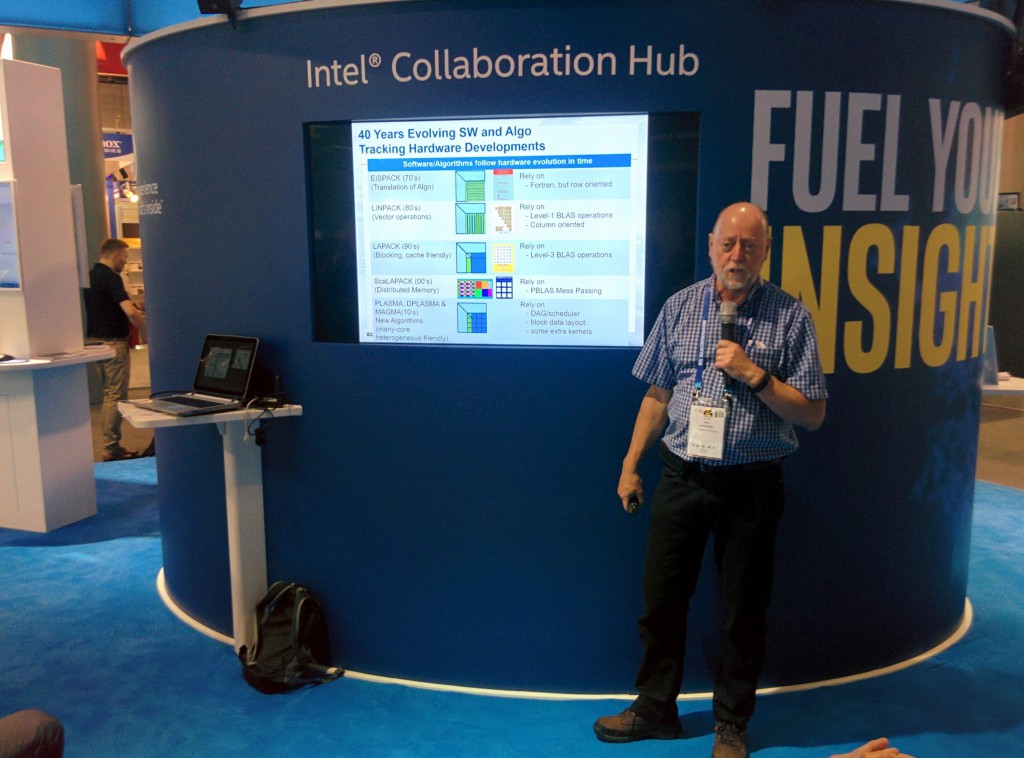

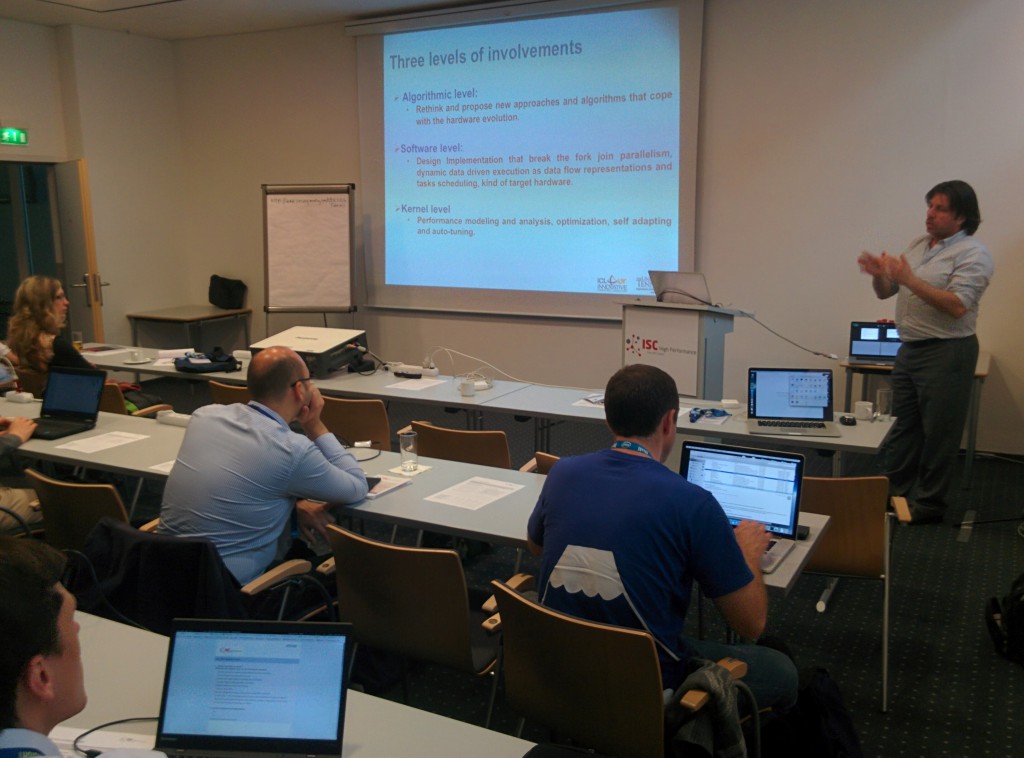
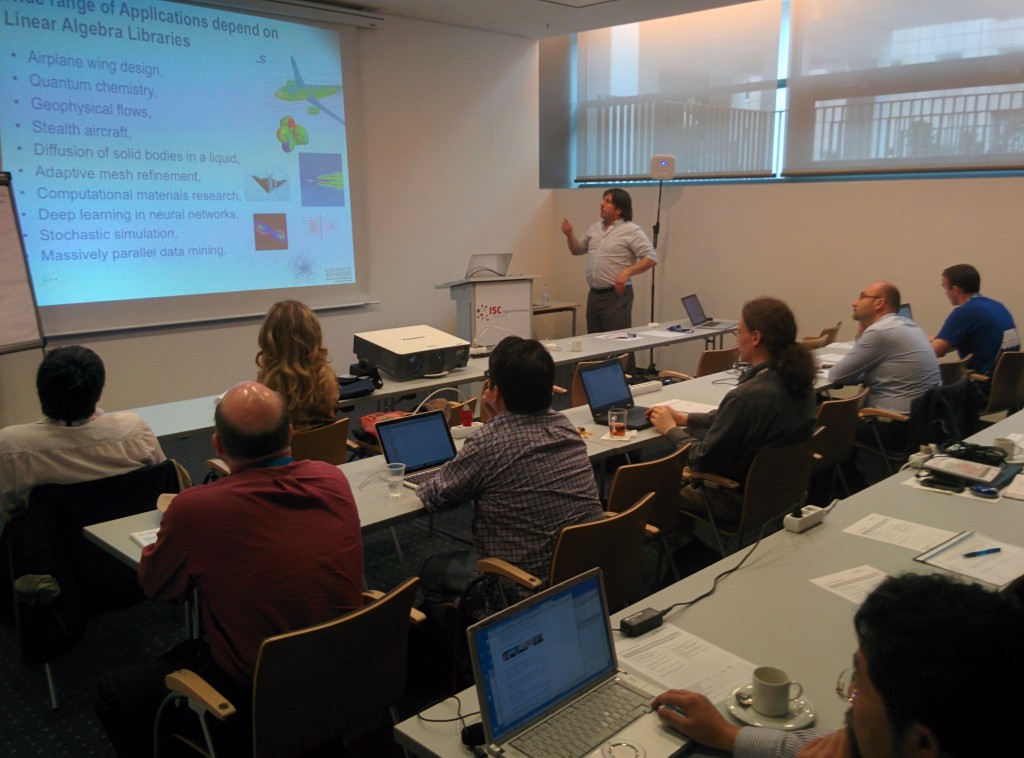
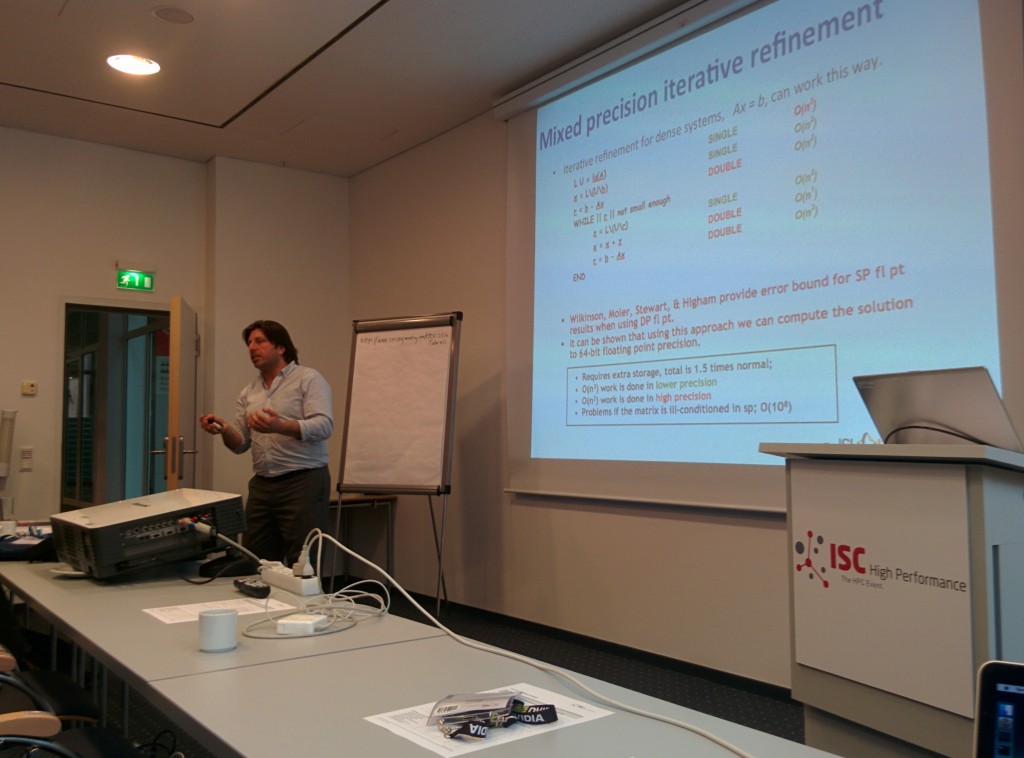
The 2016 ISC High Performance Computing conference (ISC-HPC) kicked off on June 18th in Frankfurt, Germany. Several ICL research staff members made their way to the conference, including Jack Dongarra, Jakub Kurzak, and Azzam Haidar.
Jack was busy as ISC-HPC Program Chair, but still made time to be Chair of the Research Paper Award session and the HPC Benchmarking session, while also giving a talk, “The HPL Benchmark: Past, Present & Future,” and presenting the Hans Meuer Award.
Jakub and Azzam gave a tutorial on Linear Algebra Software for High Performance Computing. Azzam also presented a research paper, “Performance, Design & Autotuning of Batched GEMM for GPUs.” Of course, these weren’t the only ICL related happenings at ISC-HPC; the ICL gang also contributed to the TOP500, HPCG Awards, the co-located BDEC workshop and more—all of which are featured elsewhere in this newsletter.
SC Program Committee

On June 6th, ICL’s Heike Jagode and Thomas Herault attended the SC Program Committee meeting in Houston, TX. Although it was plagued with flooding, travel delays, and the like, the meeting attendees sallied forth.
As you can see above, Thomas, along with Yves Robert and Anne Benoit, took this opportunity to visit Galveston State Park, which was only partially inundated. The ICL newsletter staff does not encourage the behavior depicted above, but if you take the photo, we will post it.
BDEC Frankfurt



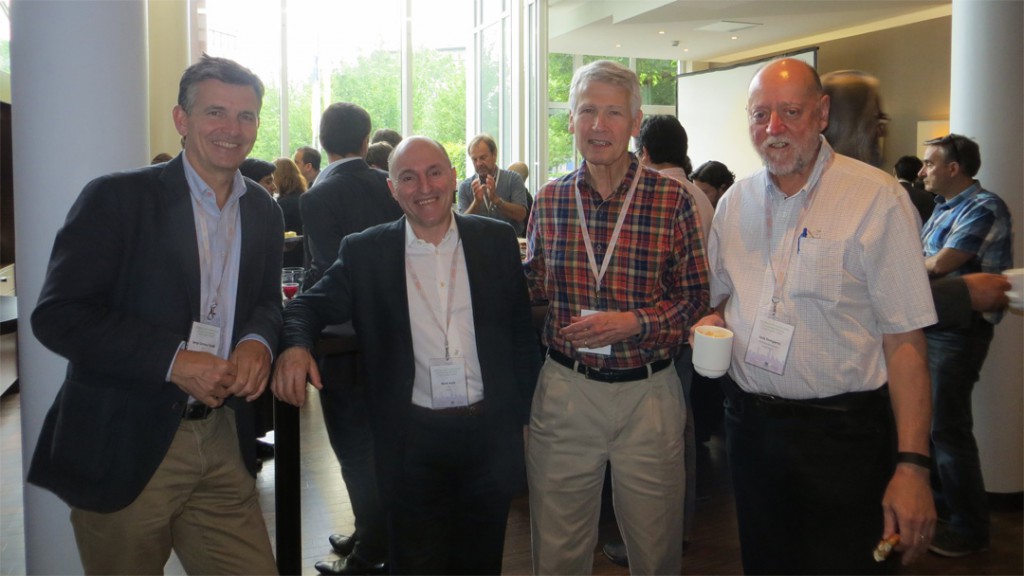
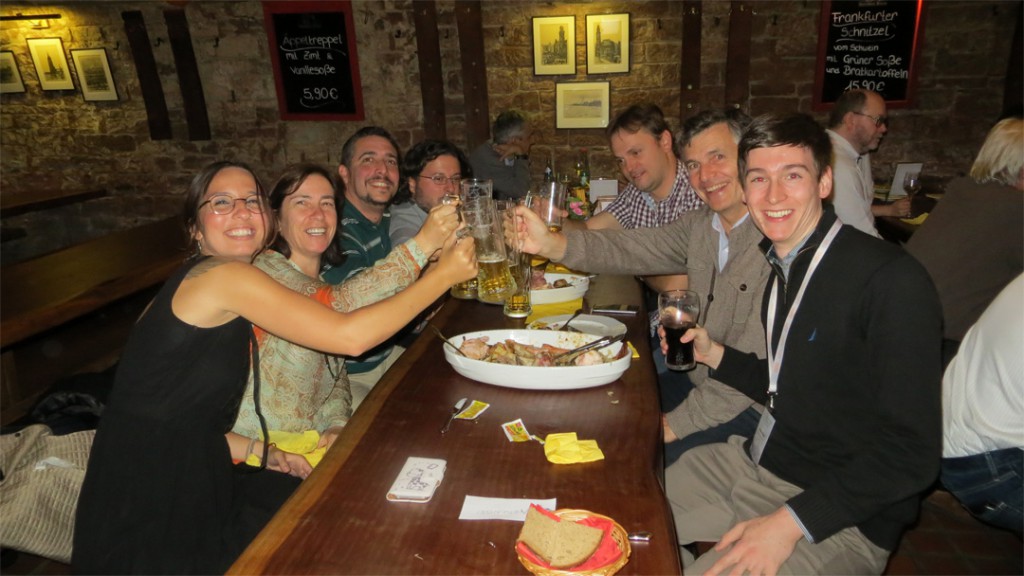


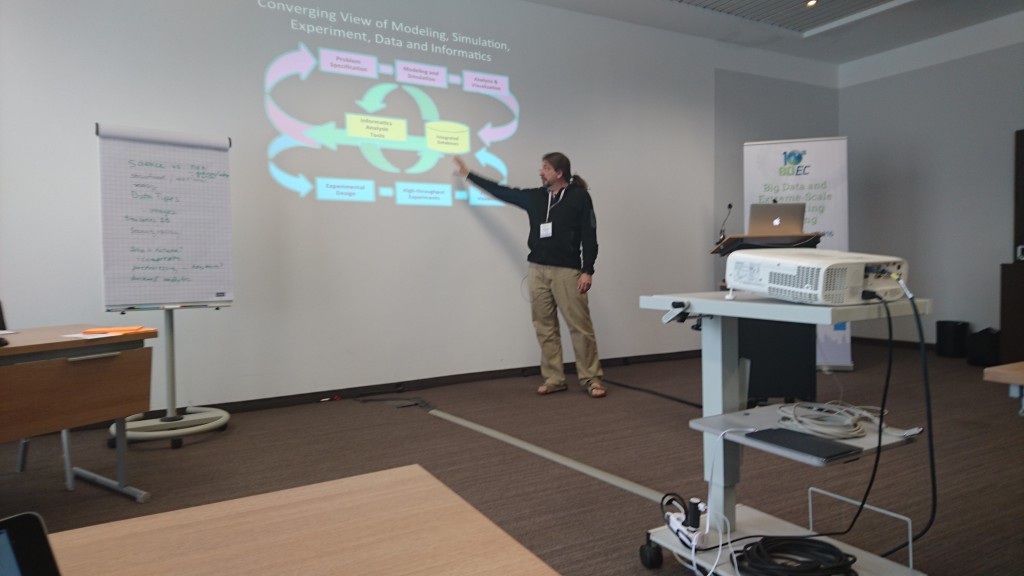
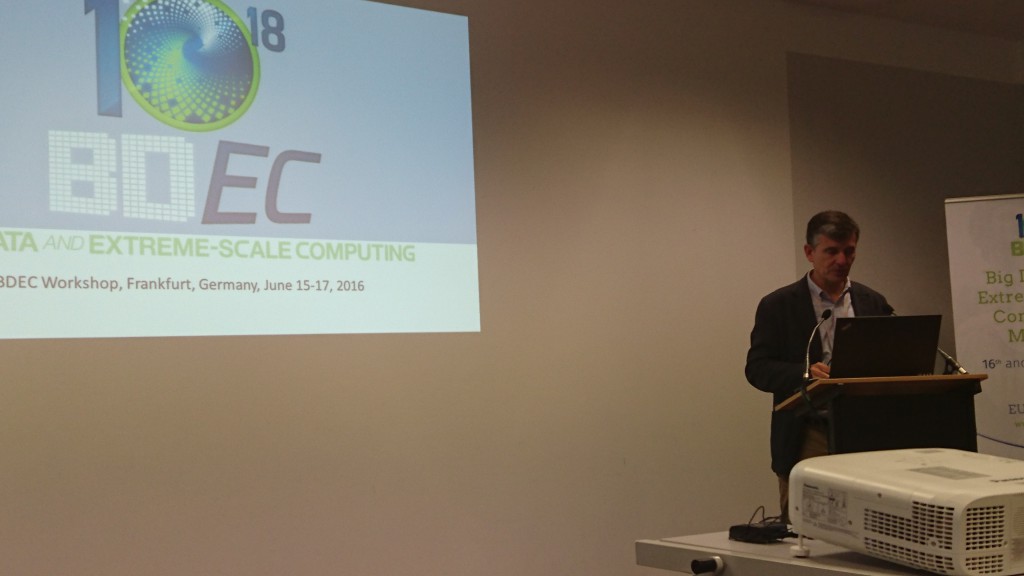
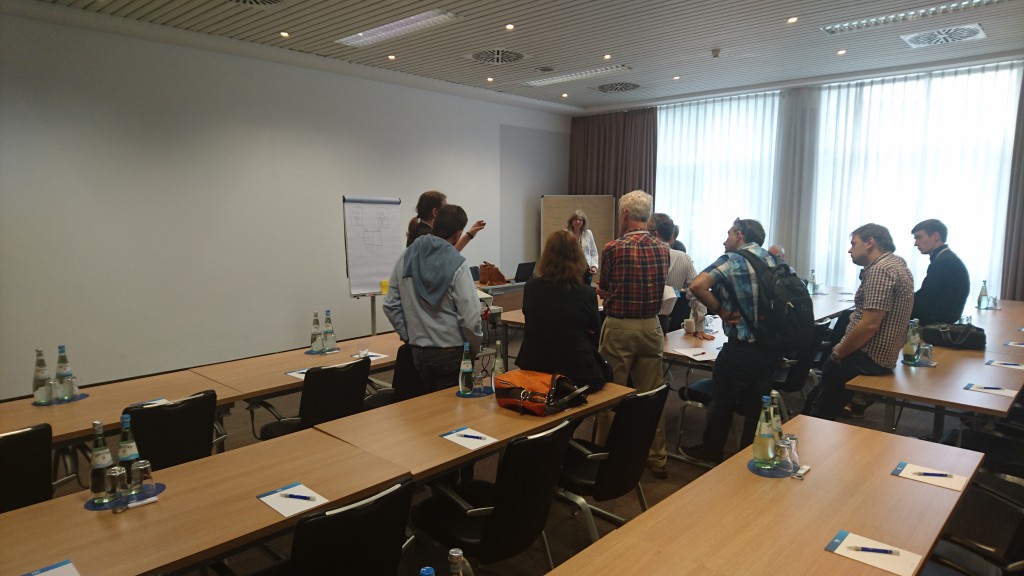


The Big Data and Extreme Scale Computing (BDEC) workshop was held in Frankfurt, Germany on June 15th and 16th at the NH Frankfurt Airport West hotel. The Frankfurt workshop, the fourth major entry in a series sponsored by the NSF, is premised on the idea that we must begin to systematically map out and account for the ways in which the major issues associated with Big Data intersect with, impinge upon, and potentially change the national (and international) plans that are now being laid for achieving Exascale computing.
This edition of the closed workshop was attended by application leaders from around the globe and focused on “Pathways to Convergence” between big data and Exascale computing. In addition, the workshop featured traditional overviews of international roadmaps, invited keynotes, and breakout groups. The workshop was a great success overall, with 30+ individual talks and panel discussions and over 80 attendees from all over the world.
Recent Releases
LAPACK 3.6.1 Released
LAPACK 3.6.1 has been released! LAPACK (the Linear Algebra PACKage) is a widely used library for efficiently solving dense linear algebra problems, and ICL has been a major contributor to the development and maintenance of LAPACK since its inception. LAPACK is sequential, relies on the BLAS library, and benefits from the multicore BLAS library. LAPACK 3.6.1 includes a blocked back-transformation for the non-symmetric eigenvalue problem and several bug fixes.
Visit the LAPACK website to download the tarball.
Interview

Markus Fischer
Where are you from, originally?
After having had broader access to the world, I would now say that I was born and raised in a small village, Stahle, in Germany. Think of north of Frankfurt, but south of Hamburg.
Can you summarize your educational background?
I was still a graduate student at the University of Paderborn finishing my Master’s thesis about Heterogeneous Load Balancing, which was using PVM as the underlying—harnessing ;)—communication layer, when I decided to study one year abroad. That decision resulted in staying a year as a graduate research assistant in Knoxville, TN and working for Jack. I had to go back to Germany to finish my thesis and also finish my Business Administration studies. I still came back to ICL a few times to work with the PVM team, but after completing my degrees I then thought UCSD would be great for getting a PhD. Note that I was a student volunteer at Supercomputing 1995 (held in San Diego) and a bicycle ride along the beach is to blame here. At UCSD I only survived half a year after figuring out their regulations would not transfer a German degree and they wanted me to take all of my classes again. I then found a position at the University of Heidelberg where I could focus on research only. I completed my PhD on topics related to system area network in 2002.
How did you get introduced to ICL?
This is all Bob Manchek’s “fault.” Bob was visiting my University giving a presentation about PVM. Right after I contacted him in a straightforward German manner and mentioned that I would like to learn more about PVM. He then got me in touch with Jack and a few months later Delta Airlines routed me to Knoxville.
What did you work on during your time at ICL?
It was still prime time for PVM at that time. It was also said that a new Windows version would conquer the world and nobody had looked at running PVM on Windows. A victim was found.
What are some of your favorite memories from your time at ICL?
What I liked most was the variety of people and knowledge at ICL. People from all over the world, from different continents, were working there and it felt like a heaven for computer science. Work wise I had access to large clusters and workstations that I could use for running tests for my master thesis. Other ICL dinosaurs like me will remember the cetus or hydra lab.
Tell us where you are and what you’re doing now.
I am back living in Germany and working on accelerating communication layers. This work can range from working closely with networking hardware, up the stacks to application level.
In what ways did working at ICL prepare you for what you do now, if at all?
The most important aspect was the introduction to a different culture and the opportunity to work with very different people. Jack gave me full responsibility for my work and allowed me to give the presentations at a couple of conferences. I am also most grateful to Bob Manchek who would always find some time to explain a lot of things to me even if he was busy himself. My excuse here is that the degree in CS in Germany has a strong focus on theory. At UTK it was different. Another important thing I learned was the access to good coffee. Tracy probably remembers the usual knock on the door in Ayres Hall when I was getting purified water so Erich and I could enjoy a good cup in the early morning.
Tell us something about yourself that might surprise some people.
From the very early days on I needed to find funding for going to high school and especially college. Starting at 15 years old, I worked on construction sites. The driver’s console for operating a construction crane looked a lot like the joystick of my Atari 2600, and I educated myself by operating that thingy during breakfast and lunch breaks. When I was 21 years old I then operated big cranes during winter and summer breaks. After getting a truck driver’s license from the former mandatory military service, I made my bucks during summer break as a truck driver moving 40t through Germany. Nowadays I still like using a joystick, this time flying a plane to adjacent countries like Austria/Italy and France so far. Eventually I would like to fly it all the way to the Serengeti – I blame it on a movie that I watched as a kid.


