
News and Announcements
Shirley Moore Moving to UTEP
 Shirley Moore, who has worked for ICL since January 1993, has accepted a faculty position at the University of Texas at El Paso (UTEP) for the fall of 2012. She will be an Associate Professor of Computational and Computer Science (split position between the graduate Computational Science Program and the Computer Science Department). Her research at UTEP will focus on using code restructuring and performance tools to enhance the performance, maintainability, and evolvability of parallel scientific applications. She hopes to continue collaborating with ICL researchers in her new position.
Françoise Tisseur Awarded Adams Prize
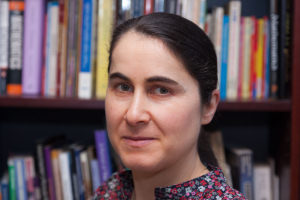 Dr. Françoise Tisseur, an ICL alumna, was awarded the Adams Prize by The University of Cambridge for her research in numerical linear algebra. Françoise, currently an EPSRC Leadership Fellow at the University of Manchester, was a post-doc at ICL back in 1997.
The Adams Prize is awarded jointly each year by the University of Cambridge’s Faculty of Mathematics and St John’s College, Cambridge to a young UK-based researcher doing first class international research in the Mathematical Sciences. Congratulations Françoise!
NIMBioS Moving into Claxton
The National Institute for Mathematical and Biological Synthesis (NIMBioS), led by Lou Gross, is in the process of moving into the newly renovated space in the first and second floors of the Claxton complex.

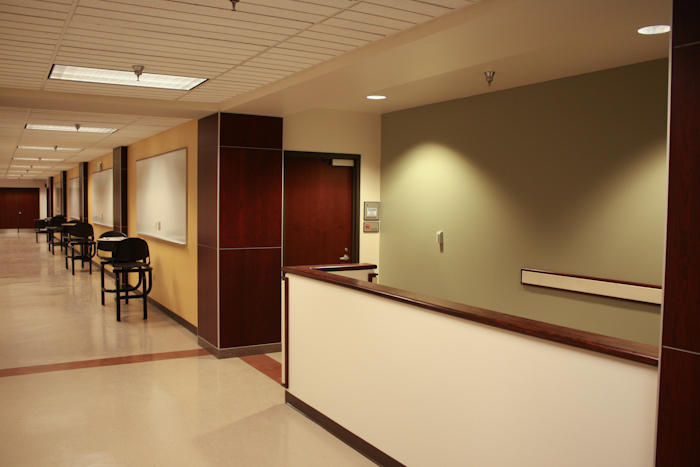
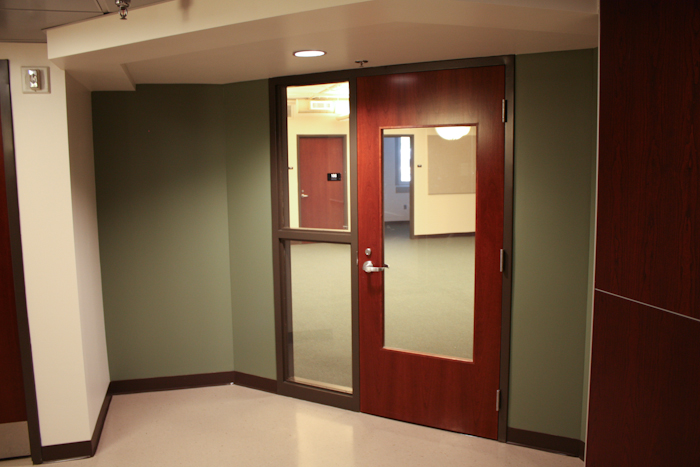

According to the latest news out of NIMBioS, they are expected to be in the building and open for business on April 16th. We warmly welcome our new neighbors and hope that our closer proximity will be conducive to future collaboration.
ICL Infrastructure Changes
With the EECS’s departure from Claxton, we will be changing our subnet of IP addresses. Our domain will also change from http://icl.eecs.utk.edu/ to http://icl.utk.edu/ over the next month. Note that this will also affect how you log in to machines, so be sure you’re using the correct domain path. This will not affect your EECS e-mail address. No precise date has been set for this transition, so keep an eye on your e-mail inbox for exact details.
In addition to the changes mentioned above, ICL’s IT staff will soon begin testing Google Apps as an alternative to the Microsoft Exchange server. Legacy EECS mail users will have to choose one of these options (Google or Exchange) in the next year, as the departmental IMAP server will be phased out and only serve e-mail forwarding.
SC12 Due Dates Approaching
It’s that time of year again! The due dates for abstracts and full submissions for this year’s Supercomputing Conference are right around the corner, so plan your work accordingly.
- April 20, 2012 – Abstracts due for:

- Technical Papers
- ACM Gordon Bell Prize
- April 27, 2012 – Full Submissions due for:
- Technical Papers
- Workshop Proposals
- Tutorial Proposals
- Panel Proposals
- ACM Gordon Bell Prize
- April 27, 2012 – Abstracts due for:
- SCinet Research Sandbox
A full list of due dates can be found here.
Conference Reports
MPI Forum
Aurelien and Thomas both attended the recent MPI Forum meeting on March 5th-7th in Chicago, IL. There, they presented UTK’s proposal for standardizing the behavior of MPI when process failure occurs.
The proposal was met with an overall good reception, and the fault tolerance group has been encouraged to pursue the proposed method. The implementation is in progress, and the group will present the proposal again, for formal voting, at the next MPI meeting in Japan on May 28th-30th.
HPC Advisory Council Switzerland Conference 2012
The HPC Advisory Council and the Swiss Supercomputing Centre hosted their 2012 conference in the Lugano Convention Centre, Lugano, Switzerland, from March 13-15, 2012. The conference brought together system managers, researchers, developers, computational scientists, students, and industry affiliates to offer cross training and discussion on High-Performance Computing essentials, new developments and emerging technologies, best practices, and hands-on training.
Among those in attendance was ICL alumnus Hatem Ltaief, who gave a talk titled “Recipe for High Performance Computing Software and Application at Exascale,” which discusses several ICL projects including LAPACK, ScaLAPACK, PLASMA, MAGMA, and QUARK to name a few. You can watch Hatem’s entire presentation in the clip below.
Interview
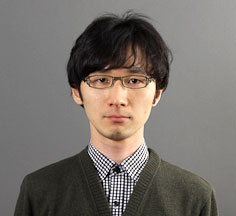
Daichi Mukunoki
Where are you from, originally?
I am from Japan and have lived there all my life. I was born in Tokyo, and spent my childhood nearby. Later, I moved to Gifu, in central Japan. Since I entered university, I have been living in Tsukuba, 35 miles northeast of Tokyo. Tsukuba is a small city, but it is called “Science City” because of the many research institutes that are located around the University of Tsukuba. Tsukuba is similar to Knoxville in that it is a university town with beautiful natural surroundings.
Can you summarize your educational background?
I studied System Control Engineering at Gifu National College of Technology for 5 years. After graduating, I went to the University of Tsukuba. I studied about Cell/B.E. for undergraduate research at the School of Library and Information Science. After that, I entered the Graduate School of Systems and Information Engineering at the university, and I started studying GPU computing at the High Performance Computing System Laboratory. I received my M.Eng. in Computer Science in March 2011. Now I am studying as a Ph.D. student at the same laboratory.
Tell us how you first learned about ICL.
In my undergraduate research, I implemented linear algebra operations on Cell/B.E. and learned about BLAS and Jack Dongarra. My advisor at the time, Hidehiko Hasegawa, is an ICL alumnus. Fortunately, my current advisor Daisuke Takahashi is also an ICL alumnus.
What made you want to visit ICL?
First of all, I am grateful for the opportunity to visit ICL. Recently, I implemented quadruple precision BLAS subroutines on GPUs. I was sure that ICL is the best place to study the GPU-acceleration of linear algebra, since I have read some great papers which were published by ICL people. I was interested not only in ICL’s high-level researchers, but also in how the ICL research group develops and releases great software such as MAGMA. I am always impressed by ICL’s high level of quality and productivity.
What are your research interests?
I am interested in GPU computing, generally. Now we can use tremendous computational power, but on the other hand, the memory and network bandwidth bottleneck will be tight, and I am especially interested in how to fully utilize the high computational power in such an environment. At present, I am studying about extended precision operations on GPUs. I consider extended precision emulation as suitable for an environment such as a computational complex operation. My current goals are to apply my study to real applications and to show the effectiveness of extended precision. There are many other things I’d like to study. For example, during my internship, I was really impressed with a study done by Jakub Kurzak et al. about auto-tuning GEMM on GPUs.
What did you work on during your visit with ICL?
I was working on the MAGMA project. I implemented a quadruple precision solver for Ax=b using mixed precision iterative refinement on GPUs, and evaluated the performance. In addition, I was trying to improve the performance of quadruple precision GEMM on GPUs using auto-tuning. I am really thankful for everyone who helped me, especially Stanimire Tomov and Jakub Kurzak.
What are your interests/hobbies outside work?
I like to go abroad. I visited many European countries in my undergraduate years as a so-called back-packer. I especially like traveling by train and tram. I prefer to go to supermarkets rather than visit tourist spots. I always visit supermarkets to understand that country’s lifestyle. I think Wal-Mart is the most exciting place in the U.S.
Tell us something about yourself that might surprise people.
I have finished a full marathon (26 miles 385 yards or 42.195 km) three times. A marathon is similar to research activities in that long-term planning, careful preparation and day-to-day effort are required to complete the work. I hope that some day I can participate in a foreign marathon race.


